

As an Amazon Associate we earn from qualifying purchases. If you buy through links on this page we may receive a commission at no extra cost to you. Product details come from Amazon listings and can change.
Looking for the best affordable strategy games for kids? This guide covers seven budget friendly board games that ask children to plan ahead, read an opponent, and make choices with a purpose. The picks suit ages 6 to 12, with a few that stretch a little younger, and every one of them is a real thinking game rather than a pure luck spinner.
Value here does not mean the smallest box. It means a game that gets played again and again, survives a rough sibling rivalry, teaches a skill, and fits a table of two to four players without a long rule book. We weigh play time, setup, replay value, and how much each game rewards thinking over chance.
Prices change often, so this guide never quotes them. Each product links to its live listing, where you can check the current offer and the delivery window before you decide. Read the age notes carefully, because a few small parts and magnets call for adult supervision with younger siblings in the house.
Key Takeaways
Best Affordable Strategy Games For Kids at a Glance
| Product | Our score | |
|---|---|---|
| CATAN Junior Board Game – Swashbuckling Best Overall |
9.6 / 10 | Check Price |
| Hasbro Gaming Connect 4 Spin Game Best for Quick Rounds |
9.4 / 10 | Check Price |
| Hasbro Gaming Battleship with Planes Strategy Best Twist on a Classic |
9.4 / 10 | Check Price |
| Hasbro Gaming Clue Junior Board Game Best for Younger Siblings |
9.4 / 10 | Check Price |
| Chain Triangle Chess Game, Strategy Board Best Brain Teaser |
9.0 / 10 | Check Price |
| Magnetic Chess Game with Full-Size Stones Best Magnet Challenge |
9.2 / 10 | Check Price |
| Sorry! Board Game for Kids Ages Best Classic Race |
9.6 / 10 | Check Price |
How We Chose the Best Affordable Strategy Games For Kids
This is a research based guide, not a lab comparison. We read each listing closely, noted the stated age range, player count, theme, and rule style, and then balanced the picks so a family gets variety: a trading game, a two player duel, a deduction game, a puzzle style game, a magnet challenge, and a classic race.
Each pick also carries an editorial score out of 10 on the site, based on features, specs, and how well the game fits the use case of budget friendly strategy play for ages 6 to 12. Safety wording on the listing, such as age grades and small part notes, was weighed too, and we point out where adult supervision is wise.
In-Depth Reviews
1. CATAN Junior Board Game – Swashbuckling: Best Overall

Our score: 9.6/10 iOur editorial score (1 to 10), based on listing specs, features and how well each pick fits its use case. It is not an Amazon customer rating.
Ages 6 and up 2 to 4 players About 30 minutes Pirate theme
CATAN Junior earns the top spot because it turns real strategic thinking into a game a six year old can follow. The listing describes a ring of tropical isles, including a mysterious Spooky Island that is home to the Ghost Captain, and the pirate story gives children a reason to care about every decision. It is a family game for kids and adults, so a parent can sit down as an equal player instead of just hosting. Families who want one game that grows with a child through several school years will find it a sensible foundation for a small collection.
The listing explains that each island produces a resource: wood, goats, molasses, or cutlasses, and gold appears as well. Players gather what they need, then spend those resources to build and grow their pirate presence. That loop of collecting, planning, and spending is the heart of many modern strategy games, and here it is trimmed down so the rules stay approachable for newer readers and players. Because the tokens and boards are clearly themed, children can often explain the rules back to a friend after a single round or two.
This game suits children who enjoy adventure stories and who are ready to think two moves ahead. It quietly teaches resource management, patient trading, and the idea that a good plan sometimes needs a change midgame. The listing title points to play sessions of about 30 minutes, which fits a weeknight better than a long campaign style game does and keeps younger attention spans comfortable. Parents who enjoy longer term planning themselves will appreciate that the game does not feel watered down or patronizing at the table.
A few practical points help. Count on a short first round to learn the symbols, since the resource types are different from a classic roll and move game. Cards and tokens are small, so keep them away from toddlers and use a tray or placemat for easy cleanup. Because it supports two to four players, it also works well for a pair of siblings plus a parent. Sharing the box between two siblings who play on different days keeps the cost per hour of fun low and the shelf space well used.
2. Hasbro Gaming Connect 4 Spin Game: Best for Quick Rounds
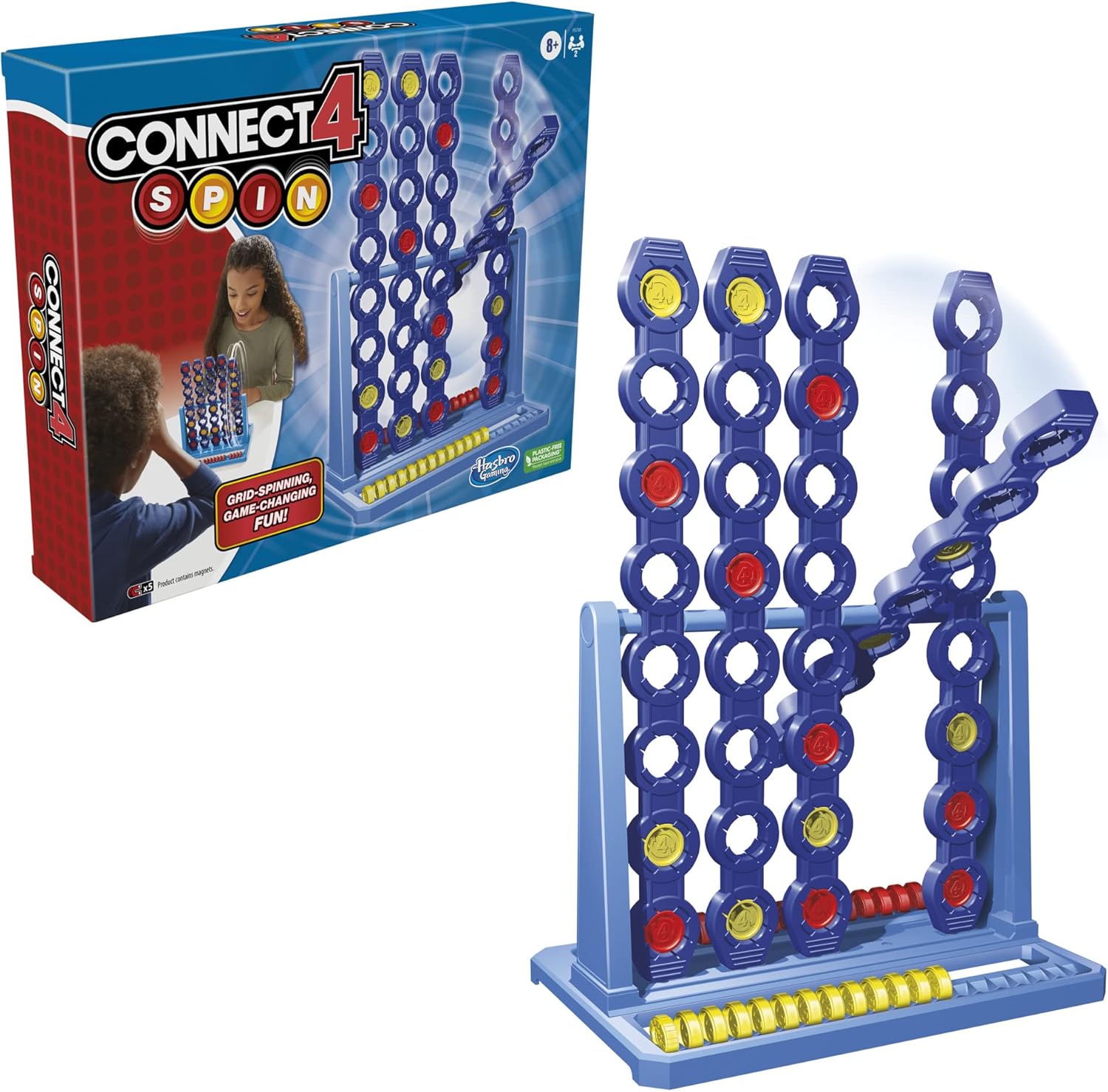
Our score: 9.4/10 iOur editorial score (1 to 10), based on listing specs, features and how well each pick fits its use case. It is not an Amazon customer rating.
Ages 8 and up 2 players Spinning grid Strategy game
Hasbro Gaming Connect 4 Spin takes a game most families already know and gives it a surprising new mechanic. The listing calls it the first Connect 4 board game with a spinning grid, and that single change is why it made this list. The old habit of simply blocking the obvious row no longer works, because a spin can scramble the position and rewrite who is winning. It also makes a handy travel or visit game, since a quick match fits easily into a waiting room, a grandparent visit, or a rainy afternoon.
Play starts the familiar way: a player pops a disc into the grid, then the grid can be spun. Players still race to line up four discs, but they must now consider what a rotation will do to both sides. The listing frames the experience as suspense, strategy, and surprises, which is a fair description of how a close game feels when a late spin changes everything. Kids who already know the original will pick up the twist quickly, which means less time reading rules and more time actually playing.
This is a two player game aimed at ages 8 and up, so it is a good match for a pair of siblings, a parent and child, or friends at a sleepover. It trains pattern spotting, planning for risk, and good sportsmanship when luck and skill mix. Rounds are quick, which makes a best of three series easy to run before dinner. A natural learning moment comes when a child spots that a spin can help an opponent as easily as it helps them, which encourages careful thought.
Keep a few things in mind. Because it is a two player game, a third child may be left waiting, so rotate winners instead of rotating seats. Discs can roll under furniture, so play over a table or rug. The spinning part is a nice talking point for kids curious about how simple mechanics can change a whole game. Because a single box serves a whole household of two player pairings, it delivers strong value for families with a few school age children.
3. Hasbro Gaming Battleship with Planes Strategy: Best Twist on a Classic

Our score: 9.4/10 iOur editorial score (1 to 10), based on listing specs, features and how well each pick fits its use case. It is not an Amazon customer rating.
Ages 7 and up Ships and planes Naval combat Strategy game
Hasbro Gaming Battleship with Planes is the pick for children who love the thrill of a hidden fleet. The listing describes a twist on the classic Battleship game, with airplanes joining the ships so there is more to hide, more to hunt, and more to protect. The theme is clear to every kid, so explaining the goal takes only a minute. Younger siblings often enjoy being the person who calls out the shots, which lets them join the fun while an older child handles the secret layout.
As the listing puts it, players sink ships and crash planes in a strategy naval combat game. The core idea is still a guessing contest across a hidden grid, where each shot gives information about where an opponent placed their pieces. Adding aircraft gives players more ways to arrange a secret layout, which makes the old tricks of the original less predictable. The strategy deepens once players begin to place their ships and planes in less obvious spots instead of lining them up along the edges.
This game is aimed at ages 7 and up, so it suits a younger elementary student who is ready for logic and deduction. It builds careful tracking of hits and misses, pattern recognition, and the habit of narrowing down possibilities. It is also a classic example of a game where taking notes in your head pays off, which is a useful skill beyond the table. Children who enjoy naval or aviation themes will likely find it more engaging than a plain abstract game with similar rules and pieces.
Practical tips matter here. Because it is a two player experience, it works best as a rematch game between siblings or a parent and child. Small pegs and pieces are typical of this style of game, so keep them out of reach of toddlers. A shoebox lid under the game can catch any pegs that bounce away. Playing a few quick rematches in a row is the best way to see how a smarter layout changes the whole result of a game.
4. Hasbro Gaming Clue Junior Board Game: Best for Younger Siblings

Our score: 9.4/10 iOur editorial score (1 to 10), based on listing specs, features and how well each pick fits its use case. It is not an Amazon customer rating.
Ages 5 and up 2 to 6 players Mystery theme Junior edition
Hasbro Gaming Clue Junior is the gentlest entry on this list, and that is exactly why it belongs. The listing introduces kids ages 5 and up to the iconic mystery board game, with a theme built for younger players: somebody has broken a favorite toy, and the group must work out who did it. The stakes are friendly, and nobody is cast as a villain. Because the theme is a mystery and not a battle, it also fits families who prefer a calm and cooperative mood at the table.
The listing says it keeps classic Clue gameplay, which means players gather clues, rule out possibilities, and move toward a solution. That is a deduction loop, and it is one of the best early lessons in logical thinking. Rather than racing to a finish line, children learn to use evidence to reduce the number of suspects, which is a different mental muscle from planning a path. Its structure invites talking aloud about what has been ruled out, which makes reasoning visible and easy to coach without a lecture.
It supports two to six players, so it is a good choice when a family has several children of mixed ages. A seven year old can help a five year old read the clues, and that shared problem solving is its own kind of teamwork. It also suits parents who want a calm game that does not trigger a big win or lose fight. A child who enjoys picture books, puzzles, or detective stories will likely feel at home with the premise straight away.
As a note on fit, this one is lighter than the other picks, so a twelve year old may outgrow it quickly. It works best as a bridge game for younger siblings or as a warm up before a heavier strategy game. Small tokens and cards call for supervision with any child still putting things in their mouths. Pairing it with a heavier game on the same shelf lets families grow into harder play without needing to replace the starter game.
5. Chain Triangle Chess Game, Strategy Board: Best Brain Teaser

Our score: 9.0/10 iOur editorial score (1 to 10), based on listing specs, features and how well each pick fits its use case. It is not an Amazon customer rating.
Kids 6 to 12 Triangle board Rubber band play Logic game
Chain Triangle Chess Game is the wild card of this guide, and it appeals to kids who like puzzles more than racing. The listing calls it a new puzzle chain triangle chess game and says the strategic kids board game helps keep children away from electronic devices. Whatever the box art suggests, the core pitch is a thinking game that sits somewhere between a puzzle and a duel. Children who prefer quiet concentration to loud competition may find this style of game a good match for their temperament.
The listing claims the game promotes brain development, imagination, logical thinking, and strategic thinking, and it lists tips for winning. Those are the seller’s claims, so treat them as aims rather than guarantees. What is safe to say is that a triangle layout with rubber band play asks children to picture shapes and plan connections, which is a different kind of challenge from a standard checkerboard. Because it is less common than the big name games, it can be a fun surprise for kids who already own the usual favorites.
The title points to ages 6 to 12, and it also mentions adults, which suggests it works as a mixed age family game. It will suit children who like geometry, spatial puzzles, or building shapes, and it could be a good bridge toward traditional chess for anyone curious about board strategy. Try a few learning games with a parent before expecting a serious match. Adults who like abstract games may also enjoy joining in, which makes it a rare title that keeps parents interested as well.
Practical caveats are simple. The rules are not as famous as other picks, so read the instructions together before the first match and agree on house rules for disputes. Rubber bands can snap, so keep them pointed away from faces and supervise younger children. Store spare bands in a small bag so a lost one does not end game night. Treat the first few sessions as practice and let the children invent small variations once they understand the basic idea.
6. Magnetic Chess Game with Full-Size Stones: Best Magnet Challenge

Our score: 9.2/10 iOur editorial score (1 to 10), based on listing specs, features and how well each pick fits its use case. It is not an Amazon customer rating.
Magnetic stones Full size stones String boundary Skill game
The Magnetic Chess Game with Full Size Stones is a different animal from the rest of the list, and it makes the cut because it blends skill, nerve, and a bit of strategy. Despite the chess name in the title, the listing describes a magnet game where stones are placed upright inside a rope or string. It is a tabletop challenge about control rather than a chess match. Matches tend to be short and tense, so it is easy to run a mini tournament among siblings or cousins on a family afternoon.
According to the listing, each player receives stones and takes turns placing them upright inside the rope. The twist is that stones can attract each other, and a player whose stone is pulled in must collect it. The first player to use up all their stones wins. That makes every placement a small risk calculation: where can a stone stand without being drawn to a neighbor? Setup is quick, which suits a family that wants a fresh kind of challenge between more traditional board games.
This game suits children who like steady hands, careful observation, and a bit of suspense. It teaches spatial planning and patience, and it is a good fit when a family wants a game that feels different from card and dice play. Players need calm movements, which makes it a nice cooldown activity after a more boisterous round of another game. It also pairs well with snack time or a homework break, since players can stop and restart without losing a long plan.
A safety note is important. Magnets are not suitable for very young children, and strong magnets can cause serious harm if swallowed, so adult supervision is essential and the stones should be counted at cleanup. Keep the set away from phones, bank cards, and electronics. The listing does not state an age range, so use your own judgment about your child’s readiness. Choose a flat, uncluttered table surface, because bumps and slopes can change how the stones behave and spoil a careful turn.
7. Sorry! Board Game for Kids Ages: Best Classic Race

Our score: 9.6/10 iOur editorial score (1 to 10), based on listing specs, features and how well each pick fits its use case. It is not an Amazon customer rating.
Ages 6 and up Pawn race Classic Hasbro game Family game
Sorry! Board Game is the most familiar name here, and it earns a place as a best classic race choice. The listing presents it as a classic Hasbro board game for kids ages 6 and up, described as a game of sweet revenge and an edge of your seat race to home. It is simple on purpose, which is a real advantage for a first family game night. Because it has been a family favorite for generations, grandparents and older cousins are often happy to join in and teach the rules.
Players move pawns around the board and try to reach the home space first. The listing says the first one home wins, and the sweet revenge in the description hints at the fun of bumping an opponent’s pawn back. That push and pull makes the game more than a straight sprint, because choosing which pawn to move and when to strike is a genuine tactical choice. That familiarity also means fewer arguments about how it works, which keeps the focus on playing and not on reading small print.
This game fits children from about six years old and works well for families with mixed ages, because luck keeps the odds fairly open. It is not as deep as a resource game, but it teaches turn taking, handling disappointment, and weighing a risky move against a safe one. Those lessons are valuable before a child tackles longer and more serious strategy games. As children grow, it can serve as a relaxed filler game between longer strategy sessions or while waiting for dinner.
On the practical side, keep in mind that it can swing on a single bump, so it may feel unfair to a sensitive player. Set expectations before the first game, and praise good sportsmanship. The pawns are small, so supervise anyone younger than three, and keep spare cards sorted in the box to avoid mix ups at the next game night. Rotating who goes first and trading pawn colors each round keeps things fair and prevents one child from always claiming a favorite.
How to Choose the Best Affordable Strategy Games For Kids
What makes a game a strategy game for kids
A strategy game rewards planning more than chance. In a pure luck game, a die decides everything and a child simply follows the board. In a strategy game, a player chooses between meaningful options, thinks about what an opponent might do, and sees the result of those choices a few turns later. Looking at a few sample game descriptions side by side helps you spot which ones ask for real choices and which ones only ask for luck.
For children aged 6 to 12, a good strategy game keeps rules short while giving room to grow. Look for a clear goal, a handful of choices each turn, and a way for a smart player to recover from a poor start. Games that mix a little luck with real decisions are often the friendliest. A quick way to check is to ask whether two players of different skill would end up with different results over many games.
How to judge value when buying budget friendly games
Value is about hours of play, not the size of the box. A budget friendly game that comes out every weekend for a year is a better buy than a larger game that sits on the shelf after two plays. Ask how many players it supports, how long a round lasts, and whether the rules allow different outcomes each time. Replay value is the single best hint of lasting worth, because it shows whether a game still feels interesting on the twentieth play.
Check the listing for what is actually included, such as boards, cards, tokens, and instructions, and avoid paying for extras you will not use. A game that two siblings can enjoy and that a parent will also join is stronger value than a solo only item. Because prices change, always compare the live listing before you commit. Games that invite house rules or small variations tend to stay fresh much longer than games that can only be played one way.
Matching age and reading level to the game
Age grades on a box are a starting point, not a verdict. A six year old who loves puzzles may handle a game graded for eight, while a nervous eight year old may enjoy a gentler one. Think about reading skill, patience for waiting a turn, and how a child handles losing. If a game feels too hard, try removing one rule for the first round and adding it back once the basics make sense.
Younger players do well with picture based rules and short rounds, such as a junior mystery game or a pirate trading game with simple icons. Older children from nine to twelve can handle more steps and hidden information. Playing the first round together lets a parent adjust the difficulty without a lecture. If it feels too easy, add a challenge such as a time limit or a small handicap for the stronger player.
Which skills strategy games build
Strategy games train several skills at once. Deduction games teach children to use clues and eliminate possibilities. Grid and placement games build spatial thinking and pattern recognition. Resource games teach saving, trading, and the idea that a small sacrifice today can pay off later. Even a short session each week adds up, and children often show the benefits first in homework habits and how they approach puzzles.
They also build social skills. Children learn to wait, to read facial cues, to negotiate, and to lose without melting down. These benefits come from regular play, not a single session, so pick a game that your family will enjoy enough to bring back to the table many times. Avoid turning the game into a lesson, because enjoyment is what keeps children coming back and building those skills naturally.
Two player duels versus family table games
Some games on this list, like Connect 4 Spin and Battleship with Planes, are built for two players. They are perfect for a parent and child pairing or two siblings, but they leave a third person watching. Plan a winner stays on rule so the group still feels included. Keeping a few spare minutes after a duel to talk about how each player decided on key moves turns a simple game into a mini lesson.
Others, such as CATAN Junior and Clue Junior, welcome larger groups. If you often have three or four children together, put one of those on the shelf first. A mixed shelf with one duel game and one group game covers most family situations without overspending. Adults can take turns joining each child so everyone gets some one on one time and nobody feels like the extra person.
Game length and setup for busy families
Short games fit school nights, while longer ones suit weekends. Check the listing for a play time, and remember that the first game always takes longer because players are learning the rules. A game with a rapid setup is more likely to hit the table on a tired evening. Having a standard game night, even once a month, helps children look forward to a game and builds a calm family routine.
Keep a small routine to cut friction: one child sets up, the other reads the rules aloud, and everyone helps with cleanup. When setup is shared, games feel like a team activity before the first move is even made, and the box stays easy to reach. Dim the screens, share snacks, and let the youngest child pick the first game to help everyone feel included.
Small parts, magnets, and supervision
Most board games include small pieces such as pawns, pegs, discs, tokens, and cards. These are not suitable for children under three, and they can be a choking hazard for any child who still mouths objects. If a younger sibling lives in the house, store games out of reach and count pieces at cleanup. A simple tray or lidded box next to the table keeps stray pieces from landing on the floor where small siblings or pets can reach them.
Magnetic games need extra care. Strong magnets can cause serious injury if more than one is swallowed, so they require adult supervision and a firm rule that stones stay on the table. Rubber bands should be used gently and never pointed at faces. Always follow the age grade and warnings printed on the box. Teach older children to take charge of counting pieces at the end, which gives them responsibility and protects the set.
Teaching a new game without the frustration
Explain the goal first in one sentence, then play a practice round with open hands so the child can see the choices. Avoid reading the whole rule book aloud. Most children learn faster by doing, and rules make more sense once a few turns have been played. If frustration builds, pause and take a short break, since a calm return often leads to better thinking and a happier mood.
Let a new player win a little, or give a small head start, if confidence is low. As skill grows, remove the training wheels and let the game get tougher. Praise clever thinking rather than just victory, and ask questions such as why a move was chosen, which builds reasoning habits. Remind children that every good player loses sometimes and that learning from a loss is how skill really improves.
Handling losing and sibling rivalry
Competition is part of the point, but it can cause tears. Set a few ground rules before the game starts: no gloating, shake hands at the end, and the loser chooses the next game. These small rituals turn a loss into a normal part of play. Keeping score across several games, such as first to win three matches, spreads the sting of a single loss across a longer series.
If two siblings have a big age gap, add a handicap, such as extra turns or a hint, for the younger player. Cooperative or team play can also help. The aim is a fun family routine, and a game that leaves everyone smiling is worth more than a perfectly fair contest. Let the winner take on a small job, such as picking the next snack or putting the game away, so the prize stays friendly.
Care, storage, and keeping games complete
A budget friendly game stays good value only if it stays complete. Keep pieces in zip bags or small containers inside the box, and check the count after each session. A missing pawn or a lost card can ruin an otherwise strong game, and replacement parts are not always easy to find. Avoid leaving boxes in hot cars or near radiators, because heat can warp boards and make plastic parts brittle over time.
Store boxes flat on a shelf, away from damp and direct heat, so boards do not warp. Wipe plastic pieces with a slightly damp cloth, and keep cardboard dry. Writing the game name on a rubber band or label around the box helps you spot missing items quickly. A permanent marker label on the inside of the lid listing what belongs in the box makes it easy to spot missing items.
A learning path from first games to harder ones
A sensible path starts with a gentle deduction or race game, such as Clue Junior or Sorry!, to build basic turn taking. Then move to a simple placement game like Connect 4 Spin, which adds planning around an opponent. After that, a resource game like CATAN Junior introduces longer term thinking. Along the way, add some classics like checkers or dominoes, which cost little and extend the same thinking skills into new forms.
For children who enjoy puzzles, a logic game such as Chain Triangle Chess can sit alongside these. Later, traditional chess, checkers, or a full size version of a favorite family strategy game become natural next steps. Let your child’s interest set the pace instead of pushing the hardest game first. Keep a small notebook of favorites so children can look back on what they enjoyed and ask for similar games next time.
Gift tips for strategy games
Strategy games make good gifts for birthdays, holidays, and rainy day surprises. Match the game to the child, not to the box. A child who loves mysteries may prefer a deduction game, while a builder may love a resource game. A note inside the box with a family game night invitation makes it feel personal. Remember that the best present of all is shared time, so offer to play the first round with the child once the box is open.
Order a little early and check the delivery window on the live listing so the game arrives on time. Add a gift receipt in case a duplicate shows up, and wrap the box with a small extra such as a notebook for keeping score. A game for two siblings to share is a gift that keeps on giving. If you are buying for another family, check the age grade on the listing and the number of players so the game fits their table.
Frequently Asked Questions
What is the best affordable strategy game for a six year old?
CATAN Junior is a strong choice because the listing says it suits ages 6 and up and uses a friendly pirate theme. Clue Junior, aimed at ages 5 and up, is a gentler option for very new players.
Are strategy games better than luck games for learning?
Strategy games reward planning, so they build thinking skills more directly. Luck games still teach turn taking and handling losses. A mixed shelf with both kinds gives children variety and keeps family game night fun for different moods.
How many players do these games support?
It varies. CATAN Junior is listed for two to four players and Clue Junior for two to six. Connect 4 Spin is a two player game, and Battleship with Planes is typically played by two opponents.
Which game is best for quick rounds?
Connect 4 Spin is the quickest on this list, with simple moves and short matches. It is easy to play a best of three before dinner, and the spinning grid keeps each round feeling fresh.
Is the magnetic game safe for young children?
Magnets are not suitable for very young children and need adult supervision. Count the stones after every game, keep the set away from toddlers, and follow any warnings printed on the box. The listing does not give an age range.
How can I tell if a game is good value without checking price?
Look at replay value, player count, play time, and what is included in the box. A game that gets played weekly for years is better value than one used twice. Compare the live listing for the current offer.
What age is Battleship with Planes for?
The listing says it is for ages 7 and up. Younger children can join with help from a parent, but the hidden grid and tracking of shots work best for readers who can keep notes in their head.
Can adults enjoy these games too?
Yes. CATAN Junior is described as a family game for kids and adults, and Chain Triangle Chess mentions adults in its title. Even simpler games like Sorry! can be a relaxed way for parents and children to play together.
How do I stop arguments during game night?
Agree on rules before the game starts, take turns choosing the game, and praise good sportsmanship. For siblings with a big age gap, add a handicap for the younger player so each match stays friendly.
Should I buy one game or several?
Start with one that fits your most common player count, then add a different style later. A duel game and a group game together cover most family needs without overspending, and variety keeps interest high.
The Bottom Line
The best affordable strategy games for kids are the ones your family will pull off the shelf again and again. CATAN Junior leads this list because it brings real planning, a lively pirate story, and room for parents and children to play as equals. It is the first game we would suggest for most households with ages 6 to 12.
Round out the shelf with a quick duel like Connect 4 Spin, a mystery for younger siblings like Clue Junior, or a puzzle style game for the thinkers in your home. Check the live listing for the current offer and delivery window, and keep small parts and magnets away from younger children.
Updated for the 2027 buying season. Amazon listings and availability change often, so check the product page for current details.




Write Your Review
No reviews yet. Be the first to share your experience!