

As an Amazon Associate we earn from qualifying purchases. If you buy through links on this page we may receive a commission at no extra cost to you. Product details come from Amazon listings and can change.
Finding the best affordable art supplies for preschoolers is less about buying a huge pile of materials and more about choosing a few safe, simple tools that small hands can manage. This guide looks at ten budget friendly picks, from washable markers and dot paints to big paper pads, no spill paint cups and boxed craft assortments.
It is written for parents, grandparents, preschool teachers and gift buyers who want children aged three to five to enjoy art without a constant cleanup battle. Each product is described using its listing details, and we say plainly when something needs close adult supervision, such as tiny craft pieces or scented markers.
Prices change often, so we link to live listings instead of quoting numbers. Use the guide to match each item to your child’s age, your space and your tolerance for mess, then read the buying advice further down to build a small kit that lasts.
Key Takeaways
Best Affordable Art Supplies For Preschoolers at a Glance
| Product | Our score | |
|---|---|---|
| Crayola Broad Line Markers Best Overall |
9.6 / 10 | Check Price |
| Do A Dot Art! Markers 6-Pack Rainbow Washable Paint Best for Dot Painting |
9.6 / 10 | Check Price |
| Crayola Pip-Squeaks Washable Markers 65ct Best Travel Set |
9.6 / 10 | Check Price |
| Melissa & Doug 9×12 Jumbo Drawing Paper Pad 2-Pack Best Paper Value |
9.6 / 10 | Check Price |
| Melissa & Doug Finger Paint Paper Pad 2-Pack Kids Best for Messy Play |
9.6 / 10 | Check Price |
| U.S. Art Supply 10 Piece Children’s No Spill Paint Best Paint Organizer |
9.2 / 10 | Check Price |
| Mr. Sketch Scented Markers Best for Scent Fun |
9.6 / 10 | Check Price |
| JOYIN 12 Wooden Magnet Painting Kit Best Craft Gift Kit |
9.2 / 10 | Check Price |
| FUNZBO Arts and Crafts Supplies for Kids Best Craft Storage Jar |
8.8 / 10 | Check Price |
| Arts & Crafts Supplies Kits & Materials Set for Best Bulk Craft Box |
9.4 / 10 | Check Price |
How We Chose the Best Affordable Art Supplies For Preschoolers
This is a research based buying guide, not a lab comparison. We read each listing’s title, bullet points and stated specs, then weighed the washable claims, grip size, age guidance, safety wording and how much a family can realistically do with the item. We also balanced the list so it covers drawing, painting, sensory play and general crafting rather than ten near identical marker sets.
Every pick carries an editorial score out of 10 that comes from its features, specs and how well it fits the preschool use case. We do not quote prices, because they move daily. Where an item has small parts or other age concerns, we say so directly, since a good value pick should also be a safe one for this age group.
In-Depth Reviews
1. Crayola Broad Line Markers: Best Overall

Our score: 9.6/10 iOur editorial score (1 to 10), based on listing specs, features and how well each pick fits its use case. It is not an Amazon customer rating.
12 markers Washable ink Broad line tips Ages 3+
Crayola Broad Line Markers earn the top spot because they solve the most common preschool art problem: stains. The listing describes an Ultra Clean Washable formula that comes off skin, clothes and surfaces with ease. For a three year old who will inevitably color the table, a sleeve and a knee, that matters more than any fancy feature. A single pack covers drawing, coloring pages and simple projects. Families who only want one marker set for the whole household will find this a sensible place to begin before adding anything else.
The set contains twelve assorted colors in a broad line format. A thick tip lays down bold color fast, which suits young children who press hard and want to see results quickly. The listing also mentions shading and layering, and while a preschooler will not plan that carefully, the wide tip does let them explore how colors overlap when they scribble over each other. Because the tips are wide, even a child who presses too hard is unlikely to wreck the point, which keeps the pack going for many weeks of daily coloring.
This set suits children who are just moving from chunky crayons to markers. It teaches basic color names, grip control and the idea that marks can make shapes, letters and pictures. Parents get a dependable classroom style tool, and the listing positions the pack as a gift as well, so it also works for birthdays and holiday stockings. For a first marker experience, the clear bold lines also make it easier for a parent to praise what the child drew and talk about the colors together.
A few practical tips help. Always snap the caps back on until they click, since dried tips are the main reason markers disappoint. Offer paper or a coloring book rather than open table space, and sit nearby for the first few sessions. Washable does not mean permanent on every surface, so wipe wood or painted walls promptly. If one color gets heavy use, such as blue for skies or green for grass, simply buy another pack later instead of replacing the whole collection.
2. Do A Dot Art! Markers 6-Pack Rainbow Washable Paint: Best for Dot Painting
Our score: 9.6/10 iOur editorial score (1 to 10), based on listing specs, features and how well each pick fits its use case. It is not an Amazon customer rating.
6 colors Washable paint No spill bottles Made in the USA
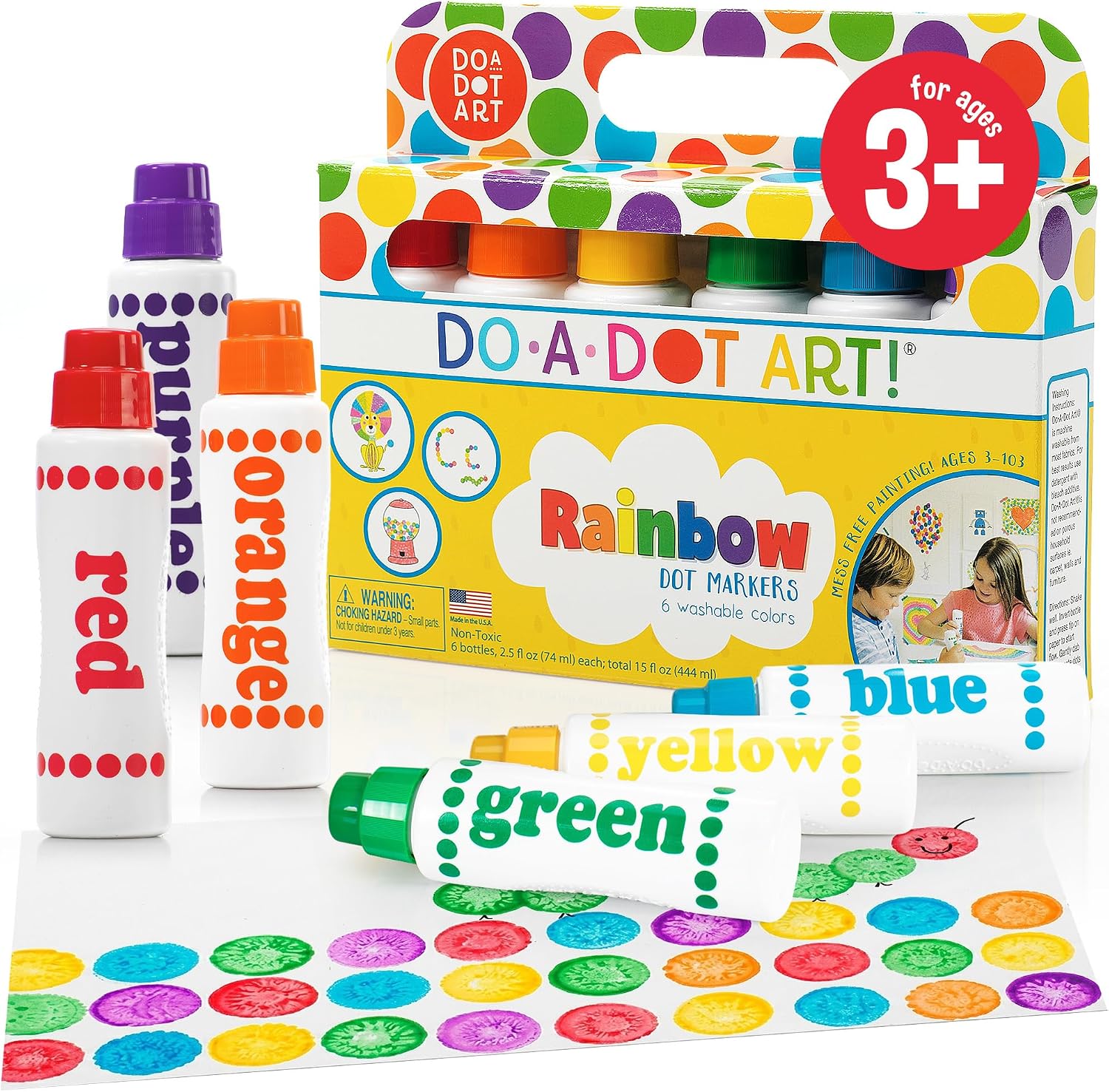
Do A Dot Art! Markers bring paint to preschool without cups, brushes or puddles. The listing says they come in no spill, no splash bottles with a large sponge tip dauber, and the six colors are red, orange, yellow, green, blue and purple. Children press the tip on paper and get a clean round dot, which makes the whole activity feel instantly successful. Teachers like this format because a whole table of children can share a few bottles and still finish a dotted picture within a short lesson.
The listing notes generous 2.5 ounce bottles and a tip that does not dry out, so a set can last through many sessions. It also describes the paint as washable and non toxic, and mentions that the line is gluten free and latex free. Kids can dab, dot, mix and layer colors, and the bottles are easy to grip for small hands. Parents can add a simple twist by asking the child to match the dot colors to a rainbow or to build a caterpillar from a row of dots.
This pick suits ages three to five very well, and the listing says the idea came from a preschool teacher. Dotting builds hand eye coordination, color recognition and counting, since a child can fill a printed shape or place one dot for each year of their age. It also gives shy drawers a way to make art without worrying about drawing a perfect line. Preschool use is easy to plan around, since a single printed shape, like a balloon or a snowman, turns into a complete activity.
The main caveat is that dots need enough paper, so pair the set with a thick pad or printed dot sheets. Wipe the sponge tip on scrap paper before closing the cap. Painting on wet paper can pool the color, and a smock is still a smart idea even with a washable formula, because bottles can be squeezed hard. Store the bottles upright, because the tip is designed to stay moist and works best when it is not left lying on the dry paper for long.
3. Crayola Pip-Squeaks Washable Markers 65ct: Best Travel Set

Our score: 9.6/10 iOur editorial score (1 to 10), based on listing specs, features and how well each pick fits its use case. It is not an Amazon customer rating.
25 mini markers 40 sheets paper Art case Washable
Crayola Pip-Squeaks Washable Markers 65ct is the pick for families who want art that travels. According to the listing, the set includes twenty five mini washable markers and forty sheets of paper, all inside a durable art case. That means a restaurant table, a waiting room or the back seat of a car can become a drawing space in seconds. Compared with a bag of loose markers, a case keeps everything together, so a child can be handed one box and told that art time is ready.
The mini marker barrels are the key feature. The listing says the smaller size fits comfortably in little hands and makes the markers easier for younger kids to use. Many preschoolers find full size markers a bit long, so a shorter barrel can improve control and reduce the urge to grip with a fist. The washable ink supports easier cleanup after trips. Because there are many markers, they also suit shared play, where two children can each choose a handful without any arguments over a favorite color.
This set suits children who like choice, because twenty five markers invite sorting by color and sharing with a sibling or friend. It also fits classrooms and playdates, and the listing mentions kindergarten and preschool use. A child can learn to put each marker back in its place, which is a small but real lesson in tidying up. Grandparents and babysitters may find this the easiest set to hand over, since everything needed for a short drawing session sits in one place.
Think of the case as part of the value. Keep it closed in a bag so the paper stays flat, and refill the paper from a larger pad when the first sheets run out. Mini markers are easy to lose under car seats, so count them at the end of a trip. Younger siblings should not chew on caps. Slip a small pad or a few extra sheets inside the case before a long trip, so a child does not run out of paper halfway through the journey.
4. Melissa & Doug 9×12 Jumbo Drawing Paper Pad 2-Pack: Best Paper Value

Our score: 9.6/10 iOur editorial score (1 to 10), based on listing specs, features and how well each pick fits its use case. It is not an Amazon customer rating.
2 pads 9 x 12 inch 50 sheets each Heavyweight bond
Melissa & Doug 9×12 Jumbo Drawing Paper Pad 2-Pack is not glamorous, but paper is the item preschool artists use up fastest. The listing describes two pads with fifty sheets each of premium heavyweight bond paper. A hundred sheets gives a child room to scribble freely, make mistakes and start again, which is how early drawing skills actually grow. Heavy paper also stands up to the firm scribbling that many three year olds enjoy, instead of ripping at the first hard line.
The paper is meant for many mediums. The listing says it works with crayons, markers, pencils, chalk, poster paints and watercolors. That flexibility is useful for a mixed art cabinet, since one pad can serve the washable markers, the dot paints and a simple watercolor tray. Sheets tear out easily, so finished pictures can be shared, framed or pinned up. A parent can tear a sheet out for the fridge while the child keeps working on the next one, which adds a little pride to every session.
The listing also mentions a collectible unicorn themed sticker stamper and activity pad bundled in the offer, which adds a small extra for children who enjoy stickers. The main point for parents, though, is the screen free play and fine motor practice that plain paper supports. It is a good choice for ages three to five who are still discovering shapes and letters. Because the size is large but not huge, it fits on most kitchen tables and many lap desks, which helps for homes with limited space.
A few habits make the paper last longer. Place a piece of cardboard behind the sheet when using markers so ink does not mark the table. For wet paint, use a thicker approach like the finger paint pad below, because bond paper can wrinkle when it is heavily soaked. Store pads flat and away from damp spots. If the child is just starting out, offer a single sheet at a time, since a thick stack can feel like a lot of pressure to fill.
5. Melissa & Doug Finger Paint Paper Pad 2-Pack Kids: Best for Messy Play

Our score: 9.6/10 iOur editorial score (1 to 10), based on listing specs, features and how well each pick fits its use case. It is not an Amazon customer rating.
2 pads 100 sheets 12 x 18 inch Glossy coating
Melissa & Doug Finger Paint Paper Pad 2-Pack is built for the stage of art when children want to use their whole hand. The listing states that the two pads hold one hundred extra large sheets that measure twelve by eighteen inches, with a glossy finish. The big size gives a preschooler space for sweeping arm movements without running off the edge. Anyone who has tried to keep a toddler away from a damp painting will appreciate a surface that dries in place and can be moved later.
The coated surface is the practical selling point. The listing says the paper is coated on both sides so paint does not leak through to the surface below, even when applied generously. That does not make finger painting spotless, but it does protect a table or tray from soaking through, and the glossy surface lets paint glide smoothly across the page. Sheets of this size also invite teamwork, with two siblings or friends painting on the same page and learning to share space.
This pad suits ages three to five who enjoy sensory exploration, and the listing highlights finger painting as a sensory activity. Squishing, smearing and mixing colors teaches cause and effect, color blending and hand strength. It also suits homeschool and classroom stacks of materials, because the sheets are large enough for group projects or a long, rolling mural. Teachers can use a single sheet for a group handprint banner or a simple seasonal scene, which gives the class a display for the wall.
Paint itself is not included, so buy a washable, non toxic finger paint made for young children and check that the label matches the age on the bottle. Cover the work area, roll up sleeves and keep wipes handy. Let finished pieces dry flat before stacking, since glossy surfaces stay tacky longer than plain paper. Try a plastic placemat under the sheet if the table is precious, and wash hands at the sink straight afterward rather than wiping paint around.
6. U.S. Art Supply 10 Piece Children’s No Spill Paint: Best Paint Organizer

Our score: 9.2/10 iOur editorial score (1 to 10), based on listing specs, features and how well each pick fits its use case. It is not an Amazon customer rating.
10 paint cups Dual lids 10 brushes Color coded lids
U.S. Art Supply 10 Piece Children’s No Spill Paint Cups with Colored Lids is a support product rather than a paint set, and that is exactly why it earns a place. Paint spills are the biggest worry for parents of preschoolers, and a cup that stays upright and sealed solves a large part of the problem. The listing describes a dual lid design that helps prevent spills and mess. The tidy design is a gentle way to teach responsibility, since children learn that open paint is a short term activity and not an open ended mess.
The set has ten cups in assorted colors, including brown, yellow, red, orange, dark blue, light blue, purple, white, black and green. The outer snap on lid is described as airtight, so leftover paint can be saved between sessions instead of thrown away. Color coordinated lids make it easy for a child to identify what is inside. A bonus bundle of ten bristle brushes in matching colors comes along. Pairing each brush with its own cup helps avoid muddy colors, which is a frequent complaint when preschoolers mix everything on a single palette.
This pack suits families who paint often or classrooms that need a tidy station. Children learn to pour, dip, wipe the brush and replace the lid, which are small routines that build independence. The pairing of cup and brush colors also gives a gentle way to practice matching, sorting and naming colors during art time. Because the cups snap shut, a parent can prepare paint ahead of time and bring it out on a rainy afternoon without a long setup.
The set does not contain paint, so you will need to pick up a washable, non toxic paint suitable for young children. Fill the cups only part way to keep the inner lid working properly. Rinse brushes soon after use, since dried bristles are hard to clean. Adults should close the outer lids at the end of each session. A tray under the cups gives extra protection, and an old towel nearby handles any drops that miss the paper.
7. Mr. Sketch Scented Markers: Best for Scent Fun

Our score: 9.6/10 iOur editorial score (1 to 10), based on listing specs, features and how well each pick fits its use case. It is not an Amazon customer rating.
22 markers Chisel tip Scented ink Non toxic
Mr. Sketch Scented Markers add a sensory twist to ordinary coloring. The listing describes an array of scents meant to spark creativity, bold shades and twenty two assorted colors. For a child who gets bored with plain markers, the added smell can make a simple page more memorable, and the large number of colors gives plenty of choices for a growing coloring habit. Children who already enjoy smelling flowers or snacks may find this a natural fit, and the colors still work well for plain coloring pages.
These markers have a chisel tip, which means a flat angled edge that can make thick strokes or thinner lines depending on how it is turned. The listing says the large cylinder is easy for kids to handle, and that the ink is certified non toxic and AP certified for children over three. Those details suit the preschool end of the age range better than a pack that mentions no age at all. The chisel shape can also be used to practice making wide bands for rainbows, roofs and simple fences, which helps explain how the angle changes a line.
They suit children who enjoy sensory play and who are ready to pair a scent with a color, such as red with cherry style thinking. They also work for school and home, according to the listing. The chisel tip is a little less forgiving than a broad round tip, so expect a short learning curve for the youngest artists. Because every marker has a different scent, the set can become a small matching game, with the child naming the smell and the color together.
Adults should keep an eye on scented products with this age group. Little ones may be tempted to sniff closely or taste a marker that smells like food, so supervise and explain that markers are for paper only. Caps should be replaced after use. The listing does not promise a washable formula, so use paper and cover the table. Keep the markers on a high shelf between sessions and bring them out only when an adult can sit nearby for part of the activity.
8. JOYIN 12 Wooden Magnet Painting Kit: Best Craft Gift Kit

Our score: 9.2/10 iOur editorial score (1 to 10), based on listing specs, features and how well each pick fits its use case. It is not an Amazon customer rating.
12 wood magnets Paint palette Brush and glitter glue Ages 3 to 8
JOYIN 12 Wooden Magnet Painting Kit works well as a gift because the child gets an actual keepsake at the end. The listing says the set includes twelve wood magnets, a paint palette, a brush and glitter glue, plus an instruction sheet. After painting, the finished pieces can go on the refrigerator, which turns a short art session into something a family can display. The kit fits a rainy weekend or a small party table, where each guest paints one magnet and takes it home afterward.
The listing mentions that children can learn to mix paints and express themselves by decorating the wooden shapes. It also states that the product is non toxic, non BPA and lead free, and that it meets a US toy standard. Parents should still read the packaging for the exact standard named, since the listing gives only general wording about safety approval. Wood is a pleasing surface for young artists, because it takes color with a satisfying thick look and feels more special than ordinary paper.
The kit is labeled for ages three to eight, which makes it a stretch for the youngest end of preschool. Three year olds can dab paint on a magnet with help, while four and five year olds will manage more detail on their own. Painting a defined shape is easier for many children than facing a blank page, so it suits kids who like clear goals. Older siblings aged six to eight can join in and make more detailed designs, which makes the kit a rare one that works across a broad age gap.
Adults should be involved because magnets and small wooden pieces are not appropriate for unsupervised play with toddlers, and magnets should never be mouthed or swallowed. Keep the set away from younger siblings. Let the paint dry fully before attaching or handling the pieces, and cover the table, since the glitter glue can spread. Always remove magnets from the table once the project is done, and store the whole kit in a closed box well out of reach.
9. FUNZBO Arts and Crafts Supplies for Kids: Best Craft Storage Jar

Our score: 8.8/10 iOur editorial score (1 to 10), based on listing specs, features and how well each pick fits its use case. It is not an Amazon customer rating.
Craft jar Construction paper Pipe cleaners Pompoms
FUNZBO Arts and Crafts Supplies for Kids is an all in one craft set built around a storage jar. The listing says it contains essential tools and materials like construction paper, pipe cleaners and pompoms, kept in a durable compartmentalized jar. For a family without a craft drawer, a single container that holds the starter supplies can make art time easier to begin and finish. The jar format is friendly to parents who do not have a craft shelf, since it can sit in a corner of a closet or on a bookcase.
The listing describes the kit as suitable for various age groups and skill levels, and it names ages four and up in its gift wording. That matters for this guide, since a number of items in a craft assortment can be small. Pompoms and other loose pieces should be treated as small parts for children who still mouth objects, so this kit leans toward the older preschooler. Children enjoy opening a container and seeing each compartment, and the neat layout can turn tidying into a small sorting challenge.
What a child can make with it is open ended. Pipe cleaners can be twisted into animals or glasses, pompoms become eyes and noses, and construction paper turns into collages or cards. This type of play builds fine motor skills, planning and imagination, and the compartments teach sorting. It also works for homeschool corners and classroom craft stations. A single craft project, such as a pipe cleaner caterpillar with pompom eyes, shows what the supplies can do in under half an hour.
As a practical tip, set a rule that craft pieces stay on the table and in the jar. Pour a small amount onto a tray rather than emptying everything at once, and add glue or safety scissors from your own stock if you want to build projects. An adult should stay close, especially around very young siblings. Check the lid after each session, and keep the jar high up if a toddler lives in the home who might open it.
10. Arts & Crafts Supplies Kits & Materials Set for: Best Bulk Craft Box

Our score: 9.4/10 iOur editorial score (1 to 10), based on listing specs, features and how well each pick fits its use case. It is not an Amazon customer rating.
Huge assortment Zipper bags Pom poms and feathers Googly eyes
Carl & Kay Arts & Crafts Supplies Kit is the bulk pick for classrooms, daycares and families with several children. The listing describes a huge assortment, including pipe cleaners, popsicle sticks, craft matchsticks, buttons, adhesive googly eyes, pom poms, craft feathers, foam sticker shapes and sequins. The quantities are large, so one box can supply many projects and many children for a long time. Such a large collection can feed a long season of rainy day projects, class parties and family craft nights without needing to be refilled.
Organization is a strong point. The listing says each craft item comes in small zipper bags and everything is stored inside one large zipper bag, which is easy to carry to a car, a camp or a friend’s house. Parents can pull out one bag at a time to keep a session focused, rather than handing a child a heap of loose pieces. The zipper bags make rotation simple, because a parent can pick two or three bags for each session and leave the rest sealed.
This kit gives a lot of room for open ended making. The listing links crafting to fine motor skills, problem solving and emotional wellness, and those benefits are well recognized for early childhood. A preschooler can sort by color, glue feathers onto a paper bird or build a simple face with eyes and pom poms, learning patience and planning along the way. Children can invent their own creatures, scenes and patterns, and the variety of shapes encourages them to explain their choices out loud.
An honest warning is needed. Buttons, sequins, craft matchsticks and googly eyes are tiny and can be a choking hazard for children under the age of three and for any child who still puts things in their mouth. For preschoolers, this is an adult supervised kit and is best for four and five year olds. Never leave small pieces unattended. Use a shallow tray for each child and pour only what is needed, then count the pieces back into the bag when the activity ends.
How to Choose the Best Affordable Art Supplies For Preschoolers
What makes art supplies right for preschoolers
Good preschool art supplies are simple, forgiving and safe. A child aged three to five is still building grip strength, so tools should be chunky, easy to hold and quick to give a result. Broad tips, big bottles and large paper all reduce frustration and keep the child interested long enough to enjoy the process. Children also gain confidence when tools match their size, so smaller barrels and lighter bottles are worth seeking out.
The goal at this age is exploration, not a finished masterpiece. Look for items that let a child make marks, mix colors and try different textures without a perfect outcome. Washable ink, sturdy paper and open ended materials keep the focus on play, which is exactly how early artistic confidence takes shape. Treat each new supply as an invitation to play, and expect a few messy tries before the child finds a favorite way to use it.
Age and skill fit
A three year old and a five year old can use very different materials. Threes usually do best with big markers, finger paint and dot paints, where the tool does most of the work. Fours begin to control a brush, cut a little with safety scissors and enjoy stickers or simple collage. Fives often want to draw recognizable shapes and letters. Skill grows quickly at this age, so an item that is too hard in spring may be easy by autumn.
Always check the age on the packaging, then compare it to your own child rather than the calendar. A child who still mouths objects should stay with large, solid items. A child who is steady with small things may enjoy pipe cleaners or pompoms, but an adult should remain close until the habits are firmly in place. Keep a few simple favorites available even as new tools arrive, since children often return to older materials with fresh ideas.
Washable and non toxic labels
For preschool use, look for the words washable and non toxic on the packaging, and for an AP seal or a similar conformity mark from the Art and Creative Materials Institute. In the United States, ASTM D4236 requires art materials to be reviewed for chronic health hazards and labeled when needed, which is why reading the label matters. These words are a starting point, not a free pass. Parents may also want to look for a clear manufacturer name and age grade on the box, because vague labels offer little guidance.
Washable does not mean stain proof on every surface. Ink and paint usually come out of skin and many fabrics, but they can mark wood, grout or untreated materials if left for hours. Wipe spills early, and use a smock or an old shirt. Non toxic still does not mean edible, so keep the rule that art materials stay out of mouths. When in doubt, wash your child’s hands after art time and keep supplies out of the kitchen where food is prepared.
Small parts and supervision
Small parts are the biggest safety question in craft kits. Buttons, sequins, beads, googly eyes and craft matchsticks can all be choking hazards for young children. In the United States, toys for children under three are subject to small parts rules under CPSIA, but craft supplies are often labeled for ages three and up, which still leaves a wide range of ability. It also helps to teach the phrase small things go on the table and nowhere else, so that rules are clear from the start.
The safest approach is simple. Give small pieces only at a table with an adult present, count out a small portion, and pick everything up when the session ends. Keep older sibling crafts out of reach of babies and toddlers. If you are unsure whether a piece is safe for your child, leave it out of that day’s activity. Check the floor after an activity, because a dropped sequin or button is easy to miss and easy for a baby to find.
Markers versus crayons versus paint
Each medium teaches something different. Crayons build hand strength because they need pressure, and they are very forgiving. Markers give bright color with little effort, which makes them a favorite for coloring pages and early writing. Paint is the messiest but also the richest in sensory experience, color mixing and big arm movements. Chalk, watercolors and washable stamp pads are good extras to add later when the child is comfortable with the basics.
A balanced budget kit often includes one of each, bought in small amounts. A single marker set, a basic paint option such as dot paints or finger paint, and a few pads of paper cover a lot of ground. Add crayons or chalk from your own supplies, and rotate the choices so the art area does not feel stale. Offering two choices at a time keeps decisions simple and avoids the overload that a full cabinet of options can create.
Paper size and quality
Paper is easy to overlook, yet it affects the experience more than most people expect. Thin sheets tear under pressure and soak through with markers or paint. Bigger sheets give a young child room to move their arm, which is better for development than cramped drawing on a small page. Thin paper often looks fine at first but can curl, tear or let ink bleed onto the table below, which costs more in cleanup time.
Match the paper to the medium. Heavyweight bond is good for markers, crayons and pencils. Coated or glossy paper is better for finger paint, because the surface helps paint slide and resists soaking. Keep a few sheets of plain printer paper for quick scribbles so the nicer pads feel special and last longer. A large pad also makes a thoughtful gift on its own, particularly for a child who loves to draw.
Budget logic without chasing the lowest number
Affordable should mean good value per use, not simply the smallest outlay. A bulk craft box that sits unused because of small parts is not good value for a three year old, while a washable marker pack that gets used every day is. Think about how often the item will be used, how long it lasts and whether it replaces something you would have to buy anyway. Value also comes from versatility, so a pad of paper or a set of cups that works with many other items often beats a single use gadget.
Buy the consumables you run out of first, such as paper, and add one new medium at a time. Sets that bundle paper, a case or cups can lower the total you spend on extras. Since prices change, compare current listings on the day you buy instead of relying on any number from last season. Set a modest limit for each season and watch which items are truly used before adding to the collection.
Space, mess and storage
You do not need a dedicated art room. A small table, a wipeable mat or an old tablecloth and a bin or tray for supplies are enough. Place paper on a tray or cardboard so paint and ink stay in a contained area. Keep paper towels and wipes within reach before the activity starts. Washable placemats, trays with a raised rim and low tables for children can all cut down on cleanup and help a child feel in charge.
Storage affects how often the supplies are used. A zipper bag, a jar or a case lets a child find and put away tools without help. Keep paint and markers where adults can reach them if you want to control when sessions start, and store anything with small pieces up high or in a closed container. A small basket on a low shelf lets a child choose a project without needing an adult to fetch things.
Care and longevity
Art supplies last much longer when they are closed properly. Markers dry out when caps are loose, and paint skins over when lids are not sealed. Teach children to listen for the click of a cap. Wipe sponge tips on scrap paper before closing a dot marker, and rinse brushes soon after use so bristles keep their shape. Wash brushes with mild soap and warm water, and lay them flat or bristles up to dry so the shape is not bent.
Rotate supplies by keeping a small selection out and the rest stored. A shorter menu helps a preschooler focus and reduces the chance of crushed markers or lost lids. Check items every few months and discard dried markers or broken crayons that no longer work well. Replace them one at a time rather than buying a whole new set. Label bags or boxes if several children share supplies, which cuts down on arguments about whose pieces are whose.
A simple learning path
Start with big gestures. Finger painting and dot markers let children focus on color and movement without the need for control. Move to broad markers and large paper for scribbling, then ask simple questions such as what is this shape or which color is your favorite. Praise effort, not realism, so the child keeps experimenting. Take photographs of finished pieces before they fade or get recycled, and save a few favorites in a folder to see progress over time.
After a few months, add paintbrushes, stickers and simple collage materials under supervision. Encourage a small routine of setting up, making art and cleaning up. By age five many children can follow a basic instruction, such as paint a house with a red roof, and enjoy talking about their picture in a short sentence. Let the child lead the pace, and move to a new step only when the current one feels easy and enjoyable.
Common mistakes to avoid
One common mistake is buying a very large assortment for a very young child. Dozens of tiny pieces can overwhelm a preschooler and raise safety concerns. Another is skipping the paper, which leaves children coloring on tables or walls. A third is expecting a neat result from a three year old, which can discourage a child who is simply experimenting. Another trap is hovering too closely and correcting the picture, which can make a child lose interest in art entirely.
Also avoid mixing adult art supplies into the kids’ area. Permanent markers, craft glues with strong fumes and sharp tools are not for this age group. Read labels, keep the child’s materials separate and replace worn out items promptly. A calm, relaxed approach to mess makes art time more fun for everyone involved. Finally, avoid saving the nice supplies for special days only, since regular use is how fine motor skills improve.
Gift tips
Art supplies make easy gifts because they work for many ages and tastes. A good gift pairs a tool with a surface, such as markers with a paper pad, or paint cups with a pad of finger paint paper. This way the child can start right away and the family does not have to hunt for missing pieces. Wrap the gift with a few extras that cost little, such as a smock, a roll of paper or a few sheets of stickers.
Check the age label and think about the home. If younger siblings live there, avoid sets with small loose parts. If the family is short on space, a compact case or jar is better than a large box. A handwritten card that suggests a first activity, like painting a family portrait, adds a personal touch. Include a gift note with the age range and a safety reminder if the set has small parts, which helps other adults who may supervise.
Frequently Asked Questions
What are the best affordable art supplies for preschoolers?
Washable markers, large paper pads, dot paints, finger paint paper and no spill paint cups give the most use for the least fuss. These items are easy for small hands, keep mess under control and work for many different activities.
Which markers are best for a three year old?
Broad line washable markers are a strong choice because the thick tip is easy to hold and gives bold color quickly. Mini barrel markers also fit small hands. Always check the age label, replace caps and supervise younger children.
Are scented markers safe for preschoolers?
Look for non toxic and AP certified wording, as listed for Mr. Sketch, but remember that scent can tempt children to sniff closely or taste the marker. Adults should supervise, explain that markers are only for paper and replace the caps after use.
Is finger painting good for preschoolers?
Yes. Finger painting supports sensory exploration, color mixing and hand strength. Use washable, non toxic paint made for young children, large coated paper and a protected work area. Keep wipes nearby and supervise so paint stays away from mouths and eyes.
Are craft kits with pompoms and sequins safe at age three?
Not always. Small items like pompoms, sequins, buttons and googly eyes can be choking hazards for children who still mouth objects. They are better for older preschoolers with an adult present, and should be kept away from toddlers and babies.
What does AP certified mean on art supplies?
An AP seal usually shows that a product was reviewed by a toxicologist and is labeled in line with art material safety rules such as ASTM D4236. It is helpful when choosing items for children, but it does not mean a product is edible.
How much paper does a preschooler need?
More than most parents expect. Children at this age often fill several sheets in one session, so a pad with many sheets is practical. Keep a heavier pad for markers and a coated pad for finger paint to match each medium.
How do I limit mess during art time?
Use a tray, mat or old tablecloth, offer only one or two materials at a time and keep wipes within reach. No spill cups and dot markers help. A smock and rolled up sleeves prevent most clothing stains, and washable products handle the rest.
Can art supplies be a good gift for a preschooler?
Yes. Pair a tool with a surface, such as markers with a pad or paint cups with finger paint paper, so the child can begin right away. Check the age label and think about small parts if younger siblings share the home.
How can I make supplies last longer?
Close caps and lids firmly, rinse brushes after use, store paper flat and rotate a small selection of items. Teaching children to put things back in their place also reduces losses. Throw away dried markers instead of letting them clutter the art area.
The Bottom Line
The best affordable art supplies for preschoolers are the ones that match your child’s age, protect your table and invite repeat use. Crayola Broad Line Markers are our top pick because washable ink and thick tips remove many early frustrations, and they pair easily with any paper pad in this guide.
Start small, add one medium at a time and watch which activity your child returns to. Check the live listing for current details and prices before you buy, and keep an adult close whenever tiny parts, scented markers or magnets are in the mix.
Updated for the 2027 buying season. Amazon listings and availability change often, so check the product page for current details.




Write Your Review
No reviews yet. Be the first to share your experience!