

As an Amazon Associate we earn from qualifying purchases. If you buy through links on this page we may receive a commission at no extra cost to you. Product details come from Amazon listings and can change.
Origami is one of the few crafts that needs nothing but paper, patience and a little guidance. That makes it a natural fit for families who want a creative activity without a pile of supplies or a big spend. This guide covers the best affordable origami kits for kids, from large paper packs with illustrated books to small travel sets, sticker based animal kits and a folding puzzle game.
It is written for parents, grandparents, teachers and gift buyers who want to match a kit to a child’s age and patience level. We looked at what each listing says about sheet size, number of projects, instruction books and intended ages, then ranked ten options by value, clarity and fit. Each pick gets an editorial score out of 10 on the page.
Prices change often, so we do not quote any. Every button links to the live listing, where you can see the current cost, the full contents and the age guidance before you decide.
Key Takeaways
Best Affordable Origami Kits For Kids at a Glance
| Product | Our score | |
|---|---|---|
| Origami Paper Kit 200 Sheets 6×6 Inch Colored Craft Best Overall |
9.2 / 10 | Check Price |
| Origami Paper Best Variety |
9.4 / 10 | Check Price |
| GAMENOTE Origami Kit for Kids Ages 8-12 Best for Ages 8 to 12 |
8.8 / 10 | Check Price |
| hapray Origami Kit for Kids 5-12 Best Instruction Book |
9.0 / 10 | Check Price |
| My First Origami Kit: [Origami Kit with Book Best for Beginners |
9.0 / 10 | Check Price |
| Melissa & Doug On The Go Origami Animals Craft Best for Travel |
9.4 / 10 | Check Price |
| Amazing Origami Kit: Traditional Japanese Folding Papers and Projects Best Traditional Papers |
9.2 / 10 | Check Price |
| Easy Origami Best Book Only Option |
9.2 / 10 | Check Price |
| BUBU Origami Paper Kit 1000 Sheets 6×6 Colored Paper Best for Classrooms and Groups |
9.4 / 10 | Check Price |
| FOLDOLOGY Best Puzzle Twist |
9.2 / 10 | Check Price |
How We Chose the Best Affordable Origami Kits For Kids
This is a research based guide, not a lab comparison. We read each listing closely and compared the stated sheet counts, paper sizes, project counts, book lengths and recommended ages. We also looked at how each kit is packaged, whether it needs extra supplies, and how well it suits a child who is new to folding. Where a listing gave little detail, we wrote in general terms about the craft and avoided guessing at numbers.
We aimed to balance the list so that families with different needs find a fit: big paper packs for heavy folders, themed kits for animal lovers, a puzzle option for older kids and a classic book for those who already own paper. Each pick has an editorial score out of 10 based on features, specs and how well the use case fits the age range. The score is ours and is shown separately from any store data.
In-Depth Reviews
1. Origami Paper Kit 200 Sheets 6×6 Inch Colored Craft: Best Overall

Our score: 9.2/10 iOur editorial score (1 to 10), based on listing specs, features and how well each pick fits its use case. It is not an Amazon customer rating.
200 sheets 6 inch squares 20 model tutorials Hard storage box
The Origami Paper Kit with 200 sheets earns the top spot because it covers almost everything a new folder needs in one box. The listing describes 200 double sided sheets in a 6 inch size, an illustrated guide book with 20 model tutorials, and online video guidance for steps that are hard to follow on paper. For a family that wants a single, sensible purchase, that mix of paper, book and video is hard to beat. That balance makes it easy to recommend to first time gift buyers.
Inside the box, the sheets come in 20 bright rainbow shades, with matching color on both sides. That detail matters in practice, because many classic models show both faces of the paper as they take shape. A bird with a blue back and a white chest looks nicer when the color is consistent. The listing says the paper is thick pulp stock meant to hold sharp creases, and the colors use mild plant based ink. Parents who like to read ahead can preview the models in the book before the child begins.
This kit suits beginners of all ages, from early elementary children folding with a parent to teens who simply want a calming hobby. The book covers birds, butterflies, flowers and animals, so a child can move from a simple fold to something more detailed without buying anything else. Folding also builds fine motor control, focus and hand eye coordination, which the listing highlights as part of its appeal. Teachers and art leaders may also like the neat box for sharing among small groups.
A few practical points are worth knowing. Twenty models from 200 sheets means plenty of spare paper, so kids can redo a fold that went wrong. The hard storage box keeps sheets flat and doubles as a gift package for birthdays or holidays. Younger children should be shown how to make a crisp crease with a fingernail, and an adult should check the age guidance on the live listing. If a child wants more, the same paper works well with any other beginner book.
2. Origami Paper: Best Variety
Our score: 9.4/10 iOur editorial score (1 to 10), based on listing specs, features and how well each pick fits its use case. It is not an Amazon customer rating.
300 plain sheets 50 pattern sheets 25 projects 20 colors
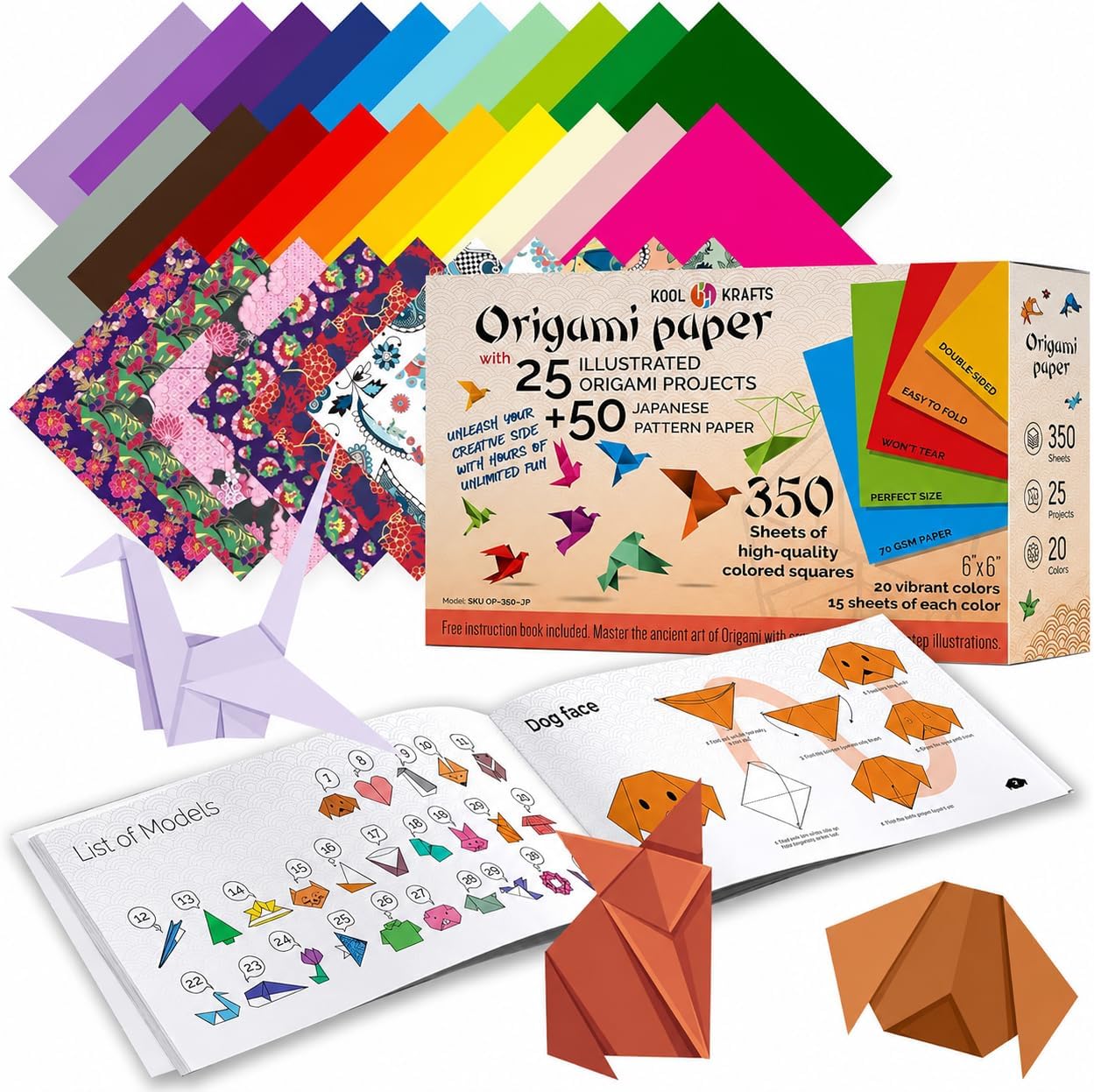
If your child gets bored with one look, the 350 piece Origami Paper kit is the most generous mix on this list. The title lists 300 sheets in 20 colors, sized 6 by 6 inches, plus 50 sheets printed with traditional Japanese patterns, and an origami book with 25 easy colored projects. The bullets add that the 300 plain sheets break down to 15 sheets of each color, so every shade appears often enough to finish several models. Few listings offer such a clear split between plain and decorative paper.
The pattern sheets are the standout. Plain colored paper is great for learning, but patterned paper makes a finished crane, box or flower look like a keepsake. Kids can fold the same model twice, once in a solid color and once in a patterned sheet, and see how the paper changes the result. The listing also says the paper is thick enough to hold a crisp fold, which helps small hands get clean edges. This pairing lets a child practice first and then fold a showpiece from the pattern sheets.
The set is aimed at children roughly in the 8 to 12 range, according to the listing, though a patient younger child with a parent beside them can still enjoy it. The book uses simple illustrated steps, and the description frames origami as quality time that needs no screen. It is a good match for a family that wants a shared weekend project or a gift for a child who already likes crafts. It also suits siblings, since two children can share the colors without fighting over one favorite.
As for caveats, a bigger pile of paper takes more room, so a box or folder for sorting helps. The sheets are standard squares, which suits most beginner models but not tiny or very large designs. Because the book holds 25 projects, older kids may soon want to look online or in other books for new ideas. Check the live listing for the latest contents before buying. Parents may want to set a simple rule about saving a few pattern sheets for special models.
3. GAMENOTE Origami Kit for Kids Ages 8-12: Best for Ages 8 to 12

Our score: 8.8/10 iOur editorial score (1 to 10), based on listing specs, features and how well each pick fits its use case. It is not an Amazon customer rating.
54 projects 120 sheets 55 page manual 14 x 14 cm paper
GAMENOTE aims its kit at children from 8 to 12, and the project count is what makes it a strong value pick. The listing promises 54 different patterns, covering flowers, plants, animals, insects, rockets and spaceships. That range matters for kids who lose interest if every model is a bird. A child who loves space can build a rocket on Monday and a beetle on Tuesday without needing a second book. That mix of themes keeps the book fresh for longer than a single subject collection would.
The paper is sized at 14 by 14 centimeters, a little smaller than the common 6 inch sheet, which is easy for small hands to manage. According to the listing, the set includes 108 double sided colorful sheets and 10 plain monochrome sheets for practicing basic skills. A 55 page teaching manual explains each model, and the description notes that the guide is meant for children and parents to use together. The practice sheets also make it easier for a parent to coach without taking over.
This kit suits a child who is ready to follow written and pictured steps on their own. The practice sheets are a thoughtful touch, because a first attempt at a new fold rarely looks perfect, and a plain sheet saves the pretty paper for later. The listing also states that the paper resists tearing and curling at the edges and has no strange smell, which parents of sensitive noses may appreciate. Children who like to collect finished models can line them up on a shelf as a small museum.
Keep a few things in mind. The listing mentions that the manual is suitable for children over 4, but the headline age range is 8 to 12, so younger kids will need adult support. No glue or scissors are needed, which keeps things tidy. Unused sheets can go back into the included box, but it still helps to set up a flat, clear table before folding. Setting a target of one new model per day gives the kit a steady rhythm.
4. hapray Origami Kit for Kids 5-12: Best Instruction Book
Our score: 9.0/10 iOur editorial score (1 to 10), based on listing specs, features and how well each pick fits its use case. It is not an Amazon customer rating.
152 papers 72 patterns 96 page book 5.5 inch squares
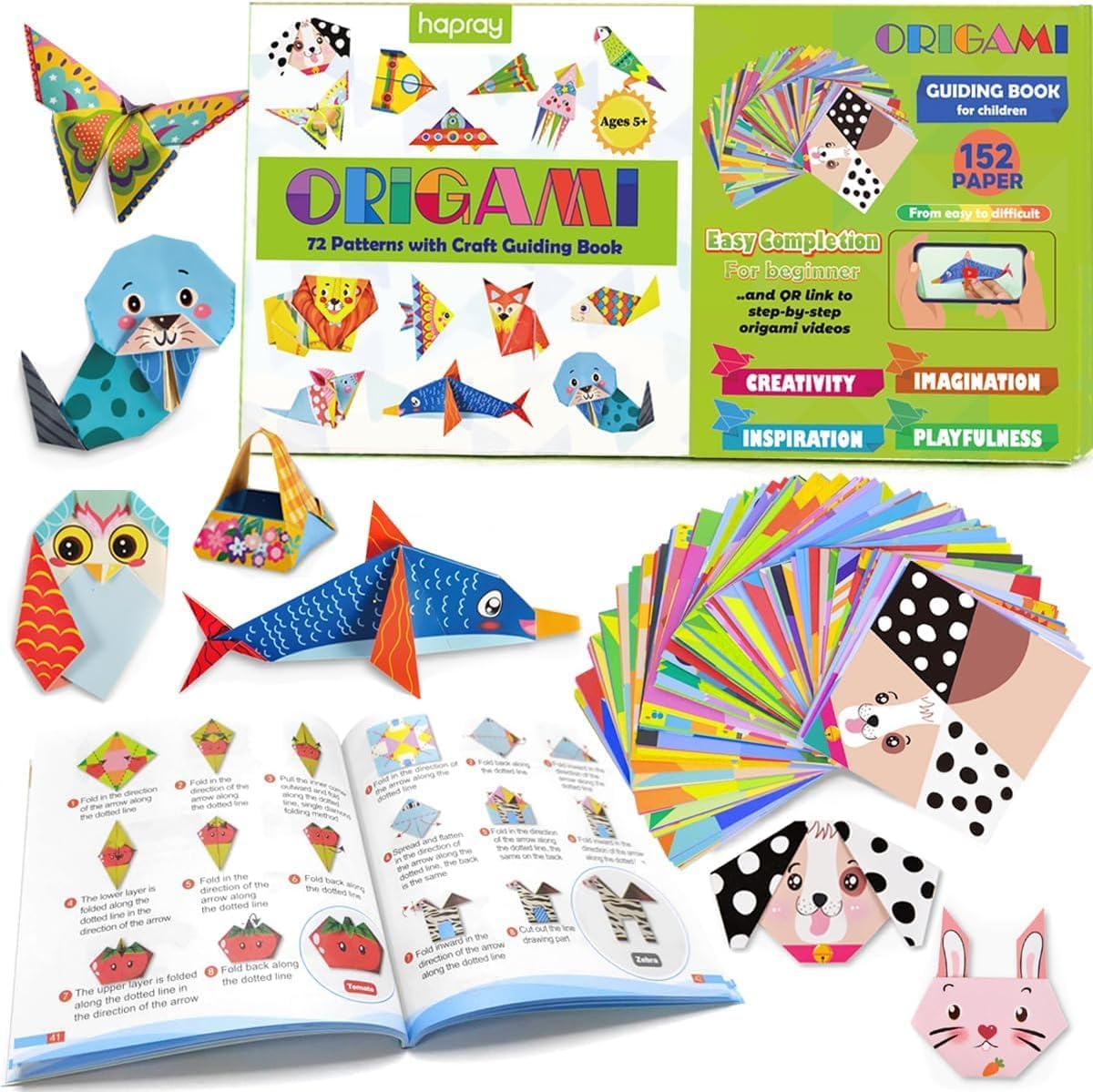
The hapray kit is the pick for families who care most about the book. The listing describes a 96 page instruction book, with 10 of those pages given to basic folding techniques. That is a lot of guidance for a craft kit, and it means a child can learn the vocabulary of origami, such as valley folds and mountain folds, before tackling a full model. A clear base of skills makes later projects less frustrating. Few kits at this level give so much space to technique alone.
The paper count is 152 in total, made up of 8 practice sheets and 144 double sided sheets in 72 unique patterns, with 2 sheets of each design. Each square measures 14 by 14 centimeters, or 5.5 by 5.5 inches. Having two sheets of every pattern is handy, because a child can make a model once, learn from the mistakes, and fold it again in the same pattern as a gift or display piece. That repeated pairing of patterns also makes matching sets of models possible.
The kit is labeled for ages 5 to 12, which gives it a wide reach. A 5 year old will need a grown up to read and fold alongside, while an 11 year old might work through the book alone. The listing says the instructions suit all skill levels, from simple to more complex designs, which makes this a kit a child can grow with across a couple of years rather than a single afternoon. Parents can use the basics pages as a quick refresher before folding together.
A few notes on fit. Because the patterns are busy, very small models can look crowded, so larger folds show off the designs best. The book is long, so a bookmark or sticky tab for the current model helps keep a child’s place. The listing also mentions customer support, but check the live page for return details. As with all paper kits, keep sheets dry and flat. A shared family session with the book open on a stand is a good way to begin.
5. My First Origami Kit: [Origami Kit with Book: Best for Beginners

Our score: 9.0/10 iOur editorial score (1 to 10), based on listing specs, features and how well each pick fits its use case. It is not an Amazon customer rating.
60 papers 150 stickers 20 projects Book included
My First Origami Kit is built for children who have never folded paper before. The title lists a book, 60 papers, 150 stickers and 20 projects, and the sticker element is the clever part. Kids fold a simple animal or object, then bring it to life with eyes, spots and faces from the sticker sheets. That finishing step rewards a child quickly, which keeps a first session fun instead of fiddly. Younger children often respond well to a craft that ends with a face.
The listing for this item carries little detail beyond the title, so we will speak in general terms. A kit named My First is meant to start with the easiest folds, such as simple animals and shapes, and build slowly. With 20 projects and 60 papers, there is room to fold each model more than once, which is how most children improve. Stickers also hide small errors, which helps nervous beginners feel proud of their work. This is also where a parent can ask the child to name each creature and invent a story.
This set suits younger crafters, especially early elementary children, who enjoy decorating as much as folding. It teaches that a flat sheet can become something three dimensional, and it builds patience, since each step must be finished before the next. A parent or older sibling can fold alongside, which turns the kit into a shared activity. Always check the age guidance on the live listing before gifting. Together, these features make the kit a gentle introduction to following steps in order.
Some cautions apply. Stickers can be small, so children who still put things in their mouths should be supervised, and loose sheets should be kept out of reach of toddlers. Because the details are limited on the page, confirm the paper size and contents on the live listing. Keep a plain tray or folder for sticker sheets so they do not curl or stick to the wrong surface. A quiet, well lit table makes the sticker step easier for small fingers.
6. Melissa & Doug On The Go Origami Animals Craft: Best for Travel

Our score: 9.4/10 iOur editorial score (1 to 10), based on listing specs, features and how well each pick fits its use case. It is not an Amazon customer rating.
40 papers 38 stickers 5 inch squares Ages 6+
Melissa and Doug On The Go Origami Animals is the best fit for car rides, flights and waiting rooms. The listing says the kit comes with everything needed to make 40 folded paper animals, packed in a format designed for families on the move. There is no need to carry scissors, glue or markers, and the whole activity fits easily in a bag or a seat back pocket. That small size is part of the appeal for a quick, low pressure activity.
The contents are clearly itemized. There are 34 animal print papers and 6 patterned papers, all 5 by 5 inches, plus 38 detail stickers and a set of instructions. Fold marks are printed on the papers, which is a smart help for beginners who struggle to line up edges. The instructions are grouped into beginner, intermediate and advanced projects, so a child can step up in difficulty as confidence grows. Parents get an easy way to hold a child’s attention without handing over a screen.
This kit suits children aged 6 and up, matching the age listed. It teaches the basics of following a diagram and working in order, while the animal prints give kids a reason to want a finished model. A child who loves zoo animals, farm life or ocean creatures will have a clear goal for each fold. It also makes a neat stocking stuffer, as the listing points out. Siblings can each fold a few animals and then compare their collections.
Think of this as a short term activity rather than a long term hobby set. With 40 papers, a keen child may finish the contents in a few sessions, so it pairs well with a larger paper pack later. The stickers are small, so keep them in the original sleeve. For a long trip, bring a hard flat surface such as a clipboard to fold on. A zip bag for finished animals keeps the creatures safe on the way home.
7. Amazing Origami Kit: Traditional Japanese Folding Papers and Projects: Best Traditional Papers

Our score: 9.2/10 iOur editorial score (1 to 10), based on listing specs, features and how well each pick fits its use case. It is not an Amazon customer rating.
144 papers 17 projects Book included Japanese folding papers
The Amazing Origami Kit leans into the traditional side of the craft. Its full title promises traditional Japanese folding papers and projects, with 144 origami papers, a book and 17 projects. For a family interested in the cultural roots of origami, that framing gives the activity a bit more story than a standard paper pack. It suits kids who like to know where a craft comes from. That cultural link can turn a simple craft into a small lesson in art and history.
The listing offers little more than the title, so details beyond it stay general. A kit with 144 sheets and 17 projects works out to many spare sheets per model, which is useful because most folders need several tries before a fold looks right. Traditional models, such as the crane, are often the first ones people learn, and a book of 17 projects is a manageable size for a child who does not want a long manual. A mid sized book also keeps the choices clear for a child who is easily overwhelmed.
This is a sound choice for older beginners, curious tweens and adults folding with kids. The traditional papers tend to look elegant, which can inspire a child to work more carefully. It also makes a thoughtful gift for a student who has seen origami in school or in a museum and wants to try it at home. Always confirm the exact paper size and age guidance on the live listing. Pairing it with a library book on Japan makes a lovely themed afternoon.
There are a few trade offs. Seventeen projects is a smaller count than several rivals, so a very active folder will move through the book faster. The more traditional look may feel less playful than animal print kits for younger children. On the other hand, it is a clean, classic option. Keep the papers flat in the book or a folder, and avoid damp hands while folding. Younger children will likely need a parent to read the diagrams with them.
8. Easy Origami: Best Book Only Option

Our score: 9.2/10 iOur editorial score (1 to 10), based on listing specs, features and how well each pick fits its use case. It is not an Amazon customer rating.
30 plus projects Dover papercraft Simple models Book format
Easy Origami from the Dover Origami Papercraft line is the pick for families who already have paper at home. The listing promises over 30 simple projects, which makes it a compact, no fuss way to start. Dover is a long standing publisher of craft books, so the format is familiar: a straightforward book, clear diagrams and a focus on models a beginner can actually finish without frustration. Its simplicity is the main strength, not a weakness.
The data for this item is thin, so we will be careful not to guess at the contents. The title and project count suggest a focus on easy models, with the kind of simple folds that teach basic skills such as folding a square in half, making a triangle and shaping a small animal or box. Check the live listing to see whether the book includes paper or expects you to supply your own squares. This is a common way for beginners to build a first small repertoire of favorite models.
The book suits a child who likes to read diagrams and who is ready to work from a book rather than a boxed kit with extras. It also suits a parent or teacher who wants a low key resource for a classroom shelf or a rainy afternoon. More than thirty projects give a long runway, and the simple models mean a child can build confidence before moving on to harder books. Teachers may find it handy for a classroom shelf or a craft club resource box.
The main caveat is that a book alone is not a full kit. If you need paper, you may have to buy a pack of squares separately, and a child who wants stickers or a pretty gift box will find this plain. On the plus side, a book is light, easy to store and simple to share. Use plain 6 inch squares for the easiest results. A pack of plain colored squares from a craft shop is an easy way to complete the set.
9. BUBU Origami Paper Kit 1000 Sheets 6×6 Colored Paper: Best for Classrooms and Groups

Our score: 9.4/10 iOur editorial score (1 to 10), based on listing specs, features and how well each pick fits its use case. It is not an Amazon customer rating.
1000 sheets 6 inch squares Guide book Ages 4 and up
The BUBU Origami Paper Kit is the volume choice, with 1000 sheets of 6 by 6 inch colored paper and an illustrated guide book. That number alone changes how you can use it. A teacher can run a class activity with plenty of paper to go around, a parent can host a birthday craft table, and a keen child can fold all summer without running out. Few listings in this price tier offer this scale. For group settings, this removes the common problem of running out of paper halfway through.
The listing describes thick, wood free craft paper with double sided patterns and solid colors, sized at the standard 6 inch square that suits most beginner designs. The book uses clear visual diagrams instead of long text, with each fold split into simple steps, and covers dozens of classic projects from animals to flowers and planes. The paper is described as sturdy enough to hold clean folds without tearing. That makes it a flexible tool for families who like to mix play and learning.
The kit is aimed at ages 4 up to adult, according to the listing, with parents invited to fold alongside younger kids. That makes it a good fit for homeschool groups, scout meetings, after school clubs and families with several children. The description also lists quiet travel use, weekend play and holiday gifts. Sheets are said to stand up to repeated unfolding and refolding, which suits practice. It also works as a gift for a school or a community center craft room.
Scale brings small trade offs. With so much paper, a child may fold quickly without reading, so a parent may need to slow things down. Storage can become messy if the sheets are not sorted, so use envelopes or a large box. The book covers dozens of projects, not hundreds, so older kids may want extra resources. Young children should always fold with an adult nearby. A shoebox or a few envelopes for color sorting keeps the stack under control.
10. FOLDOLOGY: Best Puzzle Twist

Our score: 9.2/10 iOur editorial score (1 to 10), based on listing specs, features and how well each pick fits its use case. It is not an Amazon customer rating.
100 puzzles 5 levels 6 x 6 inches Ages 10+
FOLDOLOGY takes a different approach from the other kits here. It is described as an origami puzzle game, with brain teasers for kids and adults aged 10 and up. Instead of folding a bird step by step, players tackle puzzles that ask them to fold a sheet to match a target. It earns a place on this list as a creative twist for older kids who find standard origami too slow or too passive. The mix of art and logic is what sets it apart from the other picks.
The listing promises 100 puzzles across 5 difficulty levels, with more than 50 hours of play. The pack is small, at 6 by 6 inches, and the description says it needs no surface to fold on, so it works on a bus, a train or a sofa. The game is single player, and the puzzles rise from easy to very complex, with the final level pitched as a serious challenge even for experienced puzzlers. This makes it a calm, screen free option when other entertainment is not available.
This is a strong choice for tweens and teens who like logic games, jigsaws or spatial reasoning. The listing says the puzzles train visual spatial ability, critical thinking and logical reasoning, and that no earlier origami or puzzle experience is needed. It also suits a gift for a family member who enjoys games but wants an offline pastime. Younger kids may find the puzzles too abstract. Teens who find a regular craft kit childish may enjoy this more grown up format.
Be aware that this is not a classic paper craft kit. It will not give you a bag of colorful sheets to make cranes or animals, so it is best as a second purchase alongside a regular kit or as a gift for an older child who already folds. Keep it flat and dry, and offer hints rather than solutions when a child gets stuck. Taking turns to solve a puzzle together can also make the game social.
How to Choose the Best Affordable Origami Kits For Kids
What makes an origami kit good value
Value in an origami kit is not just about the number of sheets. A kit with a thousand sheets but a thin book may leave a child stuck, while a smaller set with a clear manual can lead to more finished models. Look at the balance between paper, instructions and extras such as stickers or a storage box, and ask whether the contents match what your child will actually do.
Budget friendly does not mean low quality. Good paper holds a crease, keeps its color on both sides and does not tear at the corners. Good instructions break each fold into small steps with diagrams. When both are present, even a modest kit gives hours of play. When one is missing, extra sheets or extra projects rarely make up for it.
Matching a kit to age and skill
Children develop folding skill at different speeds. Many 4 and 5 year olds can manage a few simple folds with a parent, while most 8 to 12 year olds can follow a book alone. Tweens and teens often enjoy tougher models and puzzle formats. Use the age ranges on the listing as a guide, but also think about your own child’s patience and fine motor control.
A good rule is to start easy and give a quick win. A simple fold that looks like a real object builds confidence faster than a complex model that ends up crumpled. If a child gets frustrated, step back to an easier project or switch to a kit with stickers, practice sheets or fold marks. Confidence matters more than speed in this craft.
Paper size and thickness
The most common origami square is 6 inches, or about 15 centimeters, and it suits most beginner designs. Smaller sheets, such as 5 inch or 14 centimeter squares, are easier to carry and feel neat in small hands, but very small sheets make tiny folds harder. Larger sheets are easier for young children, though they can feel unwieldy for detailed models.
Thickness changes the folding experience. Thin paper makes sharp, detailed folds, while thicker stock resists tearing but can be bulky for complex bases. Most kids kits use a medium weight that balances both. Look for wording that says the paper holds a crisp crease and does not curl at the edges, and avoid kits that give no details at all about paper quality.
Double sided color and patterns
Many origami models reveal both sides of the paper as they take shape. Double sided sheets, where front and back are colored, make those models look finished. A plain white back is fine for learning, but it can look unfinished on a bird or flower. Kits that advertise matching color on both faces are a good fit for kids who care how things look.
Patterned sheets add charm without extra effort. Traditional Japanese prints, animal designs and bold geometric patterns turn a simple fold into a keepsake. They do hide small folds, however, so use plain sheets for learning and patterned sheets for final versions. Mixing both in a kit is a good way to give children room to practice and also to show off.
Instruction books and video help
A book is the heart of a beginner kit. The best ones use large, clear diagrams, number each step and show the finished model at the start so a child knows the goal. A section on basic folds, such as valley and mountain folds, gives a vocabulary that helps with every later model. A book that jumps straight into complex designs can discourage new folders.
Some kits add online video guidance, which helps when a diagram is hard to read. Watching a fold in motion can unlock a step that a page of arrows could not. If the listing mentions videos, use them as a backup rather than a replacement for the book, and make sure a parent checks any online link before a child opens it.
Safety, materials and labels
Origami is a low risk craft, since it uses paper alone with no heat, glue or sharp tools in most kits. Still, parents should watch for small parts such as stickers in kits for young children, and supervise anyone who might put items in their mouth. Paper edges can cause small cuts, so teach children to fold gently and keep sheets away from eyes.
Look for kits that describe their inks as mild or plant based, and check whether the product states compliance with children’s safety standards such as ASTM D4236 or EN71 where relevant. Listings do not always give this information, so if it matters to you, read the live page carefully. If no certification is stated, treat the paper as a standard craft material and keep it away from mouths.
Size, storage and portability
Paper has a way of taking over a house, so storage deserves thought. A hard box keeps sheets flat and gives you a tidy place to return them. Kits that come in soft sleeves can work fine if you add a folder or zip bag. Keep paper dry and flat, away from direct sunlight, which can fade bright colors over time.
For travel, small sets are ideal. A compact kit with 40 or so sheets, printed fold marks and a short instruction guide is easier to use on a plane than a thick book and a thousand loose squares. For home and classroom use, bigger kits make more sense, since sorting and storage matter less when a table and shelf are available.
Budget logic without chasing the biggest count
When you compare kits, avoid assuming the highest sheet count is the best deal. A child who folds one model a week will not use a thousand sheets in a year. A mid size set with a strong book may serve better than a giant pile of paper with minimal guidance. Think about how often your child will fold and for how long. Think also about shelf space and whether the child will use the whole set.
A sound strategy is to buy one kit with a good book first, then add a bulk pack later if the hobby sticks. Books such as simple projects collections also work well with paper you already own. Since prices shift often, check the live listing before buying, and compare contents rather than just the headline number. Reading the contents list on each live page helps you avoid buying the same thing twice.
Care and longevity of paper and books
Paper kits last as long as the paper stays flat and clean. Store sheets in the original box or a folder, away from damp and heat. Keep the book flat when open, and use a bookmark rather than folding page corners. Children can fold on a clean table or a clipboard so the paper does not pick up dirt or moisture from hands. A small zip bag also keeps stray scraps from drifting around the room.
Finished models can last for years if displayed carefully. Cranes and boxes look good on a shelf or hanging from a string. Dust and sun are the main enemies of paper, so avoid direct light. For classroom projects, a simple display board or a shadow box keeps models safe, and it shows children that their work is valued. A gentle wipe of the table before folding is a good habit for tidy results.
A simple learning path for new folders
A good path starts with basic folds and a few simple models, such as a boat, a cup or a basic animal. Next, move to classic designs, such as a crane, a fox or a flower, that use the same skills in new combinations. Each step adds a small challenge without being overwhelming, so a child feels progress at every session. Short, regular sessions work better than one long, tiring afternoon.
After that, children can try themed collections, such as animals, space or holiday decorations, and then more complex models that need several bases. Puzzle formats can add a different kind of challenge for older kids. Encourage children to redo models they have already made, since a second attempt almost always looks neater and shows how far they have come. A simple chart on the fridge can track the models a child has completed.
Common mistakes to avoid
One common mistake is buying a very large pack with no useful book, then watching a child lose interest because they do not know what to make. Another is buying a kit that is too advanced for the child’s age, which leads to frustration. Check the age range and the project difficulty before purchase, and read what the listing says about the instruction book. Reading the first few steps aloud together often prevents the most common errors.
A second set of mistakes happens at the table. Rushing through folds, creasing carelessly and skipping steps all lead to messy models. Teach children to line up edges, press creases firmly and read the next step before folding. It also helps to practice a fold on a plain sheet first, then switch to patterned paper for the final version. Slowing down by even a minute per model improves the final look considerably.
Gift tips for birthdays and holidays
Origami kits make easy gifts because they are light, flat and simple to wrap. Pick a kit that fits the child’s age, then add a small extra, such as a bookmark or a set of stickers, to make it feel personal. A hard storage box doubles as part of the gift, and a kit with a clear book makes a good rainy day present.
For a group gift, such as a classroom or club, a large paper pack is the better choice. For a stocking stuffer or party favor, a small travel set works well. When in doubt, go for a kit with practice sheets and a clear guide, since those suit the widest range of skill levels and let the child decide how far to take the hobby.
Frequently Asked Questions
What age is best for origami kits?
Many kits are labeled for ages 6 to 12, and some mention children as young as 4 with adult help. Younger children can enjoy simple folds beside a parent, while older kids can follow a book alone. Always check the age on the live listing.
Do origami kits need glue or scissors?
Most traditional kits need neither, since origami is folded paper only. Several listings on this page note no glue or mess. Sticker kits add decoration without glue. If a model calls for cutting, an adult should handle it and the book will say so.
Is origami safe for young children?
Origami is generally a low risk craft, but supervision still matters. Stickers and small paper scraps can be a mouth hazard for toddlers, and paper edges can cause small cuts. Fold alongside younger children and keep small pieces away from children who still mouth objects.
How many sheets do I really need?
For a single child, a set with 100 to 200 sheets is usually plenty for months of folding. Bigger packs make sense for classrooms, clubs and large families. A better book often matters more than a bigger pile of paper.
What paper size is best for beginners?
A 6 inch square is the most common and works well for most beginner models. Slightly smaller squares, such as 5 inch sheets, are easier to carry. Very small sheets can make detailed folds hard, while larger sheets suit younger children.
Are patterned sheets harder to fold?
Patterned sheets fold just like plain ones, but busy prints can hide creases and make steps harder to see. Many families use plain sheets to learn a model and patterned sheets for the final version, which gives the best of both.
Can a child learn origami from a book alone?
Yes, if the book uses clear diagrams, numbered steps and a basics section. Some children also like video help for tricky folds. Younger kids often do better with a parent folding next to them and reading each step aloud.
What if my child gets frustrated?
Go back to an easier model, use a practice sheet and fold slowly. Fold marks and stickers can help. Praise effort rather than the final result, and let the child redo a model, since the second try is nearly always cleaner than the first.
Is an origami puzzle game good for kids?
It suits older children and teens who enjoy logic problems, such as those aged 10 and up in the listing for FOLDOLOGY. It is not a typical make an animal kit, so younger children or those wanting crafts may prefer a standard paper set.
Should I buy a book only or a full kit?
A full kit is easier for first timers because paper and instructions arrive together. A book only option, such as Easy Origami, is lighter and cheaper to store, but you may need to supply your own paper. Check the listing to see what is included.
The Bottom Line
The right origami kit is the one your child will actually use. For most families, the Origami Paper Kit with 200 sheets, a 20 model book and online video help is the safest starting point, and it earns our top spot. If you want more variety, the 350 piece kit with Japanese pattern sheets is a strong second.
For younger beginners, My First Origami Kit adds sticker fun, while the Melissa and Doug travel set suits trips. Older kids who like logic may enjoy FOLDOLOGY. Prices change, so open the live listing, confirm the contents and age range, and pick the kit that best matches your child’s patience and interests.
Updated for the 2027 buying season. Amazon listings and availability change often, so check the product page for current details.
Write Your Review
No reviews yet. Be the first to share your experience!