

As an Amazon Associate we earn from qualifying purchases. If you buy through links on this page we may receive a commission at no extra cost to you. Product details come from Amazon listings and can change.
Choosing the best budget origami kits for preschoolers is trickier than it sounds, because almost every folding kit on the market is written for older kids. A three or four year old cannot follow a diagram with twelve steps, yet a young child can happily crease a square of paper into a boat, a hat or a simple fold with a grown up sitting alongside. This guide looks at eight origami paper kits and books through that lens, and it says plainly when a set is a stretch for the age.
The picks are meant for parents, grandparents, daycare helpers and gift buyers who want a lot of paper for a sensible outlay. Value here means plenty of sheets so mistakes cost nothing, instructions that a grown up can read aloud, and enough variety that a small crafter keeps coming back. Paper is light, quiet and mess free, which makes it a good rainy day activity.
Prices change often, so this guide does not quote any. Each product card links to the live listing, where you can check current cost, size and what ships in the box before you buy.
Key Takeaways
Best Budget Origami Kits For Preschoolers at a Glance
| Product | Our score | |
|---|---|---|
| Origami Kit 350 Sheets with 25 Projects Best Overall |
9.4 / 10 | Check Price |
| Japanese Origami for Beginners Kit Best With Video Support |
9.2 / 10 | Check Price |
| Origami Kit 200 Sheets 6 Inch Best Lighter Starter |
9.2 / 10 | Check Price |
| hapray Origami Kit 152 Sheets Best for Practice Folds |
9.0 / 10 | Check Price |
| Origami Extravaganza Kit Best All in One Box |
9.2 / 10 | Check Price |
| Amazing Origami Kit 144 Papers Best Traditional Style Set |
9.2 / 10 | Check Price |
| Origami Kit 116 Sheets 54 Patterns Best Patterned Paper Pack |
9.0 / 10 | Check Price |
| Easy Origami Dover Book Best Low Pressure Book |
9.2 / 10 | Check Price |
How We Chose the Best Budget Origami Kits For Preschoolers
This is a research based guide, not a lab comparison. We read each listing title and feature line, compared sheet counts, project counts and included books, and thought about how a child aged 3 to 5 would realistically use each set. Where a listing names an older age range, we say so honestly instead of pretending a kit is made for preschoolers. General craft knowledge about paper, folding and child supervision fills the gaps the listings leave open.
We also tried to balance the list. It mixes large paper stacks, compact starters, kits with video support and one book led option, so families with different budgets and shelf space can find a fit. Each pick carries an editorial score out of 10 that reflects its features, specs and how well it fits the use case of a young beginner. The score is our own judgment from the listing details and is shown separately on the page.
In-Depth Reviews
1. Origami Kit 350 Sheets with 25 Projects: Best Overall
Our score: 9.4/10 iOur editorial score (1 to 10), based on listing specs, features and how well each pick fits its use case. It is not an Amazon customer rating.
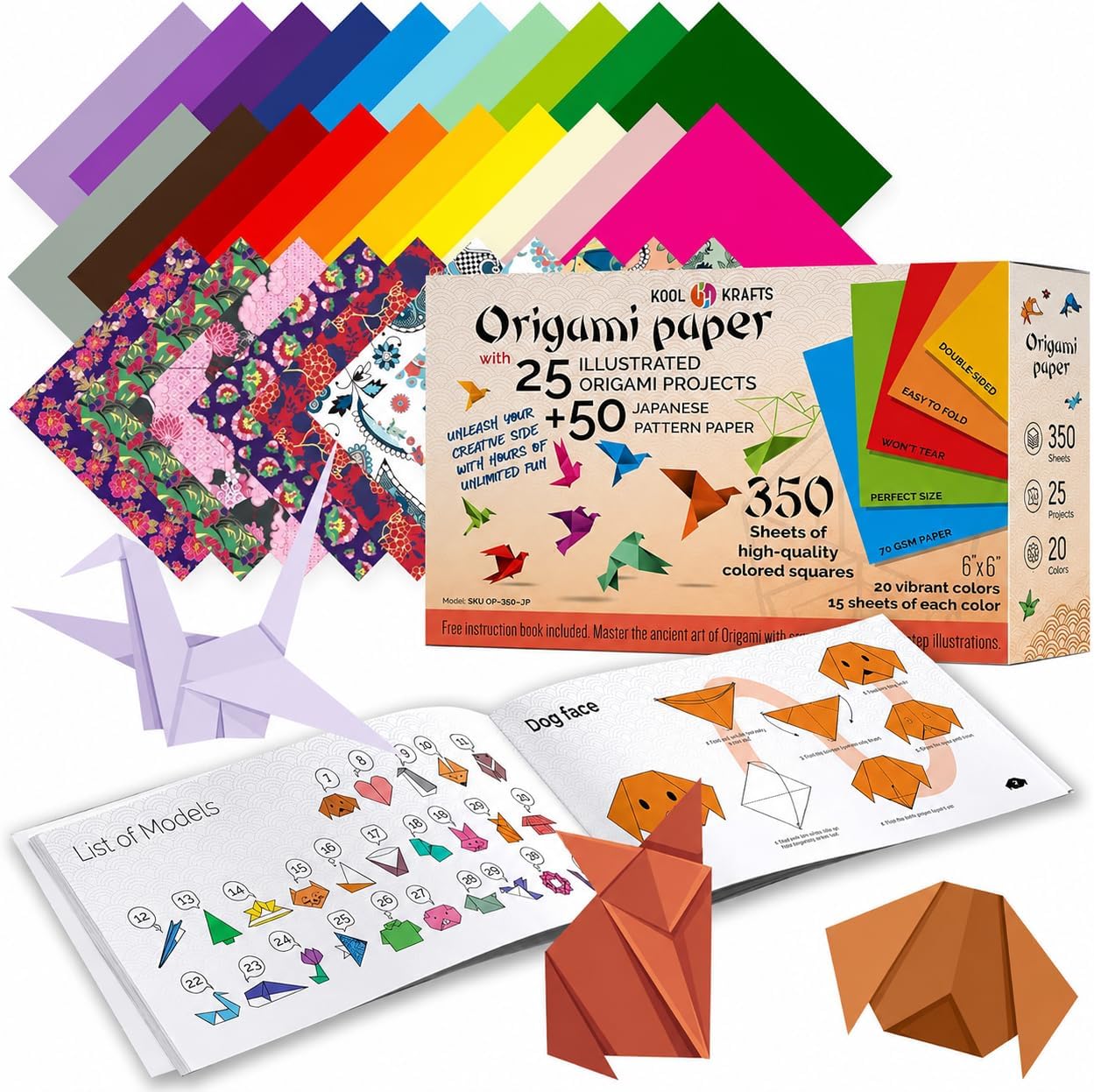
350 sheets 20 colors 6×6 inch 25 projects
Origami Kit with 350 Sheets and 25 Projects earns the top spot because its supply of paper makes the budget stretch further than almost anything else here. Preschoolers fold slowly, crease unevenly and often crumple a sheet halfway through, and that is perfectly normal at ages 3 to 5. A kit with this much paper turns every wobbly attempt into practice instead of waste, which is the most useful kind of value for a very young crafter. That mix of quantity and color choice is what lets a family treat origami as a weekly habit instead of a one time novelty.
The listing describes 300 origami sheets in a 6×6 size plus 50 Japanese pattern sheets, along with a book containing 25 projects. The twenty colors give plenty of choice for sorting games, and the pattern sheets add a treat for later. Square paper of this size is easy for small hands to pinch, turn and flatten, and it fits neatly in a tray or on a toddler table. A flat tray on the table helps keep the stack organized, and children enjoy picking each new sheet like choosing a crayon from a box.
This set suits a parent or older sibling who wants to sit with a child and fold together. The simplest projects in any beginner book, such as a basic boat or a plain hat, teach matching edges and corners, which builds the fine motor control that later helps with writing and cutting. Color naming, counting sheets and following two step directions all come along for free. Over time the same child who only pressed creases at three may be folding a whole simple project at five, and the stack supports that growth.
One honest caveat is that many of the 25 projects will be beyond a preschooler working alone, so treat the book as a menu for the grown up. Pick only the easiest few, fold along with your child, and keep the extra sheets for free play like tearing, stacking and making paper collages. Keep the pattern sheets out of reach of mouths and always supervise young children. A short tidy up song at the end of each session turns sorting leftover sheets into part of the fun rather than a chore.
2. Japanese Origami for Beginners Kit: Best With Video Support

Our score: 9.2/10 iOur editorial score (1 to 10), based on listing specs, features and how well each pick fits its use case. It is not an Amazon customer rating.
96 page book 72 papers 20 models Videos
Japanese Origami for Beginners Kit is the pick for families who feel nervous about teaching paper folding themselves. The listing title promises 20 classic models, a 96 page book, 72 origami papers and instructional videos, which is a rare mix at this level. Videos matter because a grown up can watch a fold move once or twice before showing it to a child, and that removes much of the guesswork. Having both a printed guide and moving demonstrations is a real advantage when the person leading the activity is a nervous first timer.
The format is straightforward. A book carries the written steps and diagrams, the paper stack supplies sheets for the projects, and the videos demonstrate the motions that flat diagrams struggle to show. Classic models are traditional shapes, and a handful of them are gentle enough for a first fold. The paper count is modest compared with the biggest stacks, so plan on using it more carefully. Older siblings can read the book aloud while the preschooler picks colors, which gives everyone a job and keeps the mood cheerful.
Because the kit is described as a beginner set rather than a preschool set, it fits best when an adult leads. A three year old will mostly enjoy creasing and pressing, while a five year old may manage a fold or two with guidance. The kit teaches patience, symmetry and listening to a sequence, and it gives older siblings a way to join in on the same activity. Its mix of tradition and structure also appeals to grandparents, who often enjoy sharing a classic craft with a grandchild at the kitchen table.
Practical tips help here. Preview the video before sitting down, choose one model per session, and stop while your child is still enjoying it. Watch for small paper scraps on the floor, and keep scissors out of the activity, since origami needs only folding. Because the paper supply is smaller, buy extra plain squares if your child wants to repeat favorite folds many times. Treat it as the guide that teaches the adult, and the adult then becomes the best teacher the preschooler could have.
3. Origami Kit 200 Sheets 6 Inch: Best Lighter Starter

Our score: 9.2/10 iOur editorial score (1 to 10), based on listing specs, features and how well each pick fits its use case. It is not an Amazon customer rating.
200 sheets 6 inch Double sided Color book
Origami Kit with 200 Sheets in 6 Inch is a friendly middle path between a huge stack and a tiny pack. The listing says it includes 200 double sided sheets in a 6 inch size and a full color instruction book. For a household that wants a real budget friendly set without a giant box taking over a shelf, this is a sensible and tidy choice. It is the sort of set that fits in a drawer, travels in a bag and never feels like a big commitment.
Double sided paper means each square has a different color or look on each face, which makes folds easier to see. A child can notice when a corner has flipped over because the color changes, and that visual feedback is helpful for a young beginner. The full color book shows finished projects, which gives a preschooler a picture goal to chase. Bright colors on both faces also give children an easy way to describe what they see, such as the blue side or the yellow side.
This kit suits a family with one or two young children and a limited craft area. Two hundred sheets is enough for many sessions, and the size is easy to handle and to store in a zip bag or a lunch box. It also works well for a daycare table or a grandparent visit, where a small, self contained activity is easier than a bulky kit. Because the kit is not oversized, it is easy to pass between siblings or cousins without anyone fighting over a huge shared box.
As with any origami book, the shown projects are not all aimed at three year olds. Begin with the very simplest pages, let your child choose colors, and expect the adult to do the tricky creases. Use leftover sheets for no fold play such as paper chains, sorting by color or making a flat picture. Paper edges can nick fingers lightly, so supervise and keep sessions short. A simple rule of one fold project per sitting keeps the stack lasting longer and helps small children learn to finish what they start.
4. hapray Origami Kit 152 Sheets: Best for Practice Folds
Our score: 9.0/10 iOur editorial score (1 to 10), based on listing specs, features and how well each pick fits its use case. It is not an Amazon customer rating.
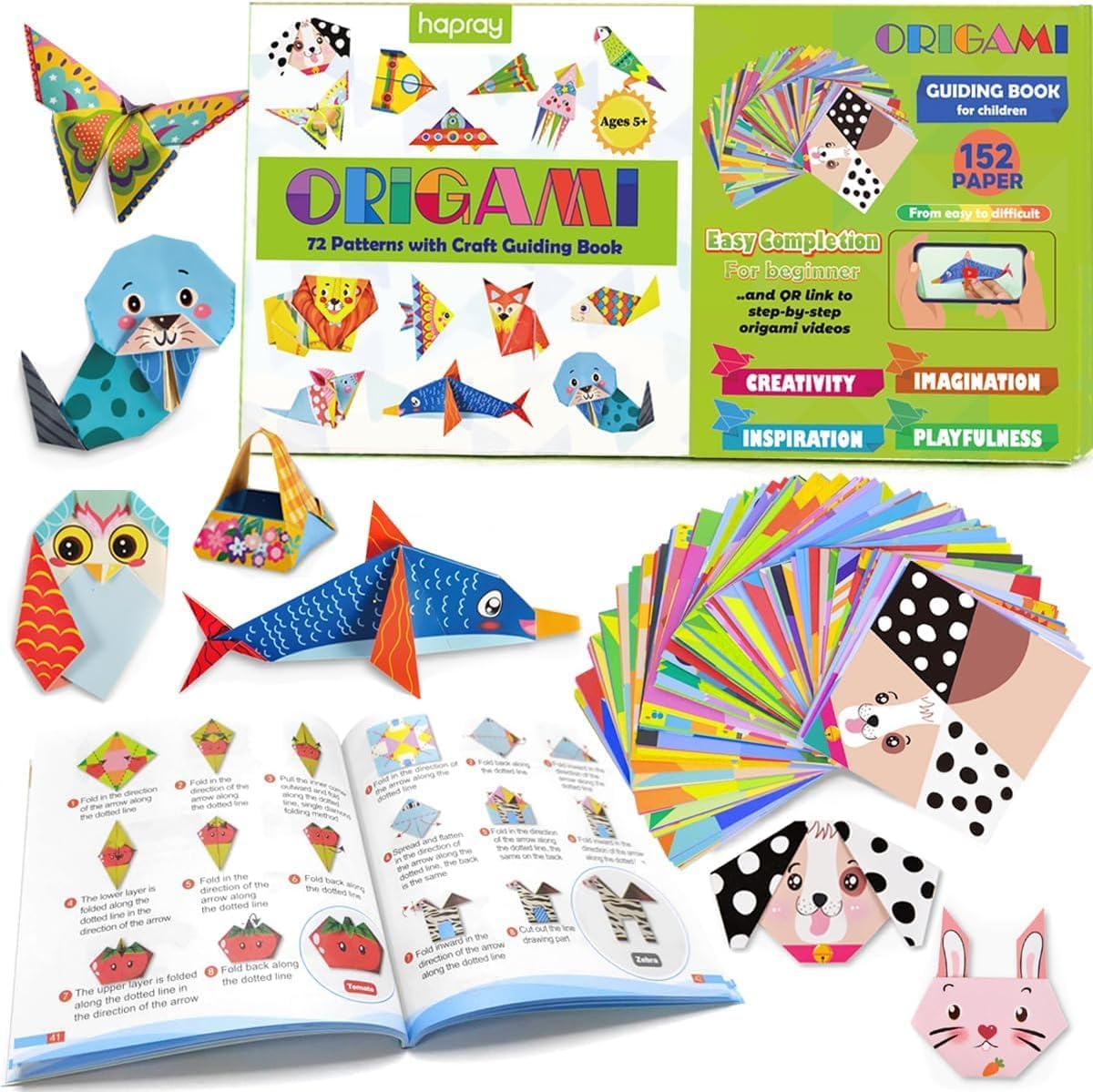
152 sheets 8 practice 144 double sided Origami book
hapray Origami Kit with 152 Sheets stands out for including practice paper, which is a thoughtful touch for beginners. The listing says the set holds 8 practice sheets and 144 double sided origami papers together with a book. Practice sheets let a child and an adult learn the fold sequence on throwaway paper before using the colorful sheets, which cuts down on frustration. That early warm up habit is a lesson many adults wish they had learned sooner in any new hobby.
The kit is a paper stack plus a guide. The double sided sheets provide color contrast for each fold, and the book supplies the project list. The title names the age range as 5 to 12, so it is aimed above the preschool years. That matters, because it means the book probably assumes some folding experience and reading ability that a three year old does not have yet. Children at this stage love adding faces with crayons, so a plain folded shape becomes a character with a name and a story.
For a four or five year old, the kit works best as a shared project with an adult doing the leading. A preschooler can handle pressing creases flat, choosing colors and decorating the finished shape with stickers or crayons. The practice sheets teach a useful lesson that mistakes are part of making things, and that trying again is normal and fun. Used this way, the book becomes a long term resource instead of something that sits unused because the first page felt too hard.
Because it is labeled for children older than the target group, be honest with yourself about expectations. Keep sessions to ten minutes, pick the simplest model only, and put the harder pages aside for a year or two. The kit then grows with your child, which adds value because it will remain useful through early school years when independent folding becomes realistic. If the instructions feel overwhelming, skip ahead to the simplest page and revisit the rest when your child is ready for new challenges.
5. Origami Extravaganza Kit: Best All in One Box

Our score: 9.2/10 iOur editorial score (1 to 10), based on listing specs, features and how well each pick fits its use case. It is not an Amazon customer rating.
162 papers 38 projects Book included Box set
Origami Extravaganza Kit is the choice for gift givers who like a complete package that arrives ready to open. The listing title mentions folding paper, a book and a box, with 38 projects and 162 origami papers. That combination makes it feel like a proper present, and the generous project count means a child is unlikely to run out of ideas for a long time. For a birthday or holiday, a complete boxed set feels generous even though the folding itself is quiet and simple.
Inside, the kit pairs a project book with a supply of sheets, so everything needed to start sits in one container. The title also says it includes a box, which suggests a handy way to keep sheets and finished folds together. The 162 papers are plenty for a family that wants to fold regularly without hunting for extra supplies. A single container makes tidy up easier, because sheets and the book return to one place rather than scattering around the house.
Thirty eight projects cover a lot of ground, but a preschooler will use only a small portion of them. The kit is better seen as a long term investment, with the earliest pages helping a three to five year old learn creases and the later pages saving challenges for school age. It also gives a parent a reason to learn alongside the child and to build a shared hobby. Parents can also use it for rainy weekends, since new projects are always waiting without another trip to the shop.
A word of caution is that the book is not written specifically for toddlers, so adult guidance is a must. Flip through before gifting and mark the three easiest pages with sticky notes. Keep the box lid and loose paper away from very young siblings who might put things in their mouths, and always supervise the folding sessions closely. Giving the set along with a small note of three recommended starter projects spares the receiving family from feeling lost.
6. Amazing Origami Kit 144 Papers: Best Traditional Style Set

Our score: 9.2/10 iOur editorial score (1 to 10), based on listing specs, features and how well each pick fits its use case. It is not an Amazon customer rating.
144 papers 17 projects Book included Folding papers
Amazing Origami Kit offers a traditional feel at a sensible size, which is why it earns the traditional style slot. The listing title describes traditional Japanese folding papers and projects, with 144 origami papers, a book and 17 projects. Seventeen projects is a manageable number for a parent who wants a focused set without feeling overwhelmed by choices. Because the list is short, children can recognize favorites and ask to fold the same project again, which builds real confidence.
The set consists of a project book and a stack of folding papers. Fewer projects means each one tends to get more attention, and a small, curated list is easier to browse with a child on your lap. The 144 sheets give enough paper to repeat favorite folds many times, so a child can practice a single shape until it feels familiar. Repetition is useful at this age, since doing the same fold three times in a row helps the movement settle into memory.
This kit suits a family who wants an introduction to the craft rather than a huge library. A preschooler can look at the pictures in the book, choose a favorite animal or object, and then help an adult fold it. The activity teaches following steps, spatial thinking and the satisfaction of turning a flat square into something three dimensional. Traditional style designs also tend to look nice on a shelf, so finished pieces can be displayed proudly in a child’s room.
The kit is not marketed as a preschool product, so some projects will be too advanced for the youngest children. Treat the book as a reference, choose the simplest options and fold slowly together. After finishing a shape, let your child draw a face or add stickers, which turns the project into pretend play and keeps small hands busy after the folding is done. Keep a small basket nearby for finished folds so that a proud creator can show them to visitors without losing them.
7. Origami Kit 116 Sheets 54 Patterns: Best Patterned Paper Pack

Our score: 9.0/10 iOur editorial score (1 to 10), based on listing specs, features and how well each pick fits its use case. It is not an Amazon customer rating.
116 sheets 54 patterns 58 page book 8 practice
Origami Kit with 116 Sheets and 54 Patterns brings visual variety, which is a strong draw for young children who love bright designs. The listing describes 116 sheets, made up of 108 double sided patterned papers and 8 practice sheets, plus a 58 page instruction book. The patterned sheets can make even a simple fold look special, and that encourages a child to keep going. Bold patterns make a good hook for children who might otherwise say folding paper looks boring.
The kit works like other paper sets, with a book to guide the folds and a stack of sheets to fold. The practice sheets give beginners a place to learn before using the decorative paper, and the 58 page book is a shorter, less intimidating read than some of the larger volumes. The title lists an age range of 5 to 16, so it is written for older children. A child who cannot fold alone can still take charge of design choices, which gives a real sense of ownership over the finished piece.
For a preschooler, the patterns are the main appeal. Children can sort sheets by pattern, match colors and pick a favorite design to fold with an adult. Even if the finished animal looks wobbly, a bright pattern makes it feel like a success. The kit also has value for later years, because the instruction book targets a wider and older group. That wider age span gives the kit a longer shelf life, and many families find that a pack bought now is still being used later.
Be realistic about the age. The projects are not designed for a three year old, so an adult has to do most of the careful creasing. Use the practice sheets first, fold one simple shape at a time and let the child decorate or play with the result. Store loose sheets in a folder so patterned papers do not get creased before use. Avoid pressing hard on fold lines with sticky hands, because patterned surfaces can smudge when they get dirty.
8. Easy Origami Dover Book: Best Low Pressure Book

Our score: 9.2/10 iOur editorial score (1 to 10), based on listing specs, features and how well each pick fits its use case. It is not an Amazon customer rating.
30 plus projects Dover series Simple folds Paper book
Easy Origami from the Dover Origami Papercraft line is the quietest and simplest option on the list. The listing title promises over 30 simple projects, and the word simple is what makes it relevant for early learners. It is a book led choice, so it feels less like a big kit and more like a gentle introduction that sits happily on a bookshelf. Its modest size also makes it an easy add on to a library visit, a travel bag or a gift basket.
Unlike the large boxed sets, this is a papercraft book rather than a stack of loose colored sheets. The listing does not spell out exactly how many folding papers are included or what their size is, so check the live listing before buying and be ready to supply extra squares of ordinary paper if needed. Simple projects keep the steps short and the paper requirements modest. Very short instructions mean an adult can scan a page in seconds and then fold without staring at the diagram the whole time.
This is the best fit for a parent who wants a calm, low pressure activity without a heap of materials. A four or five year old can watch an adult fold a simple shape, then try the first crease alone. The book teaches that folding is a series of small steps, and it gives a family a repeatable routine for quiet afternoons. For some families, a small book and a pile of printer paper is all that is needed, and it keeps the whole activity pleasantly low key.
Its biggest limit is paper supply. Because it is not a large stack, plan to add plain printer paper cut into squares by an adult, since children this age should not use scissors unsupervised. The book works best as a companion to a bigger paper stack, giving easy instructions to go with plenty of sheets. Keep sessions brief and cheerful, and praise effort rather than neat results. Set a rule that a grown up does all the cutting, and the child does all the folding, so the activity stays safe and calm.
How to Choose the Best Budget Origami Kits For Preschoolers
What Budget Really Means for a Preschool Paper Folder
For a young child, budget value does not simply mean the lowest price on the page. It means how many usable minutes of play you get from the purchase. A pack with a large number of sheets gives many chances to try again, while a tiny pack may be used up in a single wobbly afternoon. Think about cost per fold, not cost per box. Many families discover that the budget friendly choice is the one that survives repeated use rather than the one with the flashiest box.
Value also comes from longevity. A kit that is only slightly too advanced today may become the perfect activity in a year or two, so you get use out of the same purchase across several stages. When two kits look similar, choose the one with the larger paper supply and clearer instructions, because those two features matter most to a beginner. Before buying, picture a typical afternoon with your child and ask whether the paper supply and the instructions would carry you through it.
Age Fit for Three, Four and Five Year Olds
At three, children mostly enjoy creasing, pressing and tearing. A single fold in half is a real achievement at that age. Four year olds can often match corners and follow a two step instruction, especially when an adult demonstrates slowly. By five, many children can manage a simple multi step shape with help, although patience still runs out quickly. Remember that every child develops at a different pace, so a four year old who is not ready for folding simply needs more time, not a different kit.
Nearly every kit in this guide is labeled or built for older children, so treat them as adult led activities for the preschool years. Read the instructions together, let the child do the safe parts such as choosing colors and flattening creases, and save the harder folds for the grown up. This keeps the activity fun instead of frustrating. Watching your own child’s mood is a better guide than any age label on a box.
Paper Size and Why Six Inch Squares Work
Several kits in this guide use 6×6 inch sheets, and that size is a good match for small hands. It is large enough to see the folds clearly and small enough to press flat without a wrestling match. Tiny squares are fiddly and frustrating for beginners, while very large sheets can be awkward to line up on a toddler table. Check the listing for sheet size before you buy, because some sets mix sizes and a child may prefer the larger squares.
If you have plain printer paper at home, an adult can trim squares in a similar size for extra practice. Fold a corner over to meet the opposite edge, and cut off the leftover strip. Having a stack of ordinary paper alongside the decorative sheets lets a child practice without worrying about wasting the special colors. A ruler is handy for adults trimming extra squares, but keep it away from the child to avoid wasted pieces and fussing.
Safety Basics for Paper Craft at Ages 3 to 5
Paper folding avoids many of the risks that come with other crafts, because it needs no heat, glue or sharp tools. Even so, adult supervision is wise for children under five. Loose paper scraps can end up in mouths, and edges can give small paper cuts. Keep the activity at a table where you can watch, and sweep up leftover bits afterward. Teach children early that paper goes on the table and not in the mouth, and repeat the rule kindly each time you start a session.
Always read the packaging on any kit you buy. For general craft supplies, labels such as ASTM D4236 for art materials and EN71 for toy safety in Europe are useful clues, but only count on them if the listing states them. Origami paper is not edible, so if a child still mouths objects, wait until that stage has passed. A small tray or placemat also defines the work area and keeps loose bits from drifting off to the floor.
Washable and Non Toxic Questions Parents Ask
Origami paper is dyed or printed, and parents often wonder whether the colors rub off. Most folding paper is meant to be handled, but no listing in this guide promises washable or non toxic properties, so we do not claim any. If your child tends to chew on things, choose a different activity until the habit fades. Read what the listing says about materials and do not guess, because craft paper varies by maker and no listing here claims special safety properties.
Wash hands after a long folding session, especially before snack time. If you plan to add markers or stickers to finished shapes, pick products that are labeled for young children and try a small area first on scrap paper. A little caution keeps a quiet craft time truly quiet and worry free. When in doubt, choose a different quiet activity for children who still chew on paper.
Why Sheet Count Matters More Than Project Count
Project count looks impressive on a box, but preschoolers will only manage a few of the simplest projects. Sheet count is what actually keeps the activity going. A child may fold one shape ten times before it looks right, and every try uses a sheet. More paper means more relaxed practice and fewer moments where you have to say there is none left. Counting the sheets aloud with your child turns a pack of paper into an early math game, and it helps them feel the size of the supply.
Look for sets that list the number of sheets clearly, and check whether any of them are practice paper. A balanced kit has enough sheets to cover the book projects several times over. If a book offers dozens of projects but only a small paper supply, plan to add plain squares of your own. This simple habit also shows why a larger stack lasts longer than a small one.
Instruction Style: Books, Diagrams and Videos
Origami books use diagrams with arrows and dashed lines that adults can usually follow after a minute of study. For a preschooler, those pages are better treated as a picture menu. Show the finished animal, let your child pick, and then fold slowly while describing each step in plain words like fold the corner down to the other corner. Choose a set whose book has large, clear pictures rather than tiny dense diagrams, since the pictures are what a preschooler will actually look at.
Video support, such as the instructional videos mentioned for one kit here, can make a real difference when an adult has never folded before. Watching the motion once clears up confusing steps that a flat drawing cannot show. Preview the video yourself first, then fold together while your child watches and joins in on the easy parts. Sticky notes on the easiest pages save time at the start of every session.
Building Fine Motor Skills Through Folding
Pinching a corner, lining up two edges and pressing a crease flat all exercise the small muscles in a child’s fingers and hands. These are the same muscles used later for holding a pencil and using scissors. Origami gives that practice in a low pressure form, because the child sees a clear result from each careful movement. Occupational therapists often recommend folding and tearing paper as gentle hand exercise, though a parent does not need any special training to try it.
Keep expectations playful. If a fold lands slightly crooked, celebrate the effort anyway. Try songs or counting games while pressing creases, and rotate between simple folds and free play like tearing paper strips. A short ten minute routine a few times a week builds skill more reliably than one long session that ends in tears. Simply keep the sessions light, positive and short.
Storage, Sharing and Sibling Use
Paper kits are light, but loose sheets can get bent or scattered. A flat zip bag, a lunch box or a shallow plastic bin keeps papers neat and easy to carry from room to room. Store finished shapes in a separate small box so younger siblings do not crush them, and sort sheets by color for quick matching games. Label the box with your child’s name if it will travel to daycare or to a friend’s house, so the stack comes home complete.
Sharing works well with origami because there is plenty of paper to go around when you pick a large set. An older child can read the book aloud while a younger one chooses colors, giving both a role. For daycare or playgroup use, a big stack lets several children fold at the same time without arguments over sheets. A shallow bin slides neatly under a bed and keeps flat paper from curling over time.
Common Mistakes When Starting Origami With Little Ones
The most common mistake is choosing a project that is too hard. A multi step animal that looks cute on the cover may take an adult several tries, and a preschooler will lose interest quickly. Start with the easiest shape in the book, such as a simple hat or boat, and repeat it a few times before moving on. Avoid comparing your child with siblings or cousins, because folding speed has nothing to do with intelligence or future ability.
Another mistake is insisting on perfect folds. At this age, enjoyment matters more than neat corners. Avoid correcting every crease. Also avoid long sessions, because attention fades fast. Stop when your child is still smiling, and bring the paper out again another day so the activity stays something they ask for. If a session goes badly, simply put the paper away and try again another day with a fresh attitude.
Gift Tips for Grandparents and Party Hosts
An origami kit makes a quiet, screen free gift that a child can share with a grandparent. Pick a set with a book that adults can read easily and with enough paper for several visits. Add a small box of child safe crayons or stickers so the finished shapes can be decorated, and include a note suggesting the three easiest projects. Include a short handwritten card inviting the child to fold something together on the next visit, since shared time is often the best part of the gift.
For party favors or a classroom activity, a large stack is the better buy because many children can use it at once. Ordering a little early helps, and you should check the delivery window on the live listing. Remember that kits labeled for ages 5 and up are best given with an adult helper. Wrapping the kit with a ribbon of folded paper adds a personal touch for little cost.
Next Steps After the First Few Folds
Once your child is comfortable with a handful of shapes, you can grow the activity gently. Try folding to music, making a paper zoo for pretend play, or using finished pieces to decorate a card. These extensions turn a craft into a story and help young children link folding to imagination and language. Keep a small display shelf or a corkboard for finished folds, which gives children pride and motivates them to keep trying new shapes.
As your child approaches school age, move on to the harder pages in the same book. A kit that seemed too advanced at three may be a good match at six. That upgrade path is part of the value in a budget kit, because the same box can serve a growing learner for several years. A quick photo of each completed project also makes a sweet record of progress for family albums.
Frequently Asked Questions
What is the best budget origami kit for preschoolers?
Origami Kit with 350 Sheets and 25 Projects is our top pick because the large stack gives many chances to practice. For a lighter starter, consider the 200 sheet kit. Every kit here works best when an adult leads the folding.
Can a three year old really do origami?
A three year old can crease, press and flatten paper, and may manage a single fold with help. Complete shapes usually need an adult. Treat origami as a shared activity at that age and focus on enjoyment rather than perfect results.
Are these kits made for preschoolers?
Not exactly. Several listings name older ages, such as 5 to 12 or 5 to 16, and the others are written for general beginners. We recommend them as adult led kits, and we say so on each product card.
How many sheets should I look for?
More sheets means more relaxed practice, because preschoolers use up paper while learning. A set with a couple of hundred sheets is a comfortable starting point. Practice sheets are a helpful bonus for families who want to rehearse folds first.
Is origami paper safe for young children?
Paper itself avoids heat and sharp tools, but loose scraps and edges still call for supervision. No listing here promises non toxic or washable claims, so do not assume them. Children who mouth objects should wait before using any paper kit.
Do I need scissors or glue?
No. Traditional origami is folding only, which keeps the activity simple and low mess. If you want to trim plain paper into squares for extra practice, an adult should do the cutting while the child folds.
What should we fold first?
Begin with the very simplest shapes in the book, such as a basic hat, boat or a plain fold in half. Repeat the same shape several times so your child feels confident before you try anything new.
How long should a folding session last?
Ten to fifteen minutes is plenty for most children aged 3 to 5. Stop while they are still interested and bring the paper out again later. Short, happy sessions work better than long ones that end in frustration.
Will the kit still be useful as my child grows?
Yes, that is part of the value. Books with dozens of projects offer harder pages that suit a six or seven year old. Keep the box and revisit it each year as folding skills improve.
How do I store a big stack of paper?
Use a zip bag, a lunch box or a shallow bin so sheets stay flat. Sort by color for matching games, and keep finished shapes in a separate container so younger siblings do not crumple them.
The Bottom Line
The best budget origami kits for preschoolers are the ones that give you plenty of paper, clear instructions and room to grow. Origami Kit with 350 Sheets and 25 Projects takes the top spot for its sheer supply, while the beginners kit with videos and the 200 sheet starter are strong alternatives for families who want guidance or a smaller box.
Remember that most of these sets are written for older children, so plan to fold alongside your child, keep sessions short and celebrate every crooked crease. Check each live listing for current cost, size and contents, since those details change often.
Updated for the 2027 buying season. Amazon listings and availability change often, so check the product page for current details.
Write Your Review
No reviews yet. Be the first to share your experience!