

As an Amazon Associate we earn from qualifying purchases. If you buy through links on this page we may receive a commission at no extra cost to you. Product details come from Amazon listings and can change.
Finding the best affordable knitting kits for kids is mostly a matter of matching the craft to the child. A kit that looks like a bargain on the page becomes a drawer ornament if the needles are too fiddly, the yarn splits, or the first project takes three weeks. This guide sorts nine budget friendly starters into clear picks so you can spot the one that fits your child’s age, attention span and goals.
Because the list covers more than one craft, it also explains knitting, crochet and loom work in plain language. Several picks are round or straight looms, which let young beginners make hats and scarves without handling long needles. A few are crochet sets, and one is a finger knitting book. Each entry says what the listing includes, who it suits and what to watch for.
This guide is for parents, grandparents, gift buyers, and tweens or teens choosing a first kit for themselves. Prices change often and kit contents can be updated, so we link to live listings instead of quoting numbers. Always check the age guidance on the page before you order.
Key Takeaways
Best Affordable Knitting Kits For Kids at a Glance
| Product | Our score | |
|---|---|---|
| Creativity for Kids Quick Knit Loom Kit Best Overall |
9.2 / 10 | Check Price |
| Creativity for Kids Learn to Knit Pocket Scarf Best With Real Needles |
8.8 / 10 | Check Price |
| Hapinest Learn to Knit Hat and Scarf Knitting Loom Best Hat and Scarf Set |
8.8 / 10 | Check Price |
| Knitting Loom Kit for Beginners Best Needle Free Set |
9.0 / 10 | Check Price |
| Complete Knitting Kit for Beginners Best For Older Beginners |
9.0 / 10 | Check Price |
| PREBOX Weaving Loom Kit Toys for Kids and Adults Best Weaving Alternative |
9.0 / 10 | Check Price |
| MAGIMUSE Crochet Kit for Beginners Best Crochet Starter |
8.8 / 10 | Check Price |
| Finger Knitting for Kids: Super Cute & Easy Things Best Book Starter |
8.8 / 10 | Check Price |
| INSCRAFT 113 Piece Crochet Kit with Yarn Set Best Big Yarn Stash |
9.0 / 10 | Check Price |
How We Chose the Best Affordable Knitting Kits For Kids
This is a research based guide, not a lab comparison. We read each listing closely, noting the tools in the box, the yarn weight, the age guidance, the learning aids such as video tutorials, and any safety wording the seller provides. We then balanced the list across looms, needles, crochet and a book, so families with different goals each find a sensible starting point. Where a listing was silent on a detail, we speak in general terms rather than guess.
Every pick also carries an editorial score out of 10, shown separately on the site. The score comes from features, specs and use case fit: how complete the kit looks, how well it matches the stated age range, how forgiving the first project should be, and how much value the contents suggest. Budget friendly here means a sensible amount of material for the money, never a thin kit padded with tools a child will not touch.
In-Depth Reviews
1. Creativity for Kids Quick Knit Loom Kit: Best Overall

Our score: 9.2/10 iOur editorial score (1 to 10), based on listing specs, features and how well each pick fits its use case. It is not an Amazon customer rating.
Round loom Chunky rainbow yarn Pom pom hat Ages 7+
The Creativity for Kids Quick Knit Loom Kit takes the top spot because it removes most of the early frustration from knitting. Instead of two needles and a slippery first row, the child wraps yarn around pegs on a round loom and lifts loops over. The listing frames the craft as simple and repetitive, which suits beginners well. A finished pom pom hat arrives quickly enough to keep a young maker motivated. That quick win matters for budget minded buyers, because a kit that gets finished is worth far more than a bigger one left in a closet.
According to the listing, the box holds a 9 inch round loom, 90 yards of chunky rainbow yarn, rainbow pom poms, a knitting hook, a felt patch, a plastic needle and a threader. The kit targets two projects, a pom pom hat and a cup cozy. Illustrated instructions come with a how to video, so a child can pause and replay a tricky step while an adult stays nearby. Adults will like that the yarn is a named brand in the listing, which hints at a soft, chunky strand that is easy to see and handle.
This kit is aimed at ages 7 and up, and it fits kids who like to see results fast. Loom knitting builds hand coordination, counting and patience, and it teaches the loop and bind off motions that carry over to needle knitting later. The listing also says the tools can be reused with extra yarn, which stretches the value well beyond the first hat. Children who enjoy gifts they can wear will feel proud to say they made it, and relatives often love receiving such a present.
Practical points are worth planning for. A first hat can run uneven, and that is normal; encourage a relaxed grip and let the child rip back a row if needed. The loom is plastic, so keep it away from heat and store the small hook and needle with the yarn. Younger children may need help with the pom poms and the final sewing step. If your child wants a second hat right away, shop for more chunky yarn in a similar weight and keep the same loom.
2. Creativity for Kids Learn to Knit Pocket Scarf: Best With Real Needles
Our score: 8.8/10 iOur editorial score (1 to 10), based on listing specs, features and how well each pick fits its use case. It is not an Amazon customer rating.
Straight needles Pocket scarf Video tutorial Ages 9+
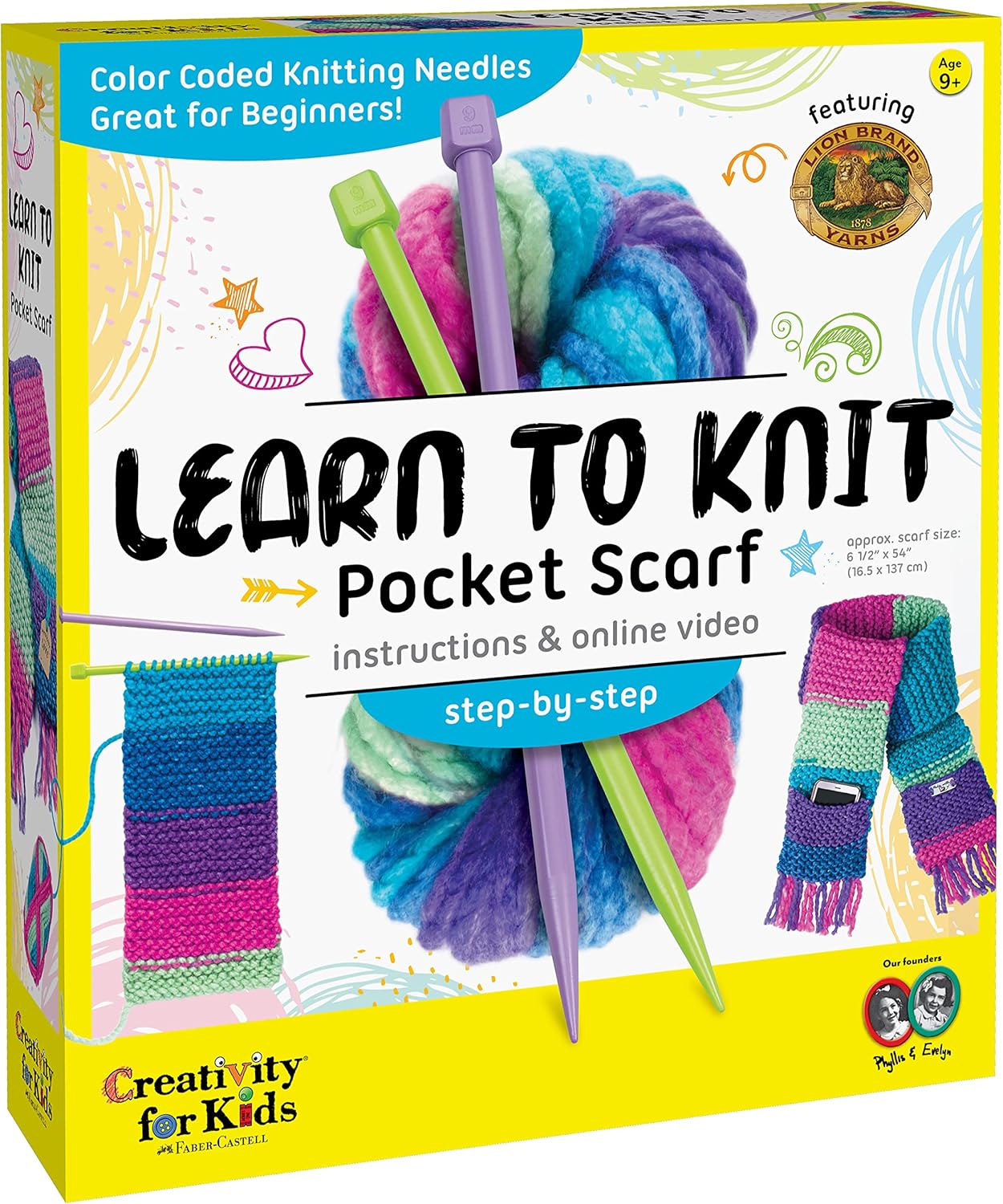
For a child ready to hold real needles, the Creativity for Kids Learn to Knit Pocket Scarf kit is the strongest budget friendly option here. It follows the traditional path: cast on, knit rows, and bind off. The scarf has a built in pocket, which gives a nine year old a reason to keep going beyond the plain rectangle most first projects deliver. That small twist makes it a better gift than a plain starter scarf, and it keeps the project fun for a child who enjoys surprises.
The listing describes soft rainbow yarn, color coded knitting needles, a sewing kit, an embroidered patch, a gift tag and illustrated instructions, plus a video tutorial. Color coding is a clever teaching aid, because it helps a child tell which needle goes where. The sewing kit is there to close the pocket seams and attach the patch once the knitting is done. Together these parts mean a family does not have to hunt for extra supplies, which keeps the real cost of the kit predictable.
The seller states the kit is meant for ages 9 and up, and mentions it is non toxic and safety focused. It suits kids who enjoy calm, repetitive work and can sit for longer stretches. Knitting at this level builds focus, finger control and the pride of wearing something made by hand. Some adults also learn alongside their child with this set. It also fits adults who want a gentle beginner project, since the listing says parents can learn alongside their child.
Needles take more patience than a loom, so expect a few dropped stitches early on. Keep a spare needle or crochet hook handy for rescues, and show the child how to read the row they just knitted. Needle tips are blunt but still pointed, so younger siblings should be kept away, and the sewing needle needs adult supervision for small hands. A tip is to knit a few practice rows on scrap yarn first, so the child feels calm before starting the scarf itself.
3. Hapinest Learn to Knit Hat and Scarf Knitting Loom: Best Hat and Scarf Set

Our score: 8.8/10 iOur editorial score (1 to 10), based on listing specs, features and how well each pick fits its use case. It is not an Amazon customer rating.
Round loom 6 yarn skeins 2 faux fur pom poms Ages 8 to 12
The Hapinest Learn to Knit Hat and Scarf Knitting Loom kit earns its place by promising two wearable projects from one box. Many starter looms stop at a hat; this one also points toward an infinity scarf. For a child who finishes the hat and wants more, that extra project keeps the momentum going without another purchase. For families who want the most wearable results from a single loom kit, that two project plan is the main selling point.
The listing names a round knitting loom, six acrylic yarn skeins, a crochet hook, a yarn needle, two faux fur pom poms and an instruction booklet. The large round loom and sturdy hook are described as friendly for young beginners. A booklet with clear steps guides the child through beanies and scarves, which is helpful for families who prefer paper instructions over screens. Because the loom is round, the same method that builds a hat also builds a tube, which is how an infinity scarf is shaped.
This set is aimed at ages 8 to 12, and the seller highlights fine motor practice and tactile play. It suits crafty kids who enjoy picking colors and making gifts for friends. Because six skeins are included, a child can plan stripes or color blocks, which turns the project into a small design exercise as well as a knitting lesson. It is a pleasing choice for a birthday or a holiday gift, since the listing frames the finished pieces as presents for friends.
As with any loom, loose tension is the usual trouble. Remind the child to keep loops relaxed so the hat does not curl or tighten around the pegs. Faux fur pom poms can shed a little, so attach them firmly. The crochet hook and yarn needle are small items, so store them in a lidded box away from younger children. If a hat comes out too loose, simply stitch the brim a little tighter next time, and the child will learn from each version.
4. Knitting Loom Kit for Beginners: Best Needle Free Set

Our score: 9.0/10 iOur editorial score (1 to 10), based on listing specs, features and how well each pick fits its use case. It is not an Amazon customer rating.
50 peg loom 4 yarns Storage bag Video QR code
The Knitting Loom Kit for Beginners stands out for a needle free approach and a carry along storage bag. The seller points out that a loom lets children make hats, scarves and coasters without juggling long needles, which gives anxious parents some peace of mind. It sits just below the top picks only because the listing offers fewer specific project plans. That calm, needle free setup is a real advantage for a household with a younger sibling who tends to grab anything pointed.
The listing describes a 7.8 inch loom with 50 pegs, a smooth knitting tool with a crochet hook, four yarns, two bags of colored elastic loops, an instruction booklet and a storage bag. The elastic loops are a nice extra, since they let kids make coasters in a different style. A QR code links to a step by step video that shows each stage. Their mix of loops and yarn means two different looks can come from one box, which stretches the value of the purchase.
This kit is marketed to girls ages 7 to 12, though any child who likes handwork can enjoy it. It teaches the wrap and lift routine, color planning and the satisfaction of finishing a useful item. Because the storage bag keeps everything in one place, it suits car rides, waiting rooms and quiet afternoons when a bulky craft would be a hassle. The seller also notes that the tools can be reused, so a future round of projects only needs more yarn.
Check the video on a phone or tablet before the child starts, so you know what to expect. Loom pegs can bend if forced, so teach a gentle pull. Elastic loops can snap back, and the small tools can be lost in a messy room, which makes the included bag worth using. Younger kids should have an adult nearby for the first project. A good habit is to keep the bag zipped between sessions so pegs, hook and yarn stay together and nothing ends up in the vacuum.
5. Complete Knitting Kit for Beginners: Best For Older Beginners

Our score: 9.0/10 iOur editorial score (1 to 10), based on listing specs, features and how well each pick fits its use case. It is not an Amazon customer rating.
Super bulky yarn Bamboo needles Stitch markers Video tutorials
The Complete Knitting Kit for Beginners is the most grown up pick on the list, and that is why it suits tweens and teens. The listing speaks to adults, yet its thick yarn and simple needles are just what an older child needs for a first real project. A patient twelve year old or a teen who wants a calming hobby will get plenty from it. Thick yarn is a smart choice for anyone learning, because large loops show mistakes clearly and make them simple to fix.
The seller lists three skeins of super bulky 100 percent acrylic yarn, bamboo knitting needles, stitch markers, pom pom makers and more, plus video tutorials and a written guide. It also mentions three little projects to get started. Bamboo needles are lighter and grip the yarn better than slick plastic or metal, so stitches are less likely to slide off by accident. Pom pom makers add a playful finish, so a plain scarf or hat can feel more personal and less like homework.
This kit works best for older kids and for parent and child pairs who want to learn together. Knitting with super bulky yarn grows quickly, which rewards beginners with visible progress. The listing talks about relaxation and focus, and many teens enjoy that screen free routine. It is also a sensible gift for a young person who has outgrown character themed crafts. Another plus is that the set works as a joint activity, so an older sibling or parent can teach while the child practices.
Because the listing is written for adults, parents should check that the tools feel comfortable in smaller hands. Thick yarn pairs with thick needles, which can feel heavy for a younger child. Make sure the child understands that needles are not for poking or play. Keep the stitch markers and pom pom makers away from toddlers and pets, since small parts can be a choking risk. Buyers who want a gentler fit for younger hands might compare this kit with the loom kits above before deciding.
6. PREBOX Weaving Loom Kit Toys for Kids and Adults: Best Weaving Alternative

Our score: 9.0/10 iOur editorial score (1 to 10), based on listing specs, features and how well each pick fits its use case. It is not an Amazon customer rating.
7 inch loom 8 colors of loops Storage box Ages 6 to 12
The PREBOX Weaving Loom Kit is not a knitting kit in the strict sense, but it belongs on a knitting list because it teaches many of the same skills. A potholder loom has children weave stretchy loops over and under on a square frame. It is a gentle first step into textile craft for kids who are too young for needles or who lose patience with yarn. For families on a tight budget, that variety of crafts from one box can make the set feel like several activities in one.
The listing describes a storage box, a plastic loom, eight colors of acrylic loops, a needle, a crochet hook, yarn and pattern instructions. The seller says kids can weave potholders and also make coasters, hair bands, coin purses and bags by sewing edges. The finished pieces are flat and practical, so a child sees a useful object after the very first project. Weaving loops this way also gives children a clear picture of how over and under patterns create a fabric, which is a good concept for later knitting.
This kit suits children around ages 6 to 12 who like color matching and pattern play. The listing mentions imagination, color skills and fine motor development, and it calls out the nostalgic appeal for parents who wove potholders themselves. That makes it a good shared activity between a child and a grandparent, with no knitting experience needed on either side. Craft sessions like this also make a lovely quiet time for siblings, because each child can weave a different color story.
Be honest with expectations: this is weaving, not knitting, and it will not teach stitch names. The loops can pop off the pegs if pulled too hard, and the metal or plastic hook should be handled with care. Check the finished potholder before using it near heat, since loops are not a guaranteed heat shield and adults should supervise anything near a stove. Fine motor practice is real, but tiny fingers still tire quickly, so short sessions with breaks work best for the youngest weavers.
7. MAGIMUSE Crochet Kit for Beginners: Best Crochet Starter

Our score: 8.8/10 iOur editorial score (1 to 10), based on listing specs, features and how well each pick fits its use case. It is not an Amazon customer rating.
Plant projects 6 yarn colors Video tutorials Beginner hook
The MAGIMUSE Crochet Kit for Beginners earns its spot because crochet is often an easier first craft for fingers than knitting, and this kit turns it into a cute plant project. Instead of a long scarf, a child makes small stuffed potted plants. Short projects mean more finished items, and finished items keep a young crafter excited about learning. Cute projects like this often hook a child on the craft faster than long, plain pieces, which is why the kit fits a starter list.
The listing describes six colors of yarn, stuffing, eyes, an ergonomic crochet hook, a yarn needle and a stitch marker, with beginner instructions and videos. The seller also says it adds extra yarn in every color, so mistakes can be redone. Smooth yarn that does not split is helpful for new crocheters, because split strands are a common source of confusion. Together, the contents mean a child can follow a complete project from first loop to the final stitched face without extra shopping.
This kit suits tweens and teens, and patient younger kids with a helper nearby. Crochet uses one hook and one active loop, so there is less risk of dropping a whole row. Making amigurumi style toys teaches counting, tension control and basic shaping. The listing also mentions email and text support, which may help parents who have never crocheted themselves. It can also work as a calm after school activity, since the listing describes crochet as a mindful and relaxing pastime.
Please read the age guidance on the live page, because stuffed toys with small eyes can pose a choking risk for younger children. Safety eyes should be fitted firmly and checked, and finished plants are not meant for babies or toddlers. Crochet also has its own stitch language, so expect a short learning curve before the plants take shape. Left handed crafters should look for videos that show their own hand, because many tutorials are filmed for right handed people.
8. Finger Knitting for Kids: Super Cute & Easy Things: Best Book Starter

Our score: 8.8/10 iOur editorial score (1 to 10), based on listing specs, features and how well each pick fits its use case. It is not an Amazon customer rating.
Finger knitting Book format No needles Easy projects
Finger Knitting for Kids: Super Cute and Easy Things to Make is the odd one out, because it is a book, not a boxed kit. It earns a place for budget minded families, since finger knitting needs no needles, no loom and very little gear. The title promises easy and cute projects, and the craft itself is well known as one of the gentlest ways to introduce yarn to a child. That makes the book a low risk way to find out whether a child enjoys yarn before buying a loom or needles.
The data for this entry is thin, so we will stay general. Finger knitting means looping yarn with the fingers to build a long chain or cord, which can become bracelets, headbands, bookmarks and similar small makes. A book like this typically shows photos and steps for those projects. Check the live listing for page count, age guidance and the sample pages before you buy. If the listing sample shows clear photos, that is a good sign, because finger knitting is easiest to learn from pictures.
This option suits younger crafters and families who want to try yarn work before spending on a full kit. It builds finger dexterity, rhythm and patience, and it leads naturally to loom and needle knitting later. Parents can also learn it in minutes and sit beside the child. Because the book supplies no yarn, you pick your own material, which can be a bonus. It is also a good rainy day activity, because it needs no setup and can happen at a kitchen table or on a couch.
Since there are no tools in the box, you will need to buy or find yarn. Chunky, soft yarn is easiest for small fingers, and scraps of leftover yarn work well. Keep scissors out of reach of very young children, and remind kids not to wrap yarn tightly around fingers or necks, since tight loops can cut off circulation. Finally, if the book catches on, move up to a loom kit from this list, which turns the same rhythm into bigger projects.
9. INSCRAFT 113 Piece Crochet Kit with Yarn Set: Best Big Yarn Stash

Our score: 9.0/10 iOur editorial score (1 to 10), based on listing specs, features and how well each pick fits its use case. It is not an Amazon customer rating.
113 pieces 40 yarn colors 9 crochet hooks Storage bag
The INSCRAFT 113 Piece Crochet Kit with Yarn Set is the volume leader of this list, and its appeal is breadth. A huge yarn stash and a wide set of tools let a keen crafter try many small projects. It lands last, because the seller states it is not for children age 12 and under, so it serves teens and adults better than younger kids. If you are shopping for a teen who is serious about yarn crafts, that scale is a genuine benefit rather than a gimmick.
The listing says there are 40 colors of acrylic yarn, 1600 yards in total, with each ball about 16 grams and around 40 yards long. The kit also has 9 ergonomic crochet hooks, three knitting needles, scissors, a measuring tape, 10 stitch markers and a see through storage tote bag. Altogether the seller counts 73 accessories, which makes this a full toolbox. The measuring tape and stitch markers hint at a toolkit that grows with the crafter, so skills do not outgrow the box quickly.
This set suits an older teen, a parent crafting with a teen, or a family that wants plenty of yarn for charity or gift projects. The wide color range helps with stripes, color blocks and small toys. Because it covers both crochet and a little knitting, it is a flexible choice for someone who has not yet decided which craft to follow. A mixed craft box like this is especially good for sharing, because two people can work on separate projects at once.
Because of the age warning, please treat this as a gift for an older teen or for adults, and keep it out of reach of younger children. Scissors, hooks and tiny stitch markers are not toys. It also has no single guided project in the listing, so a beginner may need free online patterns or a book to turn all that yarn into something. A parent who likes the stash but wants a kid friendly option should look at the loom kits instead, and keep this one for teens.
How to Choose the Best Affordable Knitting Kits For Kids
Knitting, Crochet and Loom Work: What Is the Difference
Knitting uses two needles and holds many live stitches at once. Each row is built by moving loops from one needle to the other. It makes a stretchy, smooth fabric, and it is the craft most people picture when they hear the word. The trade off is that dropped stitches can run, so beginners often need an adult to rescue them.
Crochet uses one hook and works one loop at a time, which makes mistakes easier to undo. Loom knitting wraps yarn around pegs and lifts loops over, making a knit style fabric with no needles at all. Most kits on this list use looms or crochet hooks, so be clear about which craft you are buying. Knowing this up front saves families from buying a crochet kit when they wanted knitting.
Matching the Kit to Your Child’s Age
Age ranges on listings are a good starting guide. A round loom kit often points to ages 7 and up, while a needle based scarf may say 9 and up. Children under 6 usually do better with finger knitting or large, simple weaving frames and an adult beside them for the whole session. Adult help is still wise at any age for the first session, even when the box says the kit is easy.
Tweens and teens can handle thin tools and longer projects, so a bulky yarn needle kit is a fair choice for them. Always read the seller’s age notes, because some kits warn against use by younger children. A caution like that usually reflects small parts, sharp ends or both. Skill matters as much as age, so a patient seven year old can sometimes outpace a restless ten year old.
Why Looms Are Popular With Beginners
A loom holds the stitches on pegs, so nothing slips off the way it can on a needle. That one feature removes the biggest early frustration and lets a child finish a hat on the first try. The motions are repetitive, which is calming and builds a steady rhythm. Many families find that a loom keeps a child engaged longer, because the project grows visibly with every round of pegs.
Looms also introduce circular knitting, the method behind most hats. The limit is size and style: a plastic loom has a fixed peg count, so project shapes are set by the tool. Kids who enjoy looms often move to needles later, and the skills transfer well. Loom knitting is also easy to teach to others, so parents with no craft background can still guide a child through a session.
Needle Knitting for Kids Who Want the Real Thing
Some children want to knit the way a grandparent does, and needles give them that. Choose wooden or bamboo needles because they grip yarn better than slick metal. A size that feels chunky in the hand is easier to control than a thin one. A comfortable sitting position and good light also help young knitters avoid sore hands and tired eyes during longer sessions.
Pair needles with a thick yarn in a light color so stitches are easy to see. Cast on for the child at first, and let them practice the knit stitch on short rows. Expect uneven edges and holes early on, because that is part of how the hands learn. Short needles are easier to hold than long ones, so check the length before buying for a young child with small hands.
Yarn Weight and Fiber Basics
Yarn weight changes how a project feels. Chunky and super bulky yarns make big stitches that are easy to see and fast to finish. Thin yarns look finer but ask for more skill and patience. Beginners do best with smooth, thick yarn in a solid or gently varied color. Light colors show the loops more clearly than black or navy, which are hard to read under household lamps.
Many starter kits use acrylic yarn, which is soft, easy to wash and gentle on a budget. Wool is warmer but may itch some children. Check the listing for fiber details, and if a child has a skin sensitivity, hold a small piece against the skin first. One easy check is to pick a strand and see if it splits when pulled; split yarn frustrates new crafters and wastes time.
Safety Labels and Small Parts
Craft kits can contain small items such as hooks, yarn needles, stitch markers, buttons, safety eyes and pom poms. These can be a choking risk for children under three and for pets. Keep such parts in a closed box, and count the tools after each session. Always read the age grading on the listing, and treat it as a safety note rather than a suggestion about skill.
Where a seller states that a kit meets standards such as ASTM D4236 for art materials or CPSIA for children’s products, that is a helpful sign, though it does not replace supervision. Needles and scissors are sharp or pointed, so younger crafters should work at a table with an adult close by. A simple rule is to put a lid on the box whenever the session ends, so no tool is left behind for pets.
Size, Storage and Mess Control
Yarn is soft, but it creates clutter. Kits that include a bag or box help a lot, because a child can pack up unfinished work without losing the hook or pom poms. A see through pouch also makes it easy to spot what is missing. A tidy kit also makes it simpler for a child to start the next session without a long search for the right tool.
Store projects away from pets and toddlers, since cats love yarn and little ones love loose ends. Keep yarn balls in a small bowl so they do not roll under furniture. A shallow tray on the lap or table stops pegs and needles from sliding off the edge. A bag with a clear window is handy, because children can see their work without having to dig through the yarn.
Budget Logic Without Chasing the Smallest Kit
A fair kit gives enough yarn to finish at least one project and tools that suit a child’s hands. A very small kit can leave a child short of yarn halfway through a hat, which is discouraging. Look at the yarn length, the number of projects and whether the tools can be reused. A kit that looks cheap on the surface can cost more once you add missing tools, so count everything included.
Reusable looms, hooks and needles stretch the value, since extra yarn is easy to add later. Large tool sets can also be good value, but only if the child will use most of them. Compare what is in the box before you judge a kit by its size alone. If a child may lose interest, start with a modest loom kit and upgrade later, instead of buying the largest set at the start.
Learning Paths That Keep Kids Interested
A smooth path might start with finger knitting, move to a round loom hat, and then try a simple needle scarf. Each step uses the same ideas in a more demanding way. Short wins, such as a bracelet or a cup cozy, keep spirits high between longer projects. Plan a gentle schedule, perhaps two short sessions each week, so the craft feels like play and not a chore.
Crochet makes a nice side route, because small stuffed toys finish quickly and teach shaping. Video lessons help with tricky moves like casting on. Let the child pick colors and projects, since a sense of ownership is a strong motivator for children. Many children also enjoy sharing progress photos with relatives, which gives a warm reason to finish the next row.
Common Mistakes First Time Crafters Make
The biggest mistake is pulling stitches too tight. Tight loops are hard to lift off pegs or slide on needles, and they make stiff fabric. Remind children to keep a relaxed hold and breathe. Another common trouble is losing count of stitches, so use a marker or write down the row number. Rushing at the end of a row is another trap, because the last few stitches are where many slips occur.
Parents also sometimes pick a kit that is too hard because it looks impressive. Starting with a simple hat or scarf is better than a complicated toy. If a child gets stuck, ripping out a few rows is a normal part of learning and not a sign of failure. A final habit to build is to check the work after every few rows, since small errors are far easier to fix than big ones.
Caring for Finished Projects
Check the yarn label or listing for washing guidance. Acrylic knits often tolerate gentle washing, and cool water with mild soap is usually a safe starting point. Lay finished items flat to dry so they keep their shape rather than stretching on a hanger. Wool blends and cotton may call for different handling, so follow whatever the label of your chosen yarn says.
Weave in loose ends with a yarn needle so the work does not unravel. Pom poms may need to be sewn on again after heavy wear. A hat or scarf made by a child makes a heartfelt gift, and showing how to look after it teaches responsibility too. If a child is proud of a hat, take a photo of it before its first wash, so the memory outlasts the yarn.
Gift Tips for Parents, Grandparents and Friends
Give a kit together with a short sit down lesson if you can. A child who gets help for the first ten minutes is far more likely to finish the project. Pair the kit with extra yarn in a favorite color, and the set will last well beyond the first make. Wrap the kit with a small bag of treats or a notebook for project ideas, and the present will feel complete.
Think about the child’s personality. A fast, colorful loom suits an active kid, a needle scarf suits a calm one, and a crochet plant kit suits a child who loves small toys. Check return and age details on the live listing, since contents may change over time. If you are not sure, a gift receipt and a note about the craft will help the child feel welcome to try.
Frequently Asked Questions
Which craft is easiest for a child to start with?
Finger knitting and loom knitting are usually the easiest. Loom pegs hold the stitches in place, so nothing slips off. Crochet is the next easiest, because only one loop is active. Needle knitting asks for more patience and is better for ages nine and up.
What age is right for a knitting kit?
Most boxed kits point to ages 7 or 8 and up for looms, and about 9 and up for needles. Younger children can try finger knitting with an adult. Always check the age guidance on the live listing, because some kits include small parts or sharp tools.
Is crochet the same as knitting?
No. Knitting uses two needles and many live stitches, while crochet uses one hook and one loop at a time. Both make fabric from yarn. Crochet is easier to undo, and knitting is stretchier. Loom knitting is a needle free way to make a knit style fabric.
Are looms good for hats and scarves?
Yes. A round loom is a common tool for hats, and long scarves can be made on a loom too. The fabric is knit style and quite stretchy. Check the peg count and loom size, because they decide how wide the finished piece can be.
What yarn is best for beginners?
Thick, smooth yarn in a light or solid color is easiest, because stitches are large and easy to see. Many kits use acrylic yarn, which is soft and easy to wash. Avoid fuzzy or very thin yarn for a first project.
Are these kits safe for young children?
They are meant for the ages shown on each listing, with supervision. Hooks, needles, stitch markers, safety eyes and scissors are small or pointed. Keep them away from toddlers and pets, and follow any age warning the seller includes.
How long does a first project take?
A simple loom hat or cup cozy can take a few sessions, while a needle scarf can take several days or longer. Speed depends on age and focus. Chunky yarn speeds things up. Short, regular sessions work better than one long sitting.
Can adults learn alongside their kids?
Absolutely. Several kits describe themselves as suitable for adults, too, and parents often learn faster than they expect. Learning together makes it easier to help with dropped stitches and gives the child a role model.
What if my child gets frustrated?
Pause, take a short break and try an easier step. Offer to fix a row or restart with a looser grip. Video tutorials can help, and switching to a simpler craft like finger knitting often rebuilds confidence.
Do kits come with everything needed?
Most boxed kits include yarn, a loom or needles, and a hook or sewing needle. Some books, such as finger knitting guides, do not include yarn. Read the contents list on the live listing before buying, and add extra yarn if you want more projects.
The Bottom Line
The Creativity for Kids Quick Knit Loom Kit is our top pick for most families, because it gives a young beginner a quick, satisfying first hat without the fuss of needles. If your child is ready for traditional knitting, the Pocket Scarf kit is the natural next step, and the Hapinest loom kit adds a scarf to the hat.
Whichever kit you choose, match it to your child’s age and patience, read the age notes on the live listing, and plan to sit with them for the first session. A small, finished project is the best way to turn a first try into a lasting hobby.
Updated for the 2027 buying season. Amazon listings and availability change often, so check the product page for current details.



Write Your Review
No reviews yet. Be the first to share your experience!