

As an Amazon Associate we earn from qualifying purchases. If you buy through links on this page we may receive a commission at no extra cost to you. Product details come from Amazon listings and can change.
Finding the best affordable markers for kids is mostly a question of matching the tool to the child. A toddler needs a washable, chunky marker that forgives a missed page. A ten year old may want fine tips, scents or shimmer. A tween decorating rocks needs paint pens that stay put. This guide sorts ten budget friendly options by those real needs instead of by hype.
The list covers classroom style washable sets, scented markers, dot paint bottles, a glitter outline set, two acrylic paint marker kits and two dry erase packs for whiteboard play. Each pick explains what the listing says, who it fits, and what to watch for. It is written for parents, grandparents, teachers and gift buyers.
Prices change often, so we do not quote them. Each product links to its live listing, where you can check the current cost, pack size and delivery before you decide.
Key Takeaways
Best Affordable Markers For Kids at a Glance
| Product | Our score | |
|---|---|---|
| Crayola Ultra Clean Washable Markers 40ct Best Overall |
9.6 / 10 | Check Price |
| Crayola Super Tips Marker Set 100ct Best for Big Groups |
9.6 / 10 | Check Price |
| Do A Dot Art! Markers 6-Pack Rainbow Washable Paint Best for Preschoolers |
9.6 / 10 | Check Price |
| Mr. Sketch Scented Markers Best Scented Set |
9.6 / 10 | Check Price |
| Mr. Sketch Scented Stix Markers Best Fine Tip Scented |
9.4 / 10 | Check Price |
| 12 Outline Markers Metallic Glitter Pens for Kids Best for Tweens |
9.0 / 10 | Check Price |
| 24 Colors Dual Tip Acrylic Paint Markers Best Craft Paint Markers |
9.2 / 10 | Check Price |
| Acrylic Paint Markers Best Large Art Kit |
9.2 / 10 | Check Price |
| EXPO Dry Erase Markers Best for Whiteboards |
9.4 / 10 | Check Price |
| Amazon Basics Dry Erase Whiteboard Markers Best Budget Whiteboard Pack |
9.0 / 10 | Check Price |
How We Chose the Best Affordable Markers For Kids
This is a research based buying guide, not a lab comparison. We read each listing closely, noted the stated tip shapes, pack sizes, ink types and safety wording, and then balanced the field so that every kind of young artist has an option. Washable ink, age guidance and any named safety standard counted for more than flashy packaging, since those details matter most when kids handle the product.
Every pick also carries an editorial score out of 10. That score comes from features, specs and use case fit for children, such as how easy the marker is to hold, how forgiving the ink is on skin and fabric, and how well the set suits its stated purpose. A score reflects value for the job it is meant to do, so a dry erase pack is judged as a whiteboard tool, not as a coloring set.
In-Depth Reviews
1. Crayola Ultra Clean Washable Markers 40ct: Best Overall

Our score: 9.6/10 iOur editorial score (1 to 10), based on listing specs, features and how well each pick fits its use case. It is not an Amazon customer rating.
40 colors Broad line tips Washable ink Less mess formula
The Crayola Ultra Clean Washable Markers 40ct earns the top spot because it solves the problem parents worry about most: stains. The listing describes a less mess formula that washes from skin, washable clothing and most painted walls. For a household where marker lines sometimes wander past the paper, that promise is worth more than any extra feature, and a mid sized pack keeps the whole idea affordable. That balance of price, pack size and cleanup is what separates a good family marker from one that gets hidden in a drawer after a messy afternoon.
Inside the box are 40 broad line markers in assorted colors. Broad tips lay down wide, bold strokes, which suits coloring pages, posters and school projects. The wide barrel is easy for smaller hands to hold, and the large color range means kids can shade, layer and pick shades that match what they imagine rather than settling for the nearest crayon. Because every marker shares the same broad tip, children can switch colors without relearning pressure, and that consistency helps beginners build confident, even coloring habits.
This set fits kids from the early school years up through the elementary grades, and it also works for patient younger children with a grown up nearby. It teaches basic color mixing by overlap, steady pressure and how to fill a space neatly. The listing also points to birthdays, back to school and everyday art projects as natural uses. Teachers and parents often like that the set suits solo drawing as well as group art, so one box can travel between the playroom and a homework table.
A few practical notes help it last. Always snap caps on until they click, because open markers dry out fast. Washable does not mean unwashable surfaces are safe, so keep unfinished wood or leather out of reach. Check labels for the age grade, and place a mat or scrap paper under projects to protect tables. It also helps to rotate colors into a small cup, which keeps the favorites in reach and the rest protected until needed.
2. Crayola Super Tips Marker Set 100ct: Best for Big Groups

Our score: 9.6/10 iOur editorial score (1 to 10), based on listing specs, features and how well each pick fits its use case. It is not an Amazon customer rating.
100 colors Super Tips Washable Thick and thin lines
For sheer quantity, the Crayola Super Tips Marker Set 100ct is hard to beat. The listing calls it a bulk set of 100 different colors, which makes it a smart choice for classrooms, scout groups, after school clubs and large families. Spreading the cost across a hundred markers keeps the price per color low, and that is exactly the kind of value this guide is built around. The scale of this pack makes it as much a classroom supply as a toy, and that is the reason it ranks so high for value.
Super Tips are known for a flexible tip that makes both thick and thin lines. Press lightly with the point for fine detail, or lay the tip flatter for bolder strokes. That one tool can handle lettering, outlines and big fills, so kids do not need separate pens for each job. The washable formula is described as coming off skin and most fabrics used in children’s clothing. Kids quickly learn to vary pressure, so a single pen can outline a character and then fill a background without switching tools.
This set suits elementary classrooms, group projects and art rooms where many children share supplies. It also works well as a gift for a child who already loves coloring and wants every shade. Kids learn to choose colors deliberately, because a palette this large rewards planning, shading and careful matching of tones. Because the listing mentions kindergarten, preschool, elementary and art rooms, it is clearly meant to serve mixed ages sharing a table.
Storage deserves a plan. With so many markers, mixed up caps and stray pens are likely, so use a bin, a tray or a labeled pencil case. Hand out smaller groups at a time, and ask children to return caps before taking a new color. For very young children, watch that small caps do not go into mouths. A simple rule, such as three markers out at a time, keeps order and teaches children to finish a section before reaching for another color.
3. Do A Dot Art! Markers 6-Pack Rainbow Washable Paint: Best for Preschoolers
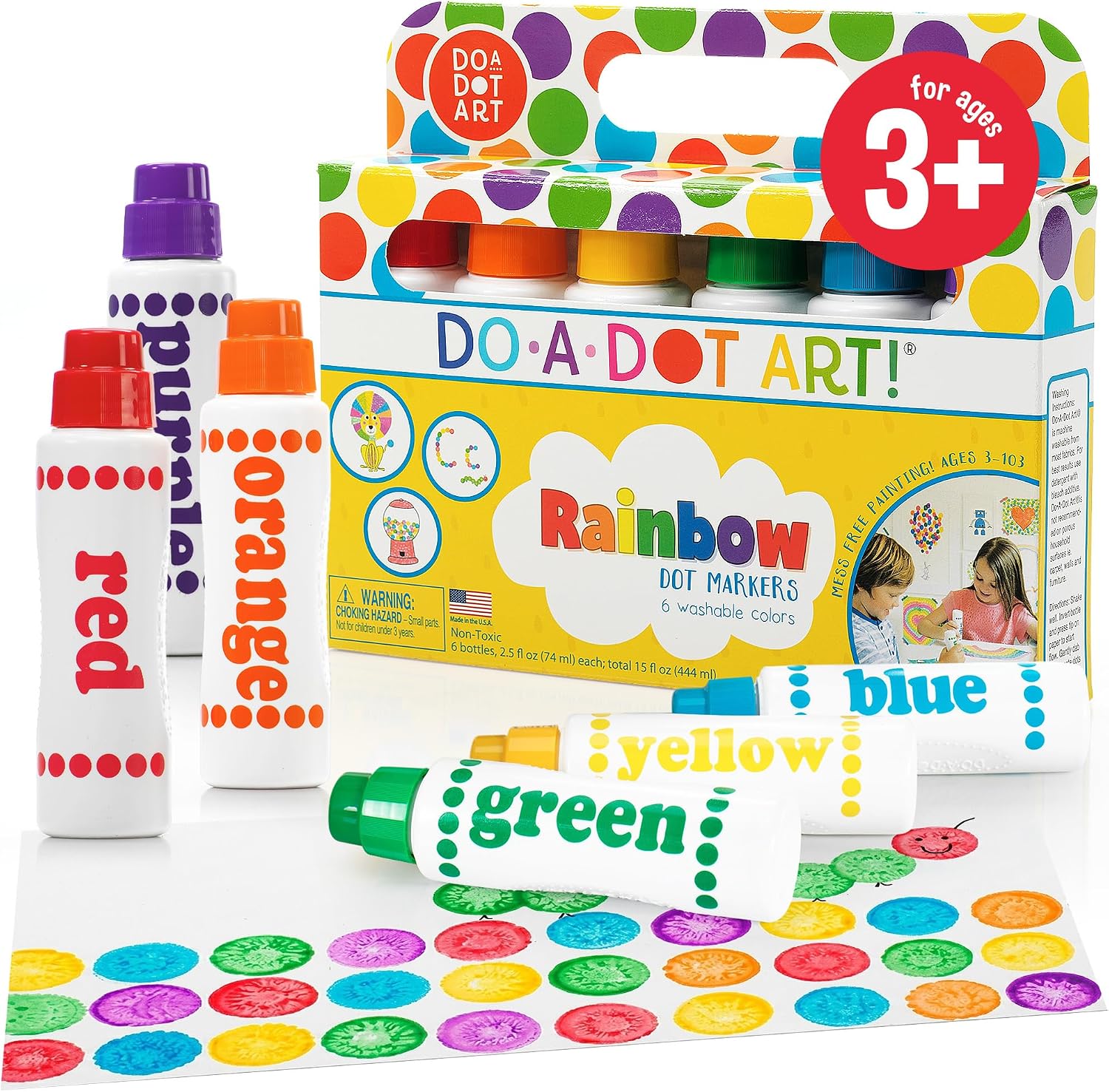
Our score: 9.6/10 iOur editorial score (1 to 10), based on listing specs, features and how well each pick fits its use case. It is not an Amazon customer rating.
6 colors Washable paint No spill bottles Made in the USA
Do A Dot Art! Markers 6-Pack is the gentlest pick for the youngest crowd. The listing says the bottles are washable, non toxic and made in the USA, and it describes the brand as created more than thirty years ago by a preschool teacher. Six classic colors keep choices simple, which suits small children who feel overwhelmed by giant sets. For parents of small children, that mix of simplicity and gentle claims is a big part of the appeal.
Instead of a pen tip, each bottle has a large sponge dauber that stamps round dots. The listing says there is no cup, no brush and no mess, and the bottles are no spill and no splash. Twist off the cap, press the dauber down and lift, and a neat dot appears. Kids can dab, layer and blend dots into flowers, rainbows and patterns. The dauber is wide, so even uncoordinated first attempts leave a recognizable round mark, which gives toddlers a quick feeling of success.
This set is aimed at toddlers, preschool classrooms and kindergarten crafts. The activity builds hand eye coordination, color recognition and early pattern skills, because children quickly discover that dots can be repeated, lined up and grouped. The easy grip bottles are sized for little hands, with a generous amount of paint listed in each one. Teachers can turn the bottles into counting games, pattern strips and letter tracing sheets, since a dot is easy to place along a printed line.
Some practical limits apply. Dot paint is wetter than a standard marker, so paper should be thick enough to avoid curling, and an old shirt is still smart. Always supervise very young children, and keep the bottles away from mouths. Wipe the daubers and snap caps tight after play to keep the paint flowing. Keeping a stack of scrap paper nearby lets children experiment freely, and washing hands right after play is a good habit to build early.
4. Mr. Sketch Scented Markers: Best Scented Set

Our score: 9.6/10 iOur editorial score (1 to 10), based on listing specs, features and how well each pick fits its use case. It is not an Amazon customer rating.
12 scented colors Chisel tip AP certified Large barrel
Mr. Sketch Scented Markers bring a playful twist to coloring: every color smells like something. The listing names twelve scents, including raspberry, watermelon, cherry, orange, banana, mint, apple, fruit punch, blueberry, grape, cinnamon and licorice. For children who enjoy sensory play, matching a scent to a color turns a simple page into a small guessing game and keeps them engaged longer. Few marker sets connect drawing with the sense of smell, and that makes this pack a memorable gift for sensory loving children.
Each marker has a chisel tip, which means a flat, angled end that makes bold strokes on its side and thinner lines on its edge. The listing also describes a large cylinder that is easy for kids to handle. Bold shades give pages a lively look, and the chunky body suits children who are still building a comfortable grip. The solid color range also gives plenty of choices for rainbows, sunsets and food themed drawings, which pair naturally with the fruity scents.
The listing states the markers are AP certified and safe for children over 3 years of age. That makes this set a sound choice for preschool graduates, early elementary students and anyone who likes themed projects. Kids can draw a fruit stand, a candy shop or a garden and use matching scents to reinforce vocabulary and imagination. Parents of cautious beginners may like that the certification wording is stated plainly in the listing, rather than buried in fine print.
Scented ink still deserves common sense. Remind children that markers are for paper, not for sniffing at length or tasting, since the smells can tempt younger kids. Keep caps on to protect both ink and aroma, and store the set away from heat. Good value comes from the twelve color assortment and sturdy barrels. A small clear pouch keeps the pens together, and rotating them in and out of use helps the scents last through the whole school year.
5. Mr. Sketch Scented Stix Markers: Best Fine Tip Scented

Our score: 9.4/10 iOur editorial score (1 to 10), based on listing specs, features and how well each pick fits its use case. It is not an Amazon customer rating.
10 scented colors Fine tip Slim barrel AP certified
Mr. Sketch Scented Stix Markers take the same scent idea as the larger set and slim it down. The listing describes a slim cylinder and a fine tip that are great for lines, which makes this pack a better fit for writing, doodling and coloring small shapes. It is a value pick for kids who want detail without giving up the fun smells. Compared with chunkier sets, it gives older children a way to keep the scent fun while still drawing with control.
The ten colors carry scents named watermelon, cherry, orange, banana, mint, fruit punch, blueberry, grape, cinnamon and licorice. Bold shades keep drawings bright, while the fine tip gives cleaner outlines than a wide chisel. Kids can trace a pencil sketch in one scent, then fill it with another, or label a map with a different smell for each place. The listing stresses bold shades, so even thin lines show up clearly on white paper, and that makes small lettering easy to read.
This set is aimed at children over 3 years of age, according to the AP certified wording in the listing. In practice, it fits early readers who are learning to write words, kids who like journaling, and school age artists who find fat markers too clumsy. The slim barrel suits a pencil style grip as children become more precise. Teachers may use the pack for labeling diagrams or color coding notes, since each scent and shade can stand for a different category.
Fine tips need gentler handling. Pressing hard can fray the point, so show children how a light touch gives smooth lines. Keep paper smooth, since rough surfaces wear tips quickly. Cap markers firmly after each session, and consider pairing this pack with a broad set so children can use fine lines for outlines and thick strokes for fills. Because there are fewer pens than in a giant set, a labeled pouch is usually all the storage the pack needs.
6. 12 Outline Markers Metallic Glitter Pens for Kids: Best for Tweens

Our score: 9.0/10 iOur editorial score (1 to 10), based on listing specs, features and how well each pick fits its use case. It is not an Amazon customer rating.
12 outline markers Metallic double line ASTM D-4236 and EN71-3 Multi surface
The 12 Outline Markers Metallic Glitter Pens set is the stylish pick for older children. The listing explains that each pen makes a double line effect: on light paper, a metallic silver center with a colored outline, on dark paper a silver line, and on smooth surfaces a solid color line. That three way trick makes ordinary lettering look like a finished design, and it is why tweens enjoy them. The effect is a little like magic to a child, which is why outline pens are so popular for cards and bubble lettering.
Each marker has a medium tip of about 2 to 3 mm with water based, acid free, odorless, quick drying ink. The listing says to shake well and press the tip until ink flows, then recap after use. It also states the ink conforms to ASTM D-4236 and EN71-3, two safety standards that are worth looking for on art supplies for young people. The named standards give parents useful context, though they should still read the packaging and keep the pens away from very young children.
Designed for kids, tweens and teens, the set is pitched at ages 6 to 12 and beyond. It suits card making, bubble lettering, scrapbooks, gift tags, posters and journal pages. Kids learn contrast, outlining and layout as they decide which paper color shows the metallic look best, which is a handy lesson in how background changes a design. Because the listing suggests holidays such as birthdays, Easter and Christmas, the pack works as both a gift and a seasonal craft supply.
A few habits protect the pens. Prime the tip on scrap paper before touching a final project, and always shake before use. The listing mentions wood, canvas, fabric, plastic, glass, rocks and ceramics, but surface results vary, so try a hidden spot first. Adults should supervise younger children, and caps should be pressed tight after every use. Practice a few letters on scrap paper first, because spacing and tip pressure change how the double line looks.
7. 24 Colors Dual Tip Acrylic Paint Markers: Best Craft Paint Markers

Our score: 9.2/10 iOur editorial score (1 to 10), based on listing specs, features and how well each pick fits its use case. It is not an Amazon customer rating.
24 colors Dual tip Cotton nibs Water based ink
The 24 Colors Dual Tip Acrylic Paint Markers kit is the pick for kids who have outgrown plain coloring and want to decorate objects. The listing describes acrylic pens that work on paper, cardstock, metal, rocks, wood, plastic, canvas, fabric and ceramics. For a child painting garden stones or decorating a wooden sign, one affordable kit replaces a stack of brushes and paint tubes. That mix of surfaces is the reason it earns a place in a budget guide, since it stretches into many hobbies at once.
Every marker has two ends: a 1 to 5 mm round nib for filling areas and a 1 mm fine nib for outlines and details. The listing highlights an upgraded cotton nib version, which can be used directly and dries faster than push type acrylic pens. The ink is described as opaque, water based, odorless and acid free, across 24 bright colors. Having two tip sizes in one pen also means children rarely need extra tools when moving from background color to crisp outlines.
Acrylic markers suit older kids, tweens and teens who can follow instructions, plan a design and be careful with permanent color. The listing mentions scrapbooks, bullet journals, planners, greeting cards and painted rock projects. Children practice layering, outlining and patience, because light colors usually go on first and dark details come last. Older siblings can share the kit with younger ones for supervised rock painting, which turns a rainy afternoon into a small gift making project.
Acrylic ink is not washable like a classroom marker, so cover the work area and dress children in old clothes. The listing advises tightening caps and storing pens horizontally. No age range is stated in the data, so adult supervision is wise, especially for younger kids. Ask for help choosing a surface, and sketch lightly in pencil before painting. Let each layer dry before adding the next, since wet acrylic can smear, and wipe nibs gently on scrap paper if color looks thin.
8. Acrylic Paint Markers: Best Large Art Kit

Our score: 9.2/10 iOur editorial score (1 to 10), based on listing specs, features and how well each pick fits its use case. It is not an Amazon customer rating.
72 colors Fine and brush tips Quick drying Canvas case
The Acrylic Paint Markers set with 72 colors is the biggest creative kit on this list, and it targets budding artists who want variety. The listing says every pen has a dual tip, with an extra fine point for detail and a brush tip for expressive strokes. Having seventy two shades in one case lowers the cost per color and takes away the need to blend paint by hand. It is a showpiece kit that turns an ordinary art shelf into something that feels like a real studio.
According to the listing, the set suits DIY crafts and paintings on paper, canvas and wood. The ink is described as quick drying and fade resistant, with precision tips that aim for consistent flow and fewer smudges. All markers arrive in a portable canvas case, which makes the kit easy to carry to a craft table, a class or a relative’s house. Those paired tips let a child jump from a delicate flower outline to a sweeping sky wash without ever changing pens.
This kit fits older children, tweens and teens who already enjoy drawing and want to move toward painted illustration, lettering and mixed media pages. A brush tip lets kids explore thick and thin strokes like a real brush, and the extra fine end supports outlines and tiny patterns. It teaches layering, color planning and how to build depth with light and dark shades. Because the listing mentions gifting, the case also helps a present feel complete, with everything neatly arranged and ready to open.
With seventy two pens, organization matters. Return markers to the case by color family, and keep caps firmly on so brush tips stay soft. Acrylic ink is permanent on many surfaces, so protect furniture and clothing, and keep the set away from very young children. A sketchbook with heavier paper holds up best under layered color. Practice strokes on scrap paper first, and let children plan a color palette before they start, so the large set feels exciting rather than confusing.
9. EXPO Dry Erase Markers: Best for Whiteboards

Our score: 9.4/10 iOur editorial score (1 to 10), based on listing specs, features and how well each pick fits its use case. It is not an Amazon customer rating.
12 count Low odor ink Chisel tip Erases with cloth
The EXPO Dry Erase Markers pack belongs on this list for families who use whiteboards for homework, chore charts and creative play. The listing describes the most vibrant ink yet from EXPO, which makes writing easier to read from a distance. Because the marks wipe away, kids can draw, erase and try again without wasting paper, a real budget advantage over time. Anyone who has watched a child draw, wipe and redraw on a board knows how much practice can happen from one pack.
Each marker has a versatile chisel tip that creates multiple line widths, from thin strokes to bold underlines. The ink is low odor and erases cleanly with an EXPO eraser or a dry cloth, according to the listing. It also says the writing pops on non porous surfaces such as glass and acrylic, and the color assortment may vary, so exact shades are not guaranteed. The listing even mentions the return of the popular yellow marker, a small detail that suggests color variety matters to many users.
These markers suit homework helpers, spelling practice, math games and rainy day drawing on a wall board. Older children can use them to plan a project, practice vocabulary, or draw comics that they wipe clean. They are not a replacement for a coloring set, since the ink is made for whiteboards and similar surfaces rather than paper pages. Parents can also use them for family boards, where children leave notes, drawings and reminders that can be refreshed every week.
Safety and care need attention. Dry erase markers are not designed for skin or fabric, so adults should supervise younger children and keep caps on. Always check the label for age guidance before handing them to small children. Store markers lying flat to keep the tips evenly moist, and erase soon after use for the cleanest results. A dry cloth within reach makes cleanup a habit, and replacing a worn marker is easier on the budget than replacing a ruined whiteboard.
10. Amazon Basics Dry Erase Whiteboard Markers: Best Budget Whiteboard Pack

Our score: 9.0/10 iOur editorial score (1 to 10), based on listing specs, features and how well each pick fits its use case. It is not an Amazon customer rating.
12 pack Chisel tip Low odor Lightweight barrel
The Amazon Basics Dry Erase Whiteboard Markers 12-Pack rounds out the list as a plain, practical value option. The listing describes dry erase ink in assorted colors that writes smoothly and erases cleanly from whiteboards. For families that go through markers quickly, a dozen pens at a modest cost covers homework boards, family calendars and drawing games without needing a premium brand. That plain approach keeps the cost sensible, and it suits households that need many pens for many boards.
The chisel tip design allows both thick and thin strokes, useful for writing, drawing and underlining. A low odor formula is noted as pleasant in enclosed spaces such as classrooms and offices. The plastic barrel is listed at 0.78 inches on each side and about 0.02 kilograms, which suggests a compact, lightweight pen that is comfortable for most hands. Because the listing lists exact dimensions and weight, parents can tell the pens are slim enough for young hands without being flimsy.
The listing is written with adults, offices and meeting rooms in mind, so this pack is best thought of as a household whiteboard supply rather than a toy marker. Kids from the early school years upward can use it for spelling, math practice, chore charts and scoreboard keeping, with a grown up setting the rules about where the pens may be used. Homeschool families can use the pack for daily lessons, while classrooms can keep a few at every table for quick problem solving.
As with any dry erase product, keep it away from skin, clothing and furniture, and supervise closely. The ink is intended for whiteboard surfaces, so avoid walls and fabrics. Replace caps promptly and store markers flat. If your child wants a vivid drawing tool on glass or smooth boards, the EXPO pack above may offer a brighter look. Keep a labeled box for these markers, so they do not wander into the art supplies where the ink is not intended to go.
How to Choose the Best Affordable Markers For Kids
What affordable really means for markers
Affordable does not simply mean the lowest price on the shelf. A marker set is good value when kids can use it for months, when colors stay bright, and when the cost per color stays reasonable. A large pack that dries out in a week is no bargain, while a modest set that lasts a school term often is. Checking pack contents against what you will really use is the quickest way to spot true value.
Think about how many children will share the supplies and how often they will draw. A single child who colors on weekends needs a different pack than a classroom or a busy family. Matching quantity to use keeps spending sensible and prevents drawers full of unused pens that dry up before anyone reaches them. A short list of needs before shopping makes the final choice far easier and keeps the total spend comfortably under control.
Washable ink versus permanent ink
Washable markers are formulated to come off skin and many kinds of children’s clothing with soap and water. That makes them the default choice for young artists, since accidents are part of coloring. Always read the label, because washable claims depend on the fabric and the product, and some surfaces such as raw wood or porous materials may still stain.
Permanent inks, including acrylic paint markers and many craft pens, are made to stay on paper, stone, wood and other materials. They suit older children who understand that a mistake cannot be rubbed out. For mixed ages in one home, keep permanent pens in a separate box that younger children cannot reach. A quick glance at the packaging before art time can save a laundry load, and it only takes a few seconds.
Tip shapes and what they do
Broad tips cover large areas quickly and leave bold strokes, which pleases beginners and speeds up big coloring pages. Fine tips support writing, outlines and small shapes. Chisel tips offer both, since the flat side gives a wide line and the edge gives a narrow one. Brush tips imitate a paint brush and respond to pressure. Letting children try each shape on scrap paper builds understanding faster than any explanation.
A smart family set often mixes two shapes: one broad pack for fills and one fine or dual tip pack for detail. Children learn faster when they can choose the right tool for each part of a drawing. Younger kids usually do best with thick barrels and broad tips that are forgiving of shaky hands. Trying each tip on scrap paper first lets children discover how pressure and angle change the line before they begin a final piece.
Age and skill fit
Toddlers and preschoolers need large, simple tools and tight supervision. Dot paint bottles and chunky washable markers work well because they ask for easy movements and give quick, satisfying results. Children over 3 can use scented sets that state an appropriate age, though adults should still watch for mouthing and make sure caps stay on. Skill matters as much as birthday count, so watch how a child handles tools before upgrading.
Elementary students can handle finer tips, bigger color sets and basic shading ideas. Tweens and teens often want metallic, lettering and paint style markers for journals, cards and decorations. Because the listings for acrylic sets do not state an age range, adults should judge the child’s care and maturity before handing them over. Reading the age line on every package and watching small children closely are simple habits that prevent most problems.
Materials and safety labels
Look for clear safety wording on packaging. In the United States, ASTM D4236 relates to labeling of art materials for chronic health hazards, and the AP seal from the Art and Creative Materials Institute indicates a product certified as non toxic for its intended use. In Europe, EN71 covers toy safety, and its part 3 addresses migration of certain elements.
Safety labels are helpful but they do not replace supervision. A marker can be non toxic and still be unsuitable for a baby who puts everything in her mouth. Small caps are a choking concern for young children, so check packaging age guidance and keep caps out of reach of children who still mouth objects. When in doubt, choose the product whose listing mentions a standard you recognize, and keep the packaging so you can refer to it later.
Paper, surfaces and what to draw on
Marker ink behaves differently on different surfaces. Thin copy paper can wrinkle or bleed through under wet paint or heavy broad tips, while heavier drawing paper and cardstock hold color better. Place scrap paper or a mat under every project to protect tables, and consider a sketchbook with sturdy pages for children who love saturated color. A cheap pad of heavy paper often improves results more than a new set of pens.
Specialty markers are designed for specific surfaces. Dry erase pens belong on whiteboards, glass and similar non porous boards. Acrylic markers work on rocks, wood, canvas and ceramics. Washable markers are made for paper. Using each type as intended prevents ghosting, stains and frustration, and it protects your furniture and walls. A cheerful, dedicated art tray, set apart from the dining table, makes cleanup quicker and teaches kids that art has its own space.
Storage, caps and keeping markers fresh
Most marker failures come from drying out. Always press caps on until they click, and teach children to cap each pen before picking another. Store markers flat or tip down as directed on the packaging, which helps ink reach the tip. Keep them away from sunny windows, radiators and hot cars, since heat shortens their life. A two minute tidy after each session protects the whole collection and keeps colors ready for next time.
Large sets benefit from containers that make cleanup easy. A tray with slots, a zip pouch, or a labeled bin lets kids see what they have and put it back. For acrylic paint pens in a case, return them horizontally. A little organization saves money, because markers that stay capped and sorted last far longer. Dated labels on a few favorite pens can help families rotate supplies, so nothing sits unused until the ink finally dries up for good.
Making a small budget go further
Buy one strong core set first, then add specialty pens only when a child shows interest. A washable broad line pack handles most coloring, and a fine tip or dual tip set can follow later. This approach spreads costs over time and avoids buying a big craft kit that sits unused after the first weekend. Patience pays here, because a considered purchase beats three rushed ones every time.
Share supplies sensibly. Large packs work well for siblings and classrooms, while single child sets stay neater. Refill your stock before holidays or school terms, and use up older markers on practice pages first. Rotating supplies keeps interest high and stops tips from drying out in a forgotten drawer. Planning purchases around birthdays or school terms helps families avoid impulse buys and keeps the collection balanced and useful.
Care and longevity
Markers last longest when children use light pressure. Pressing hard squashes fine and brush tips, and it makes ink run out sooner. Show kids how to let the marker do the work, and gently wipe tips on scrap paper if ink looks faint. Replace any marker that leaks or has a bent, frayed point. Small habits repeated daily add months to the life of every pen in the box.
Clean surfaces soon after play. Washable ink comes off easiest when it is fresh, and dry erase ink wipes cleanly when it is not left for days. Wash hands after art time, particularly before eating. Teach children that supplies are tools worth caring for, which builds habits that carry into school and later hobbies. Encouraging children to name their own tools and put them away builds pride, and well loved markers truly do last longer.
A simple learning path for young artists
Start with big shapes and bold colors. Younger children enjoy dots, scribbles and filling in outlines, which builds hand strength and color awareness. Move to coloring books and simple drawings once they can hold a marker steadily. Introduce a second color for outlines, then talk about warm and cool shades as skills grow. There is no hurry to move up, since mastery of one tool makes the next one easier.
Elementary children can try shading, patterns and lettering with broad and fine tips together. Tweens may explore metallic outlines, paint pens and mixed media pages. Each step uses a new tool that matches a new skill, so spending grows only as interest does, and children always feel challenged without being overwhelmed. Praise effort rather than perfect results, because children who feel safe experimenting tend to stay with art for many years.
Common mistakes to avoid
One common mistake is buying the largest set before knowing what a child enjoys. Another is choosing permanent paint markers for a very young artist, then discovering how hard stains are to remove. A third is leaving caps off. Check labels, start with washable options and match each product to its stated purpose. Most of these errors are easy to fix once a parent knows to look for them.
Parents also sometimes overlook paper quality. Even the best markers look dull on thin, absorbent sheets. Add a thicker pad, and cover work surfaces. Finally, do not forget supervision. Scents, shiny colors and small caps attract curious toddlers, so keep younger children’s art time in sight and out of reach of unsupervised play. Talking through each project before starting is a calm way to avoid wasted supplies and keep a creative session relaxed and enjoyable.
Gift tips
A marker set makes a handy gift when paired with something to draw on. A sketchbook, coloring book, journal or blank cards give the child a place to start. For preschoolers, a washable pack with a big pad of paper is a friendly choice, while older kids may enjoy a metallic or paint marker set with a notebook. Pairing a modest set with a thoughtful extra often feels more generous than a larger box alone.
Match the gift to the child’s interests. Fans of cooking or sweets may like scented markers, and kids who decorate rocks or cards may love acrylic pens. Always check age guidance on the live listing, confirm the current pack size and ask a parent if you are unsure about paint style products at home. A small handwritten note about what the child might enjoy drawing first turns a plain box of markers into a thoughtful, personal present.
Frequently Asked Questions
What are the best affordable markers for kids overall?
A washable broad line pack such as Crayola Ultra Clean 40ct is a strong all round pick. It has plenty of colors, an easy to hold design and ink that washes from skin and most kids clothing, which keeps cleanup simple.
Are washable markers safe for toddlers?
Washable markers reduce stain worries, but they do not remove the need for supervision. Toddlers may chew caps or taste ink, so always sit nearby, check the age guidance on the packaging and keep small caps out of reach.
What does AP certified mean on a marker?
The AP seal comes from the Art and Creative Materials Institute and indicates the product was evaluated as non toxic for its intended use. The Mr. Sketch listings mention it, along with a note that the markers are safe for children over 3.
Do scented markers last as long as regular ones?
Scented markers use ink like other washable markers, so longevity depends mostly on cap habits and pressure. Keep caps closed, store them away from heat and avoid pressing hard, and a scented set can last as long as an ordinary one.
Can kids use dry erase markers on paper?
Dry erase markers are made for whiteboards, glass and other non porous surfaces, not for paper coloring. They also are not meant for skin or fabric, so supervise children and use them only as the label directs.
Are acrylic paint markers suitable for young children?
Acrylic markers are permanent on many surfaces, and the listings in this guide state no age range. They are better for older kids and tweens who can work carefully, ideally with a protected table and an adult nearby.
What is the difference between ASTM D4236 and EN71?
ASTM D4236 is a United States standard about labeling art materials for health hazards. EN71 is a European toy safety standard, with part 3 covering migration of certain elements. Seeing either named on a listing is a helpful, though not complete, signal.
How do I stop markers from drying out?
Press caps on until they click, store markers flat or as the packaging advises, and keep them away from heat and sunlight. Teach children to cap each pen before picking up another, and discard any that are leaky or very dry.
Which set is best for a classroom or large family?
The Crayola Super Tips 100ct is the natural choice for groups. Its large color range, thick and thin line ability and washable formula help many children share supplies, though a good storage bin is smart for keeping caps and pens together.
How do I choose between a scented set and a plain set?
Choose scented markers if your child loves sensory play and themed art, and plain washable markers if you want the widest color range. Many families own one of each, using scented pens for fun projects and plain ones for school work.
The Bottom Line
The best affordable markers for kids are the ones that fit the child, the project and the household. For most families, the Crayola Ultra Clean Washable Markers 40ct is the safest starting point, thanks to its broad tips, color choice and easy cleanup. Groups can step up to the Super Tips 100ct, and preschoolers will enjoy Do A Dot Art! dabbers.
Older children can then branch into scented fine tips, metallic outliners or acrylic paint markers as their skills grow. Check each live listing for current pack sizes, age guidance and availability, and supervise little artists whenever small caps or paint are involved.
Updated for the 2027 buying season. Amazon listings and availability change often, so check the product page for current details.


Write Your Review
No reviews yet. Be the first to share your experience!