

As an Amazon Associate we earn from qualifying purchases. If you buy through links on this page we may receive a commission at no extra cost to you. Product details come from Amazon listings and can change.
Paper folding is one of the few crafts that needs no glue, no scissors and no screen, which is why the best affordable origami kits keep showing up in birthday bags, classroom bins and car trip backpacks. This guide looks at ten budget friendly options, from a boxed set with a couple of hundred sheets to a thousand sheet bundle, a puzzle game and two classic Dover books.
It is written for parents, grandparents, teachers and gift buyers who want to know what actually comes in the box before they click. Younger kids tend to do best with bright, forgiving paper and a short list of easy models. Tweens and teens often want more projects, finer diagrams or a challenge that feels like a game. Each pick below is matched to those needs, with honest notes about where it may fall short.
Prices change often, so this page does not quote any. Instead, every product links to its live listing so you can check the current cost, pack size and delivery before you decide. Value here means how much folding you get, how clear the instructions are and how well the set fits the child, not just the lowest number on a tag.
Key Takeaways
Best Affordable Origami Kits at a Glance
| Product | Our score | |
|---|---|---|
| Origami Paper Kit 200 Sheets 6×6 Inch Colored Craft Best Overall |
9.2 / 10 | Check Price |
| Origami Paper Best for Pattern Lovers |
9.4 / 10 | Check Price |
| GAMENOTE Origami Kit for Kids Ages 8-12 Best for Ages 8 to 12 |
8.8 / 10 | Check Price |
| BUBU Origami Paper Kit 1000 Sheets 6×6 Colored Paper Best Bulk Value |
9.4 / 10 | Check Price |
| hapray Origami Kit for Kids 5-12 Best Detailed Instruction Book |
9.0 / 10 | Check Price |
| Amazing Origami Kit: Traditional Japanese Folding Papers and Projects Best Traditional Papers |
9.2 / 10 | Check Price |
| My First Origami Kit: [Origami Kit with Book Best First Kit with Stickers |
9.0 / 10 | Check Price |
| Easy Origami Best Easy Book |
9.2 / 10 | Check Price |
| FOLDOLOGY Best Brain Teaser |
9.2 / 10 | Check Price |
| The Complete Book of Origami: Step-by-Step Instructions in Over Best for Teens and Advanced Learners |
9.2 / 10 | Check Price |
How We Chose the Best Affordable Origami Kits
This is a research based guide, not a lab comparison. We read each product title and listing description, noted the stated sheet counts, paper sizes, book contents and age ranges, and compared them against what a typical child needs at the start of the craft. Where a listing gave few details, as with the book titles, the writing leans only on the title and general knowledge about the publisher and format, and avoids guessing at page counts or sheet counts.
We also looked for a balance of options: complete boxed kits, a bulk paper bundle, two traditional books, a stickers kit for little hands and a puzzle game for older kids. Safety points such as non toxic inks were noted only when a listing mentioned them. Each pick has an editorial score out of 10 based on features, specs and how well it fits its intended use, and that score is shown separately on the page.
In-Depth Reviews
1. Origami Paper Kit 200 Sheets 6×6 Inch Colored Craft: Best Overall

Our score: 9.2/10 iOur editorial score (1 to 10), based on listing specs, features and how well each pick fits its use case. It is not an Amazon customer rating.
200 sheets 6 inch squares 20 model tutorials Hard storage box
The Origami Paper Kit with 200 sheets earns the top spot because it bundles nearly everything a beginner needs into one tidy box. The listing describes 200 double sided sheets in a 6 inch size, an illustrated guide book with 20 model tutorials and online video guidance. For a family that wants to open the lid and start folding on the same afternoon, that mix is hard to beat at a budget friendly level. That ready to go design is the main reason it leads the list.
The paper is described as thick pulp stock with consistent solid colors on both sides, in 20 rainbow shades. That matters in practice, because a double sided sheet lets a child fold a bird with one color showing and then switch to a different color for the next model without hunting for a pattern. The book covers animals, birds, butterflies and flowers, and the video help can rescue a stubborn fold when a diagram is unclear. The twenty shades also make it easy to sort models by color when a shelf display is the goal.
This kit suits kids who are new to the craft and adults who want a calm hobby to share with them. The listing mentions fine motor practice, hand eye coordination and focus as benefits, which fits how paper folding works: small, repeated, precise movements. Twenty projects is a manageable number for a first month, and the 6 inch size is large enough for small fingers to pinch a crease cleanly. Many adults enjoy folding alongside the child, and the book keeps both skill levels busy.
As a practical tip, start with the simplest models in the book and fold slowly on a flat table. The hard box is handy for storage and travel, but loose offcuts and finished models will still need their own container. Because videos are online, an adult may need to open them on a phone or tablet. Young children should be supervised only lightly, since there are no sharp tools involved. Budget minded buyers will appreciate that no extra craft supplies are mentioned as necessary.
2. Origami Paper: Best for Pattern Lovers
Our score: 9.4/10 iOur editorial score (1 to 10), based on listing specs, features and how well each pick fits its use case. It is not an Amazon customer rating.
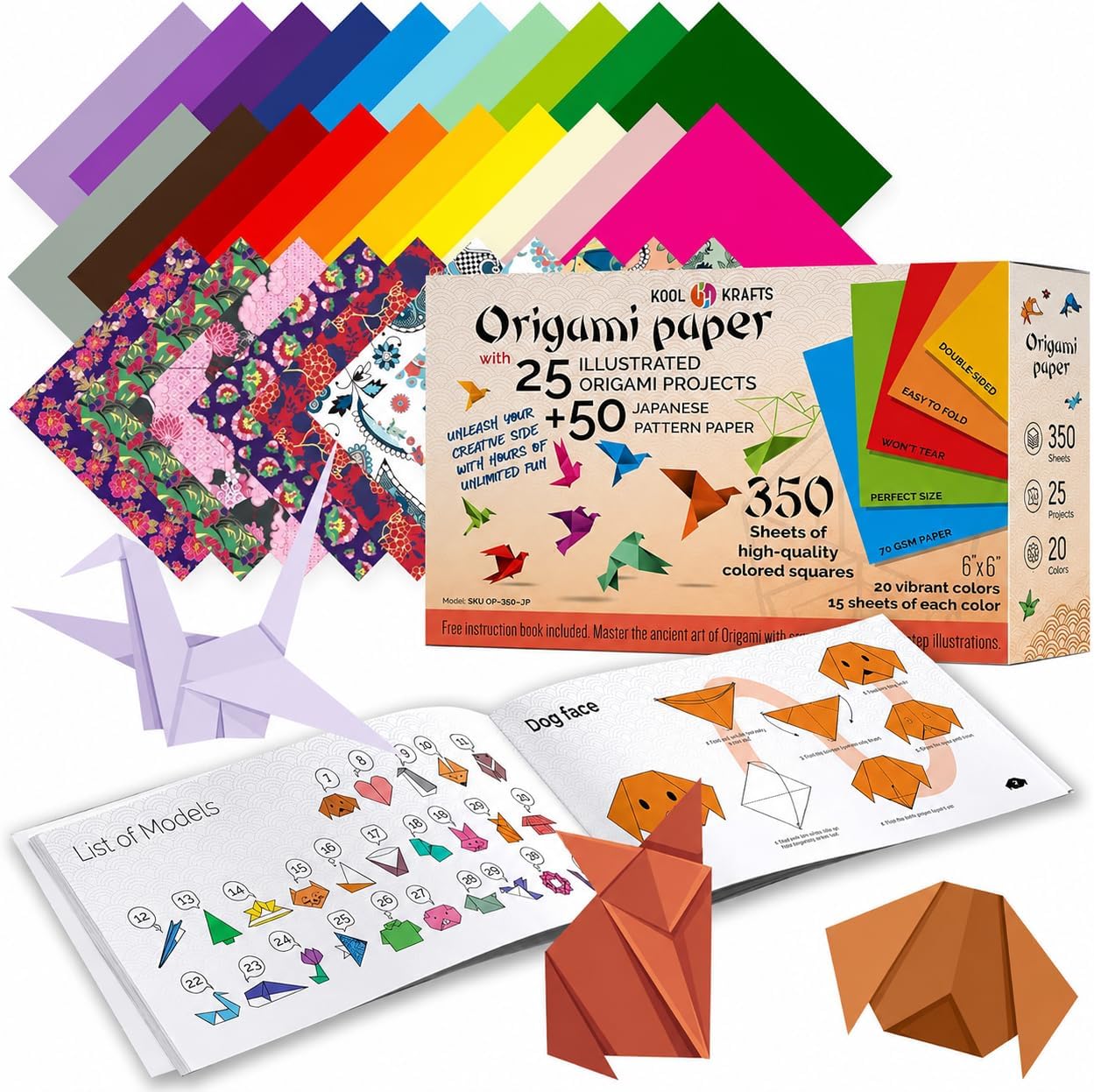
300 solid sheets 50 pattern sheets 25 project book 20 colors
The Origami Paper 350 Kit stands out for variety. According to the listing, the set holds 300 square sheets in 20 colors, with 15 sheets of each color, plus 50 sheets printed with traditional Japanese patterns. Add a book with 25 colored projects and the total comes to a generous amount of folding material for a budget friendly kit, especially for children who like to choose their own look. Few kits at this level mix plain and decorative paper so generously.
Having both solid colors and patterned sheets changes how the craft feels. Solid sheets are ideal for learning, because the folds are easy to see and the shape comes first. Patterned sheets work well once a child is more confident, since a finished crane or fox looks like a small piece of decor. The listing also says the paper is thick enough to give crisp folds, which helps models hold their shape. Keeping the patterned sheets for finished display pieces is a smart way to stretch them.
The kit is pitched at kids ages 8 to 12, and it also suits teens who want something to do with their hands. The step by step illustrations in the book are meant to guide a child through each design, and fifteen sheets per color means a project can be repeated several times to improve it. Repetition is how most folders get better, so this ratio makes sense. Siblings can each claim a few colors and fold side by side without arguments.
One caveat is that a 350 sheet set can feel like a lot of paper, so it helps to sort the sheets by color or pattern at the start. The listing does not give a long project count beyond the 25 in the book, so older kids may want a second book later. It also works as a parent and child activity, with no screens needed. Gift givers will like that a single set serves both beginners and kids with some practice.
3. GAMENOTE Origami Kit for Kids Ages 8-12: Best for Ages 8 to 12

Our score: 8.8/10 iOur editorial score (1 to 10), based on listing specs, features and how well each pick fits its use case. It is not an Amazon customer rating.
54 projects 120 sheets 14 x 14 cm 55 page manual
GAMENOTE has built its origami kit around a simple promise: lots of projects for a school age child. The listing states 54 projects, 120 sheets in total and a 55 page teaching manual. The sheets measure 14 by 14 centimeters, a little smaller than the common 6 inch size, and that makes them comfortable to handle for a child with smaller hands while still being big enough for flowers, insects and rockets. That breadth keeps a collection of models from feeling repetitive.
Inside the pack are 108 double sided folding sheets plus 10 solid colored sheets meant for practicing basic skills. The practice papers are a smart touch, because first folds are rarely pretty, and a child can learn a valley fold or a reverse fold without wasting a favorite pattern. The listing says the paper resists tearing and curling at the edges and carries no strange smell. A child can practice a fold on a plain sheet first, then repeat it on a printed one.
The project list ranges across flowers, plants, animals, insects, rockets and spaceships, so a curious kid with different interests can find something to love. The manual is described as interactive and detailed, and the listing notes that it suits children over 4, although the title aims at ages 8 to 12. Younger kids will likely need an adult beside them for the trickier diagrams. A sibling or parent can borrow the manual and fold along as a shared project.
As a practical note, the sheet count is lower than the bulk kits, so a child who folds every day may use it up quickly. The brand also says there is a box included for unused sheets, which keeps things tidy. There is no glue and no mess involved, which makes it a good candidate for a quiet rainy day or a long family trip. It is a sensible midsize option for families who do not want to store a giant bundle.
4. BUBU Origami Paper Kit 1000 Sheets 6×6 Colored Paper: Best Bulk Value

Our score: 9.4/10 iOur editorial score (1 to 10), based on listing specs, features and how well each pick fits its use case. It is not an Amazon customer rating.
1000 sheets 6 inch squares Illustrated guide Ages 4 to adult
The BUBU Origami Paper Kit is the pick for families who fold a lot. The title promises 1000 sheets in a 6 inch size along with an origami book, which makes it the largest paper stock on this list. For classrooms, scout groups, birthday party tables and siblings who share, a big bundle spreads the cost of each sheet thin and takes away the worry of running out halfway through a model. That scale makes it the most generous paper supply in this guide.
The listing describes thick wood free craft paper with double sided patterns and solid colors, and says the sheets can hold clean folds without tearing. The included guide uses visual diagrams in place of long text and covers dozens of classic projects, from simple animals to flowers and planes. All the paper comes sorted inside the package, which helps with quick access, though the listing does not break down colors or patterns. Party hosts can hand out a few sheets to each guest and still have plenty left over.
This kit is described as suitable for children from age 4 up to adult hobbyists, with parents encouraged to follow along. That broad range makes it a good shared purchase for a family with kids of different ages. A homeschool group could use the sheets for geometry lessons too, since a square folded in half is a handy way to talk about halves, quarters and symmetry. Such a wide range also means the kit can be passed from an older child to a younger one.
A few things deserve attention. With so much paper, storage is the first challenge, so a spare box or zip bag will help. The listing mentions reusable sheets that can be unfolded and folded again, but a heavily creased sheet will not give crisp new models. Kids at the younger end of the range will need an adult to read the diagrams with them. If storage is limited, divide the stack into several smaller boxes by color.
5. hapray Origami Kit for Kids 5-12: Best Detailed Instruction Book
Our score: 9.0/10 iOur editorial score (1 to 10), based on listing specs, features and how well each pick fits its use case. It is not an Amazon customer rating.
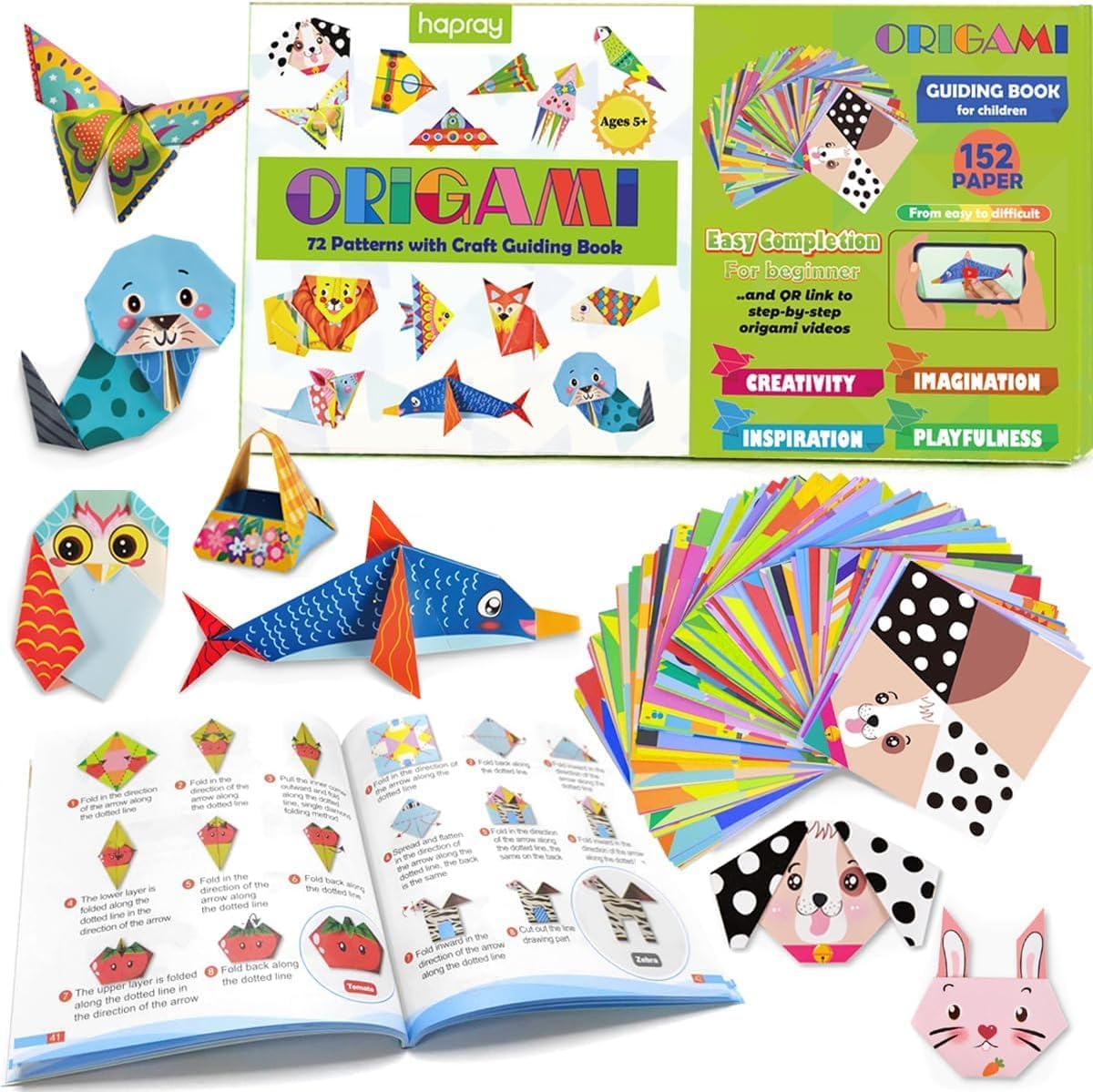
152 sheets 72 patterns 96 page book 14 x 14 cm
The hapray Origami Kit for Kids is the choice when the instruction book matters as much as the paper. The listing says the set holds 152 sheets: 8 practice sheets and 144 double sided papers with 72 unique patterns, two sheets of each design. It also includes a 96 page instruction book with 10 pages devoted to basic folding techniques, a real asset for a child who has never folded anything before. That structure is rare in a set at this level and helps a lot with early progress.
Each sheet measures 14 by 14 centimeters, which the listing calls a perfect size for various creative projects. Two sheets per pattern allows a child to make a matching pair, such as two butterflies, or to fold a model once as practice and once more as the final copy. The paper is described as smooth and durable enough to hold creases well, which helps with the early stage of learning. The matching pairs also make good decorations, such as garlands or a mobile.
With ages 5 to 12 in the title, the kit has room to grow with a child. A five year old can start with the basic techniques pages and simple shapes, while an older child can work toward the more complex designs the book promises. Because the manual runs for 96 pages, it may keep a motivated learner busy for months, and it supports fine motor development along the way. Children who enjoy reading and following instructions will get the most out of this one.
The caveat is the same one that faces every kit with fewer sheets: a keen folder may run through the paper sooner than the book. The listing does not state the number of projects, so we cannot say how many models are in those 96 pages. Younger children will want an adult close by to help read the diagrams and to keep small paper scraps out of mouths. A shorter book would be fine for some kids, but a big manual gives long term value.
6. Amazing Origami Kit: Traditional Japanese Folding Papers and Projects: Best Traditional Papers

Our score: 9.2/10 iOur editorial score (1 to 10), based on listing specs, features and how well each pick fits its use case. It is not an Amazon customer rating.
144 papers 17 projects Japanese papers Book included
The Amazing Origami Kit is a good option for families who like the traditional look of the craft. The title says it holds 144 origami papers, a book and 17 projects, and it describes the sheets as traditional Japanese folding papers. This is a compact, well known style of kit, and it appeals to anyone who wants a more classic feel than a rainbow pack of plain colors. That makes it a calm, focused alternative to bright rainbow packs.
The title gives the main contents, but the listing offered few other details, so this section sticks to what is clear: a set of papers, a book with 17 projects and a Japanese design theme. Seventeen projects is a modest number, which can be a plus for a child who is easily overwhelmed by a thick manual. Each model has room for repeat attempts, since 144 sheets are plenty for 17 designs. A child can fold a project several times to see how paper choice changes the result.
This kit suits older kids, teens and adults who want a gentle introduction to the art with an eye on beauty. It also makes a thoughtful gift for a child who is curious about Japan, because patterned papers invite conversations about culture and craft. Parents who want to model calm, focused play will find that a small, elegant set invites more patience than a giant bundle. It also fits well on a desk, where a few finished models can sit as quiet decor.
Since sheet size, paper weight and age range are not given in the listing, buyers should check the live page before ordering. A bigger shelf of projects may come later, as 17 designs will not last a very enthusiastic folder forever. Pair this kit with a general book, such as one of the Dover titles on this list, if you want to extend the learning path. For a reliable second source of ideas, a general project book makes a handy companion.
7. My First Origami Kit: [Origami Kit with Book: Best First Kit with Stickers

Our score: 9.0/10 iOur editorial score (1 to 10), based on listing specs, features and how well each pick fits its use case. It is not an Amazon customer rating.
60 papers 150 stickers 20 projects Book included
My First Origami Kit is built for children taking their very first steps into paper folding. According to the title, it includes a book, 60 papers, 150 stickers and 20 projects. The stickers are what set it apart, because they let a child decorate a finished animal or character with eyes, faces and details, turning a folded shape into something that feels personal and finished. That playful finishing step makes the kit feel like a toy as much as a craft.
A set of 60 papers and 20 projects works out to a few attempts per model, a healthy ratio for beginners who need several tries. The title names the contents, but the listing offered no further facts, so we will not guess at paper size or pattern style. Buyers should check the live page for those details, as well as the age range, before they buy. Facial details change a simple shape into a character, which is often the best part for young kids.
The kit suits younger children who enjoy decorating as much as folding, and it is a natural gift for a child who is not yet sure about a craft that seems complicated. Stickers give quick rewards, which can keep a young beginner motivated when a fold does not go well. Parents can use the finished models for pretend play, shelf decor or simple story telling games. It also makes a friendly choice for a classroom reward or a party favor.
A practical point is that stickers are small and best kept away from very young children who still put things in their mouths. Adults should supervise any preschool age use. Since paper and sticker counts are modest, this kit is a trial run for the hobby rather than a long term supply, and a second paper pack may be useful after the first twenty projects are finished. Even so, adults should stay close, since folding steps can still be a challenge at this age.
8. Easy Origami: Best Easy Book

Our score: 9.2/10 iOur editorial score (1 to 10), based on listing specs, features and how well each pick fits its use case. It is not an Amazon customer rating.
Dover book 30+ simple projects Easy level Paperback style
Easy Origami from the Dover Origami Papercraft line is a book first choice. The title promises over 30 simple projects, and that makes it one of the best project counts per cost on the list. Dover is well known for affordable craft books, and this one is aimed at people who want to learn the basics without a pile of loose paper or extra packaging to manage. That straightforward focus is a strength for first time folders.
The listing had no feature bullets, so this guide relies on the title and the publisher reputation. Expect a collection of simple models with diagrams, since the word easy is part of the name. Dover origami books often include paper in the back or a note about what size paper to use, but buyers should check the live listing to confirm whether sheets come with this edition. Having a book on hand also means a child can revisit a favorite model whenever they like.
This book suits kids who already own some square paper, such as from a bulk bundle, and adults who want a reliable teacher on the shelf. It pairs well with the BUBU kit or the 350 sheet kit, since a big paper stock and a big project book make a strong team. Parents can also read ahead and help a child who gets stuck on a diagram. A grandparent who remembers folding as a child may enjoy teaching from it.
The trade off is that a book alone does not feel as much like a gift as a boxed kit does, and a child may need help with reading the diagrams at the younger end. Without a known age range in the listing, a good guideline is to choose it for kids who are reading comfortably and enjoy following written and drawn steps. It remains one of the lightest items to slip into a bag for a trip.
9. FOLDOLOGY: Best Brain Teaser

Our score: 9.2/10 iOur editorial score (1 to 10), based on listing specs, features and how well each pick fits its use case. It is not an Amazon customer rating.
100 puzzles 5 difficulty levels 6 x 6 inches Ages 10+
FOLDOLOGY takes a different path from a regular craft kit. It is an origami puzzle game with 100 puzzles, five difficulty levels and what the listing calls 50 plus hours of play. Instead of folding a crane from a diagram, a player works out how to fold a sheet to match a target design. That turns the craft into a thinking challenge, which is why it makes the list as a budget friendly choice for older kids. That change of pace is a real advantage for kids who already know the basics.
The product is compact at 6 by 6 inches, and the listing notes that it needs no surface to fold on, so it is easy to use on a commute or a trip. It is described as a single player game with high quality printing, and it promises to build visual spatial ability, critical thinking and logical reasoning. Those are skills that also help in geometry and design classes. Solving a puzzle also gives a clear sense of progress that a craft project may not.
The age label is 10 and up, with no previous origami or puzzle experience required. That makes it a fine pick for tweens and teens who find standard kits too simple, and for adults who want to join in. The puzzles increase in difficulty, so an eager player can progress from easy ones to complex folds, while a casual player can stay on the early levels. Parents might enjoy trying a few levels with their child and comparing solutions.
A caveat is that this is not a paper pack for making animals, so it will not satisfy a child who wants a shelf full of models. Younger children may find the puzzles frustrating without support. It works best as a second purchase after a basic kit, or as a gift for someone who already enjoys logic puzzles, escape games or building sets. Its small size means it can sit in a coat pocket or school bag until needed.
10. The Complete Book of Origami: Step-by-Step Instructions in Over: Best for Teens and Advanced Learners

Our score: 9.2/10 iOur editorial score (1 to 10), based on listing specs, features and how well each pick fits its use case. It is not an Amazon customer rating.
Dover book 1000+ diagrams 37 original models Step by step
The Complete Book of Origami is the deepest resource on this list. The title says it has step by step instructions in over 1000 diagrams, covering 37 original models, and it comes from the Dover Crafts: Origami and Papercrafts line. For a teen who has outgrown simple kits, a long reference book offers a path toward more complex models and a clear way to keep learning for years. Few resources at this price level offer such a large library of fold sequences.
As with the other books, the listing gave no feature bullets, so this guide sticks to the title. Over 1000 diagrams suggests a heavy focus on clear visual steps, which is how origami is usually taught in print. Thirty seven original models implies a wide range of shapes, and a serious folder can use the book to practice standard bases and then move on to harder designs. It becomes a long term reference that a growing folder can return to again and again.
This title suits older kids, teens and adults who are comfortable following dense diagrams and who have the patience to repeat a hard fold several times. It is less suited to a young child who wants fast results. Because it does not include a stock of colorful paper in the title, buyers should plan to pair it with a bulk paper kit. A student with a steady hand and a taste for challenge will find it rewarding.
A useful tip is to read the opening pages about symbols and basic folds before starting a model, since the diagram language is the key to every project afterward. Patience is part of the craft, and a complex model may take several attempts. Parents of younger kids can place this book on the family shelf as a goal for later, once simpler books have been mastered. It is also an ideal gift for a teen who has asked for something more demanding.
How to Choose the Best Affordable Origami Kits
What affordable really means for origami
Origami is already a low cost craft, because the main material is paper. So when a guide talks about affordable kits, the useful question is how much folding a family gets for the money. A set with a few hundred sheets, a clear book and a storage box usually gives more play hours than a small pack with only a few sheets. Even a small difference in sheet count can change how long a kit lasts, so compare the numbers on each page.
Value also depends on how likely a child is to finish what is in the box. A thousand sheets mean nothing if the instructions are confusing and the child gives up after one frog. Look for a balance of paper stock, project count and instruction quality, and treat the lowest listing as a starting point, not a verdict. A well chosen set also saves the cost of replacing paper after a few busy weeks.
Matching the kit to age and skill
Age labels on listings are only a rough guide. Some of the kits here mention ages 4 and up, some 5 to 12, and some 8 to 12, while the puzzle game starts at 10. A good rule is to look at fine motor skill. A child who can pinch a corner and line up two edges will manage simple models, even if the label says an older age. Do not be afraid to try a model that seems slightly ahead of the label, as long as the child has an adult on hand.
Reading level matters as well. Diagram heavy books assume a child can follow arrows, dotted lines and symbols. Younger kids often do better with a parent who reads the steps aloud, or with video help. Teens and adults can move quickly to long diagram books, where the challenge comes from the folds themselves. Starting with a short, simple project can show whether a child is ready for the next level.
Choosing paper size
The two common sizes in this guide are the standard 6 inch square and a slightly smaller 14 centimeter square, roughly 5.5 inches. Larger paper is easier for small hands and gives a model more detail. Smaller paper is more portable and can be useful for tiny decorations once a child has gained control. A pack that includes both a standard size and a smaller size gives a child more freedom to experiment.
Most beginner diagrams assume a square sheet, so a kit that gives you the paper cut and ready saves time. If you ever fold with a non square sheet, the proportions will change and the model will not look right. Check the listing for size before buying, especially for book only options that may not include paper. Having the right size on hand means fewer cut sheets and fewer wasted attempts.
Paper quality and crisp creases
Good origami paper is thin enough to fold into many layers but strong enough to hold a crease without splitting. Several listings here describe thick, sturdy stock that keeps sharp folds and resists tearing. That quality shows up in the final model, because a crisp crease gives clean edges and helps the shape stand up. A thin, smooth paper is easier to fold than a stiff card or a wrapping sheet.
Double sided color is also worth noticing. When both faces carry a strong color, the model looks finished from every angle, and kids can plan which color will show on the outside. Single sided sheets with a white back can still be fun, but they make some designs look unfinished. Plain printer paper can work for a quick try, but it often tears at the fold and does not hold its shape.
Materials and safety labels
Paper kits are low risk, but a few points are worth noting. Listings often say that inks are mild or plant based, and parents who are cautious about coloring can look for that wording. Children’s craft products sold in the United States are expected to meet the CPSIA, and ASTM D4236 is the usual art material labeling standard, though a plain paper pack may not carry its own label. Reading the listing carefully is the best way to learn about materials, since claims differ between sellers.
Small parts deserve attention. A sticker set, loose scraps and tiny folded models can all be choking hazards for very young children. Adult supervision is the right default for preschool age use. Since origami needs no scissors or glue, sharp tools and chemicals are not a concern with these particular kits. If a child has a sensitive skin or a history of reactions, a short wash of the hands after folding is a simple precaution.
Size, storage and travel
A big sheet count looks great on the listing, but a stack of 1000 sheets needs a home. A sturdy box with a lid, a zip pouch or an envelope for each color keeps paper flat and clean. Bent corners and creases from storage can cause trouble when you try to fold the sheet later. A shoebox with dividers can double as a home for the paper and the finished animals.
For travel, small packs and the 6 inch puzzle game are easy to take along, and several kits come in a compact box. Pack a flat book or a clipboard to give a firm folding surface on a plane or in a car. Keep finished models in a small container so they do not get crushed. Label the box with the child’s name, so that the craft supplies stay together at home or at school.
Kits versus books versus puzzles
A boxed kit is the simplest gift because it holds paper and instructions together. A book alone is cheaper per project, and Dover titles are known for large project counts, but the child needs their own paper. Both formats can work, and many families find that a kit starts the hobby while a book keeps it going. There is no single best format, because the ideal choice depends on how the child likes to learn.
Puzzle formats such as FOLDOLOGY serve a different purpose. They treat the fold as a problem to solve, which can appeal to kids who like logic games more than animals. A good plan is to pick one kit as the base, then add a book or a puzzle later to match the child’s interests. Some kids want a pile of paper and a clear book, while others prefer the challenge of a puzzle.
A simple learning path
Begin with a few basic folds: the valley fold, the mountain fold and the crease and unfold. Move on to a paper boat, a jumping frog and a simple fox face. These small wins build confidence, and they show a child how the same few folds can make many shapes. Keep a tray or a folder for the best models, so that progress is easy to see.
Next, try models that involve a base, such as a crane or a flower. Then explore longer projects from a thick book or a harder puzzle level. If a model fails, unfold it and look at the creases. Those lines are a map that shows where the fold went wrong, and many folders learn more from a mistake than from a perfect first attempt. Praise the effort and the patience, rather than only the finished shape, to keep a child motivated.
Common mistakes to avoid
The most common error is rushing. A fold that is a few millimeters off at step two will turn into a crooked model at step ten. Slow down, line up the corners and press the crease with a fingernail or the edge of a ruler. Fold on a flat, hard surface rather than on a pillow or a lap. Check each crease before moving to the next step, because errors compound as the model grows.
Another mistake is picking a model that is too hard. A child who sees a stubborn project may decide they dislike origami, when the real issue is the level. Choose models marked easy at first, and save advanced designs for later. Throwing away a failed sheet is fine, and a bulk kit gives plenty of room for that. When a result looks off, compare it with the picture in the book and look for the first step where the two paths split.
Origami as a learning tool
Origami connects to school subjects in quiet ways. Folding a square into triangles introduces geometry, symmetry and fractions, and following diagrams builds sequencing and spatial reasoning. Teachers often use it as a calm classroom activity, and homeschool parents can fold it into a math block. Some teachers even use folding to explain angles and congruent shapes, since each crease creates a precise line.
For children who find it hard to sit still, the craft gives their hands a task and may help with focus. It is also a screen free way to spend time with a parent or grandparent. A shared project, such as a paper menagerie or a set of party decorations, can turn a rainy afternoon into a memory. The craft also trains persistence, because a model often needs several tries before it works.
Gift giving tips
A boxed kit with a lid makes a neat gift without extra wrapping, and a sticker set can add a playful touch for younger kids. For an older child, a thick book or a puzzle game feels more grown up. Consider adding a small tray or an envelope to keep sheets organized. Include a small note about where to find the online videos or the next project, if the kit offers them.
Check the live listing for current pack contents, since sellers sometimes update the sheet counts or books. If you are buying for a child you do not know well, a mid sized kit with a clear beginner book is a safe bet. Add a handwritten note suggesting one first model to try together. A matching pair of kits for two siblings can avoid arguments and keep both children busy.
Frequently Asked Questions
Are origami kits good for kids who have never folded before?
Yes. Many kits include a beginner book, practice sheets or video help. Start with the simplest models and fold slowly. A kit that bundles paper and instructions removes the guesswork, which is helpful for children who may feel unsure at the start.
What age is best for origami?
Many listings aim at ages 4 or 5 and up, with adult help for younger children. Ages 8 to 12 is a sweet spot for independent folding. Fine motor skill and reading level matter more than the number on the box.
How many sheets do I need?
A few hundred sheets is plenty for a beginner. Bulk sets of 1000 sheets suit classrooms, parties and siblings. Fewer sheets can work well if the book has clear projects, but a keen folder may run through them quickly.
Is 6 inch paper better than smaller paper?
The 6 inch square is the most common size and is easy for small hands. Smaller squares, such as 14 centimeters, are more portable and still work for most beginner models. Check that the diagrams match the size of the sheets.
Do origami kits need glue or scissors?
Traditional origami uses neither. The kits in this guide are described as no glue, no mess crafts, so there are no sharp tools to supervise. Adults should still watch for small parts such as stickers and loose paper scraps with young children.
Is origami paper safe for children?
Listings for several kits mention mild or plant based inks and no harmful substances. Parents who want more detail can read the live page or contact the seller. Paper is not a toy that is meant to be eaten, so supervision for small kids is sensible.
Should I buy a book or a kit?
A kit is easier as a gift because it includes paper. A book is better when you already own paper and want more projects. Many families begin with a kit and add a book such as Easy Origami once the child has finished the first set.
What is an origami puzzle game?
It is a game where you fold a sheet to match a target design, instead of copying a model. FOLDOLOGY has 100 puzzles in five difficulty levels and is meant for ages 10 and up. It builds spatial thinking and works well for travel.
How can I help a child who gets frustrated?
Pick an easier model, fold side by side, and use the video or book step by step. Remind them that creases can be undone and that spare sheets are meant for practice. Short sessions of ten or fifteen minutes often work better than long ones.
Can origami kits be used in classrooms?
Yes. Bulk sets are well suited to classrooms, clubs and parties because the sheets are uniform and the models are quick. Teachers use the craft to talk about shapes, fractions and symmetry. A shared book of diagrams keeps a group working at the same pace.
The Bottom Line
For most families, the 200 sheet Origami Paper Kit is the easiest place to start, because it combines a 20 project book, online video help and a storage box in one package. Larger households and classrooms may prefer the BUBU 1000 sheet kit, and book lovers will enjoy Easy Origami from Dover.
Whichever set you choose, check the live listing for current contents and delivery, begin with the simplest model and enjoy the slow, satisfying rhythm of folding.
Updated for the 2027 buying season. Amazon listings and availability change often, so check the product page for current details.



Write Your Review
No reviews yet. Be the first to share your experience!