

As an Amazon Associate we earn from qualifying purchases. If you buy through links on this page we may receive a commission at no extra cost to you. Product details come from Amazon listings and can change.
Shopping for the best building blocks for toddlers is different from shopping for older kids. A one or two year old does not follow instructions or finish models. They grab, stack, bang, carry and knock down, and the right blocks make all of that easier and safer. This guide covers nine sets, from soft foam and giant cardboard to chunky snap together bags and classic wooden blocks.
It is written for parents, grandparents and gift buyers of children roughly aged 1 to 3. We look at block size, weight, how easily the pieces connect and come apart, storage, and what each set can teach a child at this stage. Where a set looks better suited to older toddlers or young preschoolers, we say so plainly.
Prices and stock change often, so we link to the live listings instead of quoting numbers. Always read the age label on the listing, keep play supervised, and remember that no list replaces your own judgment about your child.
Key Takeaways
Best Building Blocks For Toddlers at a Glance
| Product | Our score | |
|---|---|---|
| MEGA BLOKS First Builders Big Building Best Overall |
9.6 / 10 | Check Price |
| MEGA BLOKS First Builders Deluxe Building Best Easy Grip Set |
9.6 / 10 | Check Price |
| Melissa and Doug Jumbo Cardboard Blocks Best Giant Fort Builder |
9.4 / 10 | Check Price |
| 24 PCS Giant Interlocking Building Blocks Best Open Ended Interlocking Set |
9.0 / 10 | Check Price |
| Large Building Foam Blocks for Toddlers Best Soft Foam Set |
9.4 / 10 | Check Price |
| Melissa and Doug 100 Wooden Building Best Classic Wooden Set |
9.6 / 10 | Check Price |
| Lillian Vernon Primary Building Bricks Best Jumbo Brick Value |
9.0 / 10 | Check Price |
| Dimple 300 Piece Large Building Blocks Best Big Set for Siblings |
8.8 / 10 | Check Price |
| burgkidz Classic Building Compatible Toddlers 15 Best Set with Baseplates |
9.4 / 10 | Check Price |
How We Chose the Best Building Blocks For Toddlers
This is a research based guide, not a lab comparison. We read each listing, title and feature bullet, and weighed them against general knowledge about toddler block play, such as why large, light and easy to grip pieces matter for small hands. We looked for variety in materials, sizes and play styles, so readers can choose between soft foam, cardboard, wood and interlocking plastic.
Safety standards and age labels differ by product, so we only mention what a listing states and point you to the live page for the rest. Each pick also carries an editorial score out of 10 on the site, based on features, specs and how well the set fits toddler use. Treat the scores as one input alongside your own child’s habits.
In-Depth Reviews
1. MEGA BLOKS First Builders Big Building: Best Overall

Our score: 9.6/10 iOur editorial score (1 to 10), based on listing specs, features and how well each pick fits its use case. It is not an Amazon customer rating.
Big building bag Chunky toddler blocks Junior set for preschoolers Soft bag storage
The MEGA BLOKS First Builders Big Building Bag leads this toddler guide because it keeps the idea simple: a bag of chunky blocks, a child, and a floor to build on. The listing presents it as a junior building set for preschoolers, and the First Builders name points to the very first stage of block play. For a parent shopping for a first set of snap together blocks, that clear purpose is a strong starting point. There are no instructions to decode and no model to finish, which suits a child who just wants to stack and knock down.
The product is sold as a building bag, so the blocks arrive in a soft bag rather than a rigid box. That bag can double as storage, which matters in small homes. The blocks are the large, easy to press type that toddler brands make for small hands, and they connect and pull apart with modest effort. The listing bullets do not give a piece count, so check the live page for the exact number and colors before you buy. Expect a mix of basic shapes meant for towers, walls and simple vehicles.
This set suits toddlers who are moving from stacking loose cups to joining blocks together. It teaches early skills such as matching colors, counting a tower, balancing, and the cause and effect of building something and taking it apart. Because it is open ended, it grows with the child: a two year old may only make piles, while a three year old starts naming creations. Siblings can share the same bag without needing a rulebook, which makes it an easy gift for a family with more than one little builder.
A few caveats apply. Always check the age grade on the live listing, because manufacturers mark very young children differently by set. Adults should look over the blocks for cracks and keep play supervised while a toddler still mouths toys. A bag is handy for travel but can let blocks spill, so a shallow tub on a low shelf works well at home. Wipe the blocks with a damp cloth when they pick up crumbs, and let them dry before they go back in the bag.
2. MEGA BLOKS First Builders Deluxe Building: Best Easy Grip Set

Our score: 9.6/10 iOur editorial score (1 to 10), based on listing specs, features and how well each pick fits its use case. It is not an Amazon customer rating.
Deluxe building bag Easy to grip and stack Pull apart friendly Made for little hands
The MEGA BLOKS First Builders Deluxe Building Bag earns its place as the pick for easy gripping. The listing says the blocks are easy to grip, stack and pull apart, and describes a fit that suits little hands. Those three verbs sum up what a toddler actually does with blocks, so the description matches real play. Parents who want a second bag to expand an existing collection, or who prefer a larger starter bag than the basic option, will find this deluxe version a natural step up in the same family.
As the name suggests, the Deluxe bag is the bigger sibling in the First Builders line, though the listing does not state an exact piece count, so confirm the number on the live page. The blocks are large and chunky, designed to press together without a hard squeeze. Pulling them apart is the part many small children find difficult, and the listing calls out that this is made easy. A set that separates smoothly keeps a toddler happy instead of frustrated, and fewer meltdowns mean longer play.
This is a good match for children around the age when they begin to join two blocks and then try a third. It supports hand strength, wrist turning and eye hand coordination, along with early ideas about size, shape and balance. Parents can sit on the floor and build a simple tower or train, then let the child take over. A larger bag also helps when two toddlers want to build at once, because there are enough blocks to avoid tug of war over a favorite.
Keep a few practical points in mind. Check the age label on the live listing and follow it, especially in homes with a baby who may reach the pieces. Blocks that go through a lot of play should be inspected now and then for damage. A bigger bag is heavier when full, so empty it onto a mat or blanket rather than dragging it across the floor. Wash with mild soap and water when sticky, and dry fully before storing.
3. Melissa and Doug Jumbo Cardboard Blocks: Best Giant Fort Builder
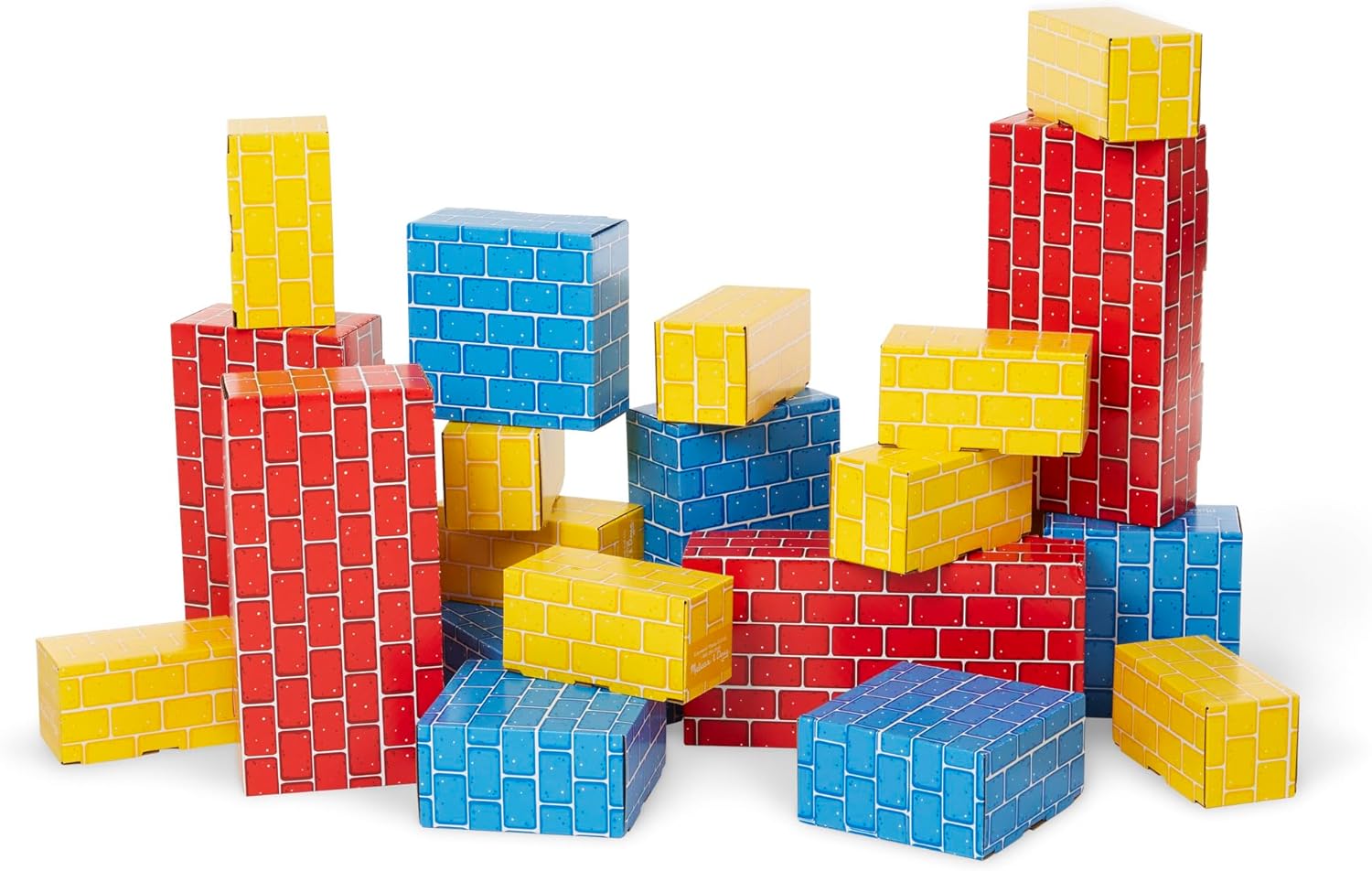
Our score: 9.4/10 iOur editorial score (1 to 10), based on listing specs, features and how well each pick fits its use case. It is not an Amazon customer rating.
40 jumbo cardboard blocks Fort building play Melissa and Doug Lightweight blocks
The Melissa and Doug Jumbo Cardboard Blocks set takes a different path from snap together bricks, and that is why it wins the fort builder award. The listing promises fort building fun with 40 jumbo cardboard blocks. Instead of tiny pieces, a toddler gets big, light blocks that turn a living room corner into a castle wall, a tunnel or a shop counter. For parents tired of stepping on plastic bricks, large blocks that fold flat or stack neatly are a welcome change.
With 40 pieces in the box, there is enough material for a wall that a toddler can hide behind, or a tall tower that begs to be knocked over. Cardboard blocks are light, so a falling stack is unlikely to hurt. The listing describes them as jumbo, which means they are meant for big, full body play rather than fine finger work. Children push, carry, stack and line them up, which makes this a movement toy as much as a building toy.
This set suits toddlers who are active and who enjoy large scale play. It teaches planning, spatial thinking and teamwork, because two children can carry one block together or build opposite sides of a wall. It also encourages pretend play, with parents joining as customers, guests or monsters. Because the blocks are not joined by studs, children learn balance by trial and error, which is a different lesson from the one taught by interlocking bricks.
A few honest notes: cardboard is not meant for wet or messy play, so keep it away from spills and damp floors. Corners can soften or dent with rough handling, and a toddler who chews on cardboard should be watched. The set needs floor space and a spot to store 40 large pieces, such as a closet shelf or under a bed. Supervise play near stairs, and teach a gentle rule about throwing.
4. 24 PCS Giant Interlocking Building Blocks: Best Open Ended Interlocking Set

Our score: 9.0/10 iOur editorial score (1 to 10), based on listing specs, features and how well each pick fits its use case. It is not an Amazon customer rating.
24 giant blocks Interlocking design Open ended pieces For toddlers
The 24 PCS Giant Interlocking Building Blocks for Toddlers set is the pick for open ended interlocking play. The listing says its open ended pieces invite kids to build anything, and the title confirms there are 24 giant pieces made for toddlers. Because the pieces are few and large, the set feels manageable to a child who gets overwhelmed by a bin of hundreds of bricks. It is a good fit for a first interlocking set in a small home.
Giant interlocking blocks connect to each other, so a toddler can make walls, steps and chunky shapes that stay together while they carry them around. Having only 24 pieces keeps decisions simple. A child can make a long line, a square enclosure or a tall tower, and see the result quickly. The listing does not name materials or exact dimensions, so read the live page for those details if size or weight matters in your home.
This set suits toddlers who like to connect things and who are ready for a bit more building than loose stacking. It supports finger strength, coordination, early counting and problem solving. A parent can offer a challenge such as building a house for a toy animal, then step back. Because the pieces are open ended rather than themed, the same set becomes a garage one week and a bed for a doll the next.
There are limits worth stating. Twenty four pieces will not build a big structure, so families with several children may want a larger set. Look at the age guidance on the live listing and keep supervision close for children who still mouth toys. Check for sharp seams or edges when the set arrives, and wash it with mild soap and water. A small bag or box for the pieces keeps them in one place.
5. Large Building Foam Blocks for Toddlers: Best Soft Foam Set
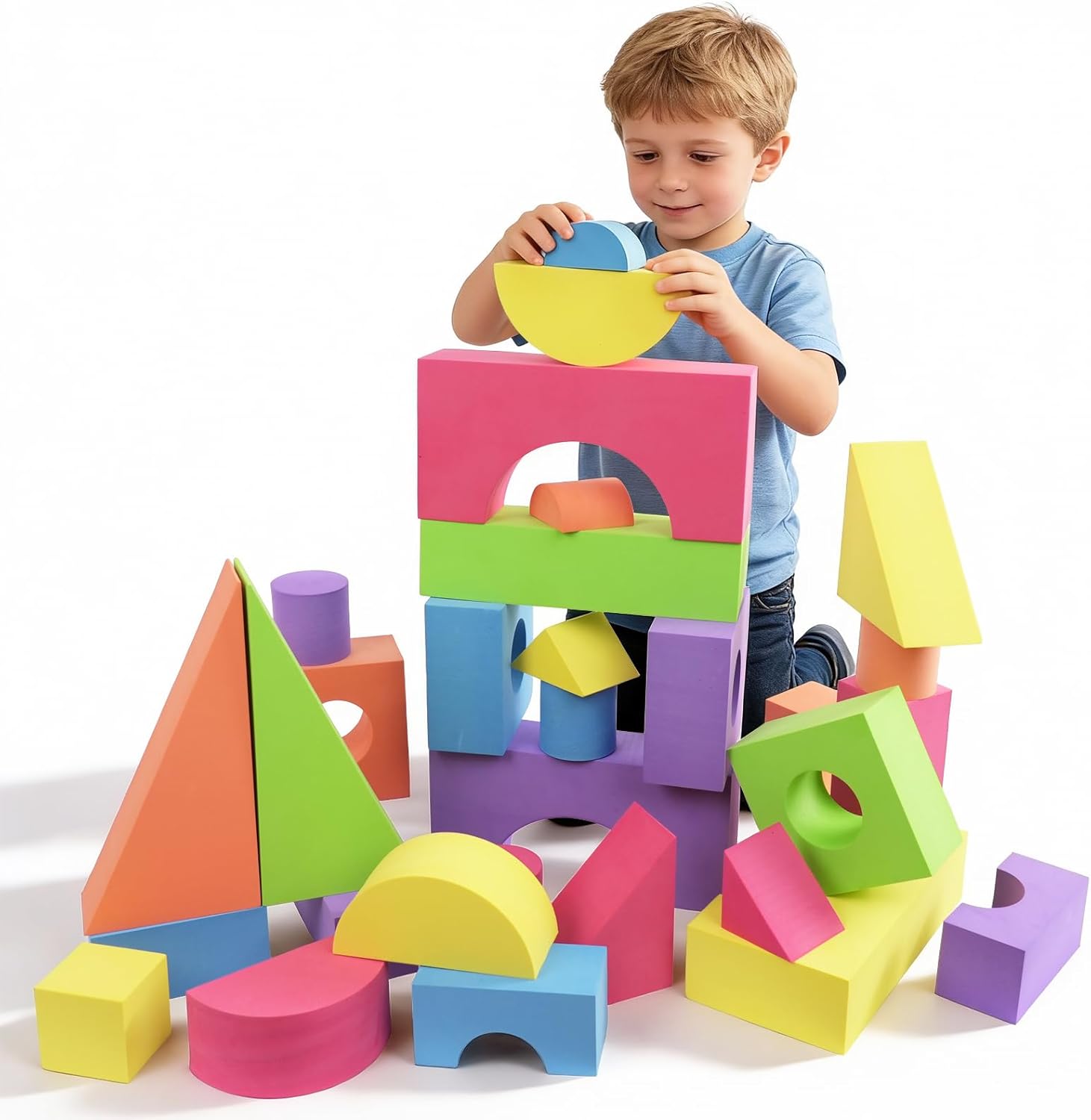
Our score: 9.4/10 iOur editorial score (1 to 10), based on listing specs, features and how well each pick fits its use case. It is not an Amazon customer rating.
30 large foam blocks For 2 and 3 year olds Foam building blocks Gift ready toddler set
The Large Building Foam Blocks for Toddlers set is the pick for families who want a soft landing. The title says it is a gift for 2 and 3 year olds, and the listing bullet confirms 30 large foam blocks. Foam is a natural material choice for the youngest builders, since towers fall without a loud clatter and a dropped block is less likely to sting a bare toe. For a parent with an early walker, that alone makes it worth a look.
With 30 large pieces, the set offers enough volume for tall stacks and wide walls without overwhelming a small play space. Foam blocks are light, so a toddler can lift and carry them alone, which builds confidence. The listing bullet does not describe connection features or exact sizes, so read the live page to see whether the pieces stack only or also join. Colors and shapes can differ from photos, so confirm them before ordering as a gift.
The set is aimed at children aged 2 and 3, per its title, and suits them well. It teaches sorting by color, counting, stacking and early balance, and it is quiet enough for apartment living or naptime adjacent play. Foam blocks also work for simple pretend games such as bridges, beds and hungry caterpillar tunnels. Parents can use them as soft obstacles for crawling and climbing games, as long as an adult is nearby.
One caution: foam can be chewed or torn by a determined toddler, and bits of torn foam are a choking concern, so supervise play and remove damaged pieces right away. Foam also does not hold up to very rough use as well as hard plastic does. Check any safety labeling on the live listing and keep the blocks away from heaters. A damp cloth cleans most surfaces, and an open bin keeps them handy.
6. Melissa and Doug 100 Wooden Building: Best Classic Wooden Set

Our score: 9.6/10 iOur editorial score (1 to 10), based on listing specs, features and how well each pick fits its use case. It is not an Amazon customer rating.
100 wooden blocks Storage box included Melissa and Doug Classic stacking set
The Melissa and Doug 100 Wooden Building Blocks with Storage Box earns the award for the best classic wooden set. The title lists 100 blocks and a storage box, and the listing says kids can build, stack and imagine with endless possibilities. Wooden blocks are the traditional toddler building toy, and a hundred of them gives a child room for tall towers, long roads and elaborate cities. For parents who like natural looking toys that last, this is a familiar choice.
Inside the box are 100 wooden blocks, which a child can sort by shape and color as part of play. The included storage box keeps cleanup simple, and the lid or box gives a toddler a place to carry blocks around. The listing bullets do not give block sizes, so read the live page if you want to know how chunky they are. Wooden blocks do not interlock, which means towers rely on a steady hand and patience.
This set suits older toddlers and young preschoolers who can stack with some control, and it grows with them for years. It teaches balance, symmetry, counting, and early math through patterns and comparisons. A child can build a tower, count the blocks, then take half away to see the difference. Because the blocks are all plain, imagination does the work: a row becomes a train, a square becomes a house, and a stack becomes a rocket.
Honest note on age: some blocks in a mixed hundred piece set may be small, so check the age label on the live listing and supervise very young toddlers who still mouth toys. Wooden blocks are heavier than foam or cardboard, and a thrown block can hurt, so teach a gentle rule. Wipe with a slightly damp cloth, never soak the wood, and keep the box on a low shelf the child can reach.
7. Lillian Vernon Primary Building Bricks: Best Jumbo Brick Value

Our score: 9.0/10 iOur editorial score (1 to 10), based on listing specs, features and how well each pick fits its use case. It is not an Amazon customer rating.
Primary building bricks Jumbo blocks Little builder design Simple brick set
The Lillian Vernon Primary Building Bricks set earns the value award because it keeps things basic. The listing calls them jumbo blocks for little builders, and the title says primary building bricks, which suggests bright basic colors. For budget minded families, a simple jumbo set without a theme or extras can be the smartest buy, because the play does not depend on a story, a figure or a special piece.
The listing bullets are short, so the exact piece count, brick size and material are not stated here. That means a careful buyer should read the live page and photos before ordering. What the listing does tell us is that the bricks are jumbo, which in toddler products usually means large pieces that are easy to hold and hard to swallow. Brick style sets like this are meant to be stacked and, depending on the design, snapped together.
This set suits toddlers who enjoy stacking and early building and families who want a plain set to add to a growing pile. It supports color recognition, counting, hand strength and simple construction such as walls, towers and steps. Because it is not tied to a theme, it mixes well with other jumbo blocks on this list, and a parent can add a toy car or animal to give a child a reason to build a garage or a barn.
A couple of cautions. Since the listing says little, confirm age grading and materials on the live page and look at the product photos closely. Keep supervision close for children who still mouth toys, and check bricks for cracks over time. Wipe with a damp cloth when sticky and let them dry. A lidded bin or a laundry basket works as storage if the set does not come with its own container.
8. Dimple 300 Piece Large Building Blocks: Best Big Set for Siblings

Our score: 8.8/10 iOur editorial score (1 to 10), based on listing specs, features and how well each pick fits its use case. It is not an Amazon customer rating.
300 large pieces Building block set Endless creative play Good for sharing
The Dimple 300 Piece Large Building Blocks for Toddlers set takes the award for siblings and playdates. The title gives the count of 300 pieces, and the listing describes a building block set for endless creative play. Three hundred pieces is a lot of material for a toddler guide, enough for two or three children to build at the same time without arguing over every block. For a family with a toddler and an older sibling, volume matters.
With that many pieces, a child can build wide structures such as farms, zoos or long roads, and still have blocks left over. The title says the blocks are large, which suggests they are sized for toddlers, though the listing bullets do not give exact dimensions or materials. Read the live page to see shapes, colors and whether the pieces connect or simply stack. A set this big also pairs well with small animals and cars for pretend scenes.
This set suits toddlers who like big projects and families who want one large set instead of several small ones. It encourages sharing, teamwork, planning and counting, and it gives a child room to try bigger ideas as skills grow. A parent can set a simple goal, such as building a fence for ten animals, and the child will need to count, sort and place pieces carefully. Over time, the set can move from piles to real structures.
Large sets bring practical needs. You will need a big bin or bag and a place to put it, and cleanup takes longer than with a small set. With 300 pieces, a lost block is hard to notice, so check floors for stray pieces around young siblings and pets. Follow the age label on the live listing and supervise play with a child who still mouths toys. Rinse or wipe the pieces when they get grubby.
9. burgkidz Classic Building Compatible Toddlers 15: Best Set with Baseplates

Our score: 9.4/10 iOur editorial score (1 to 10), based on listing specs, features and how well each pick fits its use case. It is not an Amazon customer rating.
150 jumbo blocks Baseplates included 2 in 1 storage Classic compatible style
The burgkidz Classic Building set with 150 jumbo blocks and baseplates wins the award for the best set with baseplates. The title says it is compatible and made for toddlers, and the listing describes 150 jumbo pieces with a 2 in 1 storage solution. Baseplates give a toddler a flat surface to build on, which is a real help for children who find freestanding towers wobbly. For parents who want structure without a rulebook, that mix is useful.
Inside are 150 jumbo blocks plus baseplates, and the storage piece does double duty, according to the listing. The word compatible in the title suggests the blocks are meant to fit with certain other brick systems, but the data does not say which ones, so check the live page before mixing sets. Baseplates let a child build a floor plan, a garden or a road and keep it together while moving it around the room.
This set suits toddlers who are ready for slightly more planned building and families who like to display a finished creation on a shelf. It supports fine motor skills, spatial thinking, counting and early design ideas. A parent can suggest a small town with a house, a tree and a car park, and the baseplate keeps the project in one place. Because the pieces are jumbo, they are easier to press together than small bricks.
Some caveats are worth stating. Baseplates are flat and can be slippery on smooth floors, so use a rug or mat. Check the age grading on the live page, since mixing compatible systems can change piece sizes. Keep supervision close for children who still mouth toys, and check for cracked pieces. The storage solution keeps blocks tidy, but 150 pieces still need a safe shelf the child can reach. Teach a gentle press and pull routine so the baseplates last.
How to Choose the Best Building Blocks For Toddlers
What Makes Building Blocks Right for a Toddler
A toddler block should be large enough to hold in a small fist, light enough to carry and forgiving enough to survive being thrown, chewed and stepped on. Edges should be rounded, surfaces smooth, and the set should offer a few simple shapes instead of many tiny parts. Big pieces also make success easy, which keeps a young child interested. Parents can quickly judge a set by holding one block: if it fits comfortably in a toddler sized hand and feels light, it is a good sign.
Advanced features are not the goal at this age. What matters is that blocks feel good in the hand, stack without constant collapse, and can be put into a bag at the end. A short list of reliable pieces beats a flashy set with many accessories. Sets with a clear purpose, such as stacking or snapping, tend to hold a young child’s attention for longer than mixed bundles of unrelated pieces.
Age and Skill Fit for Ages 1 to 3
Around the first birthday, children usually carry and drop blocks. By 18 months many begin stacking two or three. At two they may line blocks up, and by three they often build simple towers and name what they made. Skill varies widely, so treat these ages as loose guides. A child who skips a stage is not behind, because block play follows the child’s own pace and interests.
Match the set to the stage. Soft foam and giant cardboard suit the youngest and most active builders, snap together bags suit children developing hand strength, and wooden blocks reward the patience that arrives closer to age three. Check the age label on every live listing before ordering. If a set frustrates your child, put it away for a few weeks and try again; skills often jump after a short break.
Soft Foam, Cardboard, Wood or Plastic Blocks
Each material has a different personality. Foam is soft and quiet, cardboard is light and big, wood is sturdy and traditional, and plastic interlocking blocks hold together for taller builds. A family with hard floors and an early walker may lean toward foam, while one with a patient three year old might prefer wood. Think about noise too, since wooden blocks on a hard floor can be loud in an apartment with neighbors below. Foam and cardboard also travel well to grandparents’ homes because they are light enough to carry in a single bag.
Many homes end up with two types. A soft set for rough, noisy play and a sturdier set for careful building make a good pair, and each one teaches a slightly different lesson about balance and force. Weight matters for safety, because a heavy block dropped on a foot hurts far more than a foam or cardboard one. Rotating them every few weeks keeps each type feeling special.
Block Size, Choking Hazards and Supervision
The biggest safety question with toddler blocks is size. Children under three tend to mouth objects, and small parts can be a choking hazard. Pieces labeled for toddlers are usually larger than that, but not always across every piece in a mixed set, so check labels and look at the real pieces. A simple home check many parents use is a small parts tube or a similar size guide, though the age label remains the first thing to read.
Stay close during play, especially with a child who still chews toys. Remove any cracked or torn piece, and keep older siblings’ small bricks in a separate bin out of reach. No set is a substitute for adult attention. Teach older children to put away tiny pieces right after play so they never end up in a toddler’s reach. If a block ever breaks into pieces, treat it as a hazard and throw it away rather than trying to glue it back together.
Materials, Finishes and Safety Labels
Look for clear safety information on the live listing and on the packaging when it arrives. In the United States, toys for children are expected to meet federal safety rules, and in Europe the EN71 standard is common, but a listing must state this before you rely on it. Our data does not confirm certifications for these sets. If a listing is vague about materials, contact the seller or choose a set whose page spells out what the blocks are made of.
Check that painted wood or colored plastic has no flaking, that foam has not started to crumble, and that cardboard has not been soaked. A faint smell on arrival can mean a set needs airing out before play, and persistent smells are a reason to contact the seller. Keep packaging details and order information for a while, in case you need to ask the seller about a defect.
Interlocking Blocks Versus Stacking Blocks
Interlocking blocks press together, so a toddler can build something that survives being picked up. That is satisfying, but it takes finger strength and a bit of practice. Stacking blocks simply sit on top of one another and teach balance, patience and what happens when a tower gets too tall. Interlocking sets are handy for children who like carrying their build to show a grown up, because the structure does not fall apart.
Neither style is better. Many toddlers enjoy both, and switching between them across a week keeps play fresh. A parent can also show how to make a simple bridge with stacking blocks, then a wall with interlocking ones. Stacking sets are handy for children who enjoy the drama of a falling tower, since nothing locks in place. Mixing both gives a child two ways to solve the same problem, which is a quiet but real thinking skill.
How Many Pieces Does a Toddler Need
Bigger is not always better. A set of around 20 to 40 large pieces is plenty for a one or two year old, who will be overwhelmed by hundreds of tiny bricks. As the child grows or as siblings join, a larger count of 100 or more starts to make sense. Too many blocks at once can lead to scattering rather than building, so offering a smaller handful from a larger collection often works well.
If you are unsure, start with a modest set and add more later. Plain blocks mix well across brands, so a growing collection can come from gifts and small purchases over time, which spreads the cost of play over several years. Counting out ten blocks together is itself a small math lesson, and it keeps cleanup quick at the end of play.
Storage, Cleanup and Small Homes
Blocks multiply quickly, and a good storage plan keeps them from becoming a floor hazard. A lidded box, a soft bag, a shallow tub or a laundry basket all work. Choose something a toddler can reach, so cleanup can become part of the game. Labeling a bin with a picture of blocks helps a toddler learn where things go before they can read.
Some sets include a box or bag, and others do not. Large cardboard blocks need shelf or closet space, while foam blocks can sit in an open bin. Rotate sets every few weeks and the old toys will feel new again. Keep heavy wooden or large cardboard blocks low on a shelf so nothing can fall on a child who reaches for it.
Budget Logic Without Chasing the Lowest Number
Value in building blocks comes from how many years a set stays useful and how often it is played with. A plain set that a child uses from age one to four can be better value than a themed set that gets one afternoon of excitement. Sharing across siblings stretches value further. Watch for sets that look generous in count but include very small pieces that are unsuitable for under threes. A modest purchase that sees daily use is better value than a bigger one that sits untouched in a closet.
Compare piece counts, materials and storage included, and decide what matters most in your home. Check the live listing for the current price, and consider how many children will use the set before you decide. Hand me down blocks from relatives can be a smart supplement, as long as you inspect them for damage first. A set that survives a younger sibling is the best kind of value.
Care, Cleaning and Making Blocks Last
Plastic and wooden blocks usually clean with a damp cloth and mild soap, while foam and cardboard need gentler handling and should not be soaked. Dry everything fully before storing, because trapped moisture can cause smells and mold. Follow any care instructions on the listing. Wash hands before play when blocks are shared with other children, since toddlers pass blocks from mouth to mouth quickly.
Inspect blocks regularly for cracks, splinters or torn foam. Repair or discard anything damaged. Teach toddlers to use blocks for building rather than throwing, and rotate sets so no single one wears out too fast. Store blocks away from direct sunlight and heat, which can fade colors and weaken some plastics and foam. A quick weekly check takes only a minute and can catch small problems before they turn into safety issues.
Simple Play Ideas to Grow Block Skills
Start with stacking a tower and counting out loud. Move to lines and patterns by color, then to walls and enclosures for toy animals. Ask questions such as which block is biggest, or how many it takes to reach your knee. These tiny games build language as well as math. Songs and rhymes about building, counting down and falling over fit naturally into block play.
Build alongside your child but let them lead. Add toy cars or figures for pretend play. Take photos of creations before they come down, since toddlers often enjoy seeing what they built. Keep sessions short and stop while the child is still happy. Praise effort rather than the finished shape, because a toddler who feels proud of trying will keep trying.
Gift Tips for Toddler Block Sets
Check the child’s age and what blocks they already own, so you do not duplicate. A plain set mixes with anything, while a baseplate set suits a family that already has compatible bricks. Look at delivery windows on the listing and order early for birthdays or holidays. Wrapping a block set inside a storage bin or bag makes a gift that is useful from the first minute.
Add a gift receipt, and consider a soft bag or bin so the family has a place to store the blocks. If the child has older siblings, mention small parts and suggest a separate shelf for older toys. A grandparent or friend who lives far away can send a set directly to the home, but should confirm the age fit with the parents.
Frequently Asked Questions
What age can toddlers start playing with building blocks?
Many children begin around their first birthday by carrying, dropping and mouthing large blocks. Real stacking usually follows between 12 and 24 months. Always check the age label on each listing and supervise play closely.
Are wooden or foam blocks better for toddlers?
Foam is softer and quieter, which suits early walkers and apartments. Wood is heavier, sturdier and lasts longer, which suits steadier stackers. Both can be good, and many families keep one of each.
How many blocks should a toddler have?
A set of 20 to 40 large blocks is usually plenty for one young child. Larger sets of 100 or more make sense for older toddlers, siblings or playdates. Start modest and add more later.
Are interlocking blocks too hard for a two year old?
Some two year olds can press large interlocking blocks together, while others find it frustrating. Chunky, easy to grip designs help. If your child struggles, try stacking blocks first and come back to interlocking ones in a few months.
How do I keep blocks from becoming a choking hazard?
Choose pieces sized and labeled for toddlers, remove damaged items and keep small bricks from older siblings out of reach. Supervise a child who mouths toys. Check the live listing for age guidance on every set.
How do I clean toddler building blocks?
Wipe plastic and wooden blocks with a damp cloth and mild soap, and let them dry completely. Avoid soaking wood, foam or cardboard. Follow any care instructions on the listing, and discard blocks that crack or tear.
Can I mix blocks from different brands?
Plain stacking blocks mix easily. Interlocking blocks may or may not fit together, even when a listing says compatible, so check the live page before buying. Mixing sizes can also change safety for younger children.
Do toddler blocks teach anything?
Yes. Block play supports hand strength, balance, counting, sorting and early planning. It also encourages pretend play and language when a parent asks questions. The learning comes from open ended play more than from the specific set.
What is the best way to store blocks?
Use a lidded box, a soft bag or a shallow bin that a toddler can reach. Include cleanup in the game, and rotate sets every few weeks. Keep large cardboard blocks on a shelf or in a closet.
How do I choose between a large set and a small set?
Think about who will play and where the blocks will live. A small set suits one child and a small home, while a large set suits siblings and playdates. You can always add more blocks later.
The Bottom Line
Toddler blocks are one of the simplest toys to get right: large pieces, easy handling and a little supervision go a long way. Our top pick, the MEGA BLOKS First Builders Big Building Bag, is a friendly place to start for most families.
If your child needs something softer, look at the foam set, and if you want a lasting classic, the wooden set with a storage box is a safe long term choice. Check each live listing for age guidance, current price and availability before you buy.
Updated for the 2027 buying season. Amazon listings and availability change often, so check the product page for current details.

Write Your Review
No reviews yet. Be the first to share your experience!