

As an Amazon Associate we earn from qualifying purchases. If you buy through links on this page we may receive a commission at no extra cost to you. Product details come from Amazon listings and can change.
The best engineering toys turn a curious kid into a builder who asks how things work. This guide gathers nine picks that cover circuits, gears, hydraulics, mechanical coding, logic puzzles and screw together construction, so families can match a set to a child instead of guessing from a box photo.
It is written for parents, grandparents and gift buyers shopping for children roughly 5 to 14, plus tweens and teens who like taking things apart. Each pick comes with a plain look at what the listing says, what a child can learn by building it, and the honest limits, such as age marks, small parts and the need for an adult nearby. Some sets run on batteries while others need none, so check the listing for power needs before you order.
Prices change often and vary by seller, so we link every product to its live listing rather than quoting a number here. Read the quick answer first if you are in a hurry, then use the buying guide to decide between electronics, mechanical builds and puzzles.
Key Takeaways
Best Engineering Toys at a Glance
| Product | Our score | |
|---|---|---|
| Explore 300+ hands-on electronics projects with Best Overall |
9.6 / 10 | Check Price |
| Build 100+ STEM projects with 28 Best Compact Circuit Set |
9.6 / 10 | Check Price |
| Explore Hydraulics & Pneumatics Wearable Giant Best Mechanical Showpiece |
8.8 / 10 | Check Price |
| Mechanical coding wheel programs the robot Best for Coding Minded Builders |
9.0 / 10 | Check Price |
| Klutz Lego Gear Bots Science/STEM Activity Best for Gear Fans |
9.2 / 10 | Check Price |
| ThinkFun Gravity Maze – Falling Marble Best Logic Puzzle Challenge |
9.2 / 10 | Check Price |
| Christmas & Birthday Gift for Boys Best Wide Age Range Launcher |
9.2 / 10 | Check Price |
| Educational Toys Building Blocks, 244 Pieces Best for Young Builders |
9.4 / 10 | Check Price |
| Beginner-friendly electronics set introduces cir Best for Early Starters |
9.4 / 10 | Check Price |
How We Chose the Best Engineering Toys
This is a research based guide, not a lab comparison. We read each product listing closely, noting the age marking, the project or piece counts that appear in the title, the type of engineering involved and any power details the listing gives. We also weighed general safety standards that apply to toys, such as age grading and small parts warnings, and looked for a balance between electronics, mechanics and puzzle style challenges so no single skill dominates the list.
Each pick also carries an editorial score out of 10, built from its features, specs and how well it fits its intended use. The score is a way to compare similar sets quickly, not a promise about results. Where a title says little about contents, we say so plainly and ask buyers to confirm details on the live listing, including batteries, tools and the exact age range.
In-Depth Reviews
1. Explore 300+ hands-on electronics projects with: Best Overall
Our score: 9.6/10 iOur editorial score (1 to 10), based on listing specs, features and how well each pick fits its use case. It is not an Amazon customer rating.
300+ projects Ages 8+ Snap together parts Full color manual
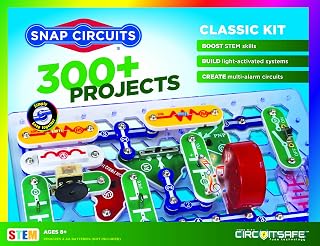
The SNAP CIRCUITS Classic SC-300 earns the top spot because it offers the widest range of projects in this guide. The listing describes more than 300 electronics projects built from easy snap together parts and guided by a full color project manual. That mix means a child can start with a simple loop and keep finding new builds for months. It is marked for ages 8 and up, which fits the upper elementary years, when reading a diagram and following numbered steps start to feel natural instead of frustrating.
Inside the box, the idea is simple. Each part snaps onto a base grid, and the manual shows which pieces connect and in what order. There are no soldering irons or loose wires to manage, so the focus stays on how current flows through a circuit. Builders can swap a part, change the layout and watch the result change. Exact part counts and power needs are not spelled out beyond the title, so confirm the battery requirement on the listing before checkout.
This set suits a child who likes to ask what happens if one thing changes. It teaches the basics of reading a circuit diagram, following a sequence and troubleshooting when a build does not work. It also makes a good shared family project, where an older sibling or parent reads the manual while a younger child places parts. Kids who already finished a smaller electronics set will find the larger project list a natural step up rather than a repeat.
A few practical notes help. Work on a clear table so small parts do not roll away, and keep them away from children under the age mark and from pets. Batteries should be installed by an adult, and any part that feels warm should be removed from the build. Store pieces in a labeled box so the set stays complete. Because the project list is long, expect a slow burn across many weekends rather than a one afternoon toy.
2. Build 100+ STEM projects with 28: Best Compact Circuit Set

Our score: 9.6/10 iOur editorial score (1 to 10), based on listing specs, features and how well each pick fits its use case. It is not an Amazon customer rating.
100+ projects 28 snap parts Ages 8+ Full color manual
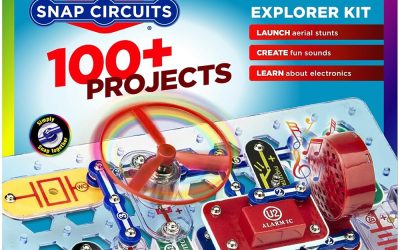
The SNAP CIRCUITS Explorer SC-100 is the right size for families who want electronics without a huge box. The title promises more than 100 STEM projects from 28 snap together parts, plus a full color project manual. That is a tidy count, easy to store and easy to keep complete. It is marked for ages 8 and up, so it lands in the same age band as the larger Classic set but asks for less shelf space and less commitment.
Because the parts snap together, a builder never touches a soldering iron or strips a wire. The manual walks through each project with pictures, and the pieces click onto a grid in the pattern shown. With a smaller parts list, each component gets used often, which helps a child learn what each one does. The listing title does not name the individual parts or the battery type, so read the product page for those details before buying.
This kit fits a child who has shown a first spark of interest in how lights, sounds and switches work. It also suits classrooms, clubs and travel, where a compact box is easier to carry and a manageable parts count means fewer lost pieces. A parent can sit nearby for the first few projects, then step back as the child learns to read the layout drawings alone and fix small mistakes without help.
Keep expectations realistic. A set with 28 parts naturally offers fewer combinations than a bigger one, so a keen builder may finish the best projects quickly and want an upgrade. That is not a flaw, just a sign the hobby has taken hold. Use an adult for battery changes, keep the parts away from very young siblings, and return everything to its tray after each session so nothing goes missing. Explorer builders often enjoy photographing a favorite layout before taking it apart.
3. Explore Hydraulics & Pneumatics Wearable Giant: Best Mechanical Showpiece

Our score: 8.8/10 iOur editorial score (1 to 10), based on listing specs, features and how well each pick fits its use case. It is not an Amazon customer rating.
Hydraulics and pneumatics Wearable giant hand No battery Ages 7+
The Thames & Kosmos Mega Cyborg Hand stands out because the finished model is something a child can actually wear. The title calls it a wearable giant mechanical hand that explores hydraulics and pneumatics, and it states plainly that no battery is needed. That makes it the most dramatic mechanical project in this guide, the kind of build a kid wants to show off to friends at school or at a family gathering. It is marked for ages 7 and up.
The core idea is moving force through fluid or air instead of through gears or wires. The listing places it in the robotics and engineering category, which suggests a set of parts that assemble into a hand with moving fingers controlled by the wearer. Specific pieces, tubing and the exact build steps are not detailed in the title, so check the product page and instructions for the full contents and any extra supplies the build may call for.
This set suits a child who loves robots, superhero gadgets or anything with moving parts. It teaches that pressure can transfer motion from one place to another, an idea behind real machines like lifts and brakes. The build asks for patience and careful reading, which makes it a good fit for a determined seven year old with an adult helper, or an older child working alone and enjoying the challenge of fitting parts together.
Plan for a longer build session and a clear workspace. Adult help is wise for the first assembly, especially when sizing the hand to a child and checking that nothing pinches. Small parts and tubing should stay away from children below the age mark. Play should stay gentle, since a wearable model is not a toy to swing at people. Store it on a shelf away from heat, so any soft parts keep their shape. A shelf away from direct sun also keeps tubing and soft parts from aging early.
4. Mechanical coding wheel programs the robot: Best for Coding Minded Builders

Our score: 9.0/10 iOur editorial score (1 to 10), based on listing specs, features and how well each pick fits its use case. It is not an Amazon customer rating.
Mechanical coding wheel Robot building kit Ages 10+ Throw, lift, kick, draw
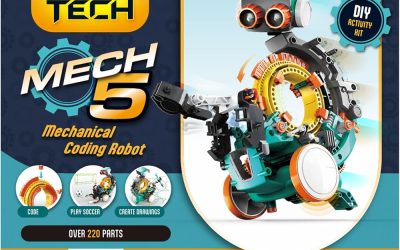
The TEACH TECH Mech-5 is the pick for kids who like the idea of programming but also want to build the machine themselves. The title explains that a mechanical coding wheel programs the robot to throw, lift, kick, draw and perform other actions. Instead of typing code on a screen, a child sets up a physical pattern, which makes the logic of a program easy to see and touch. It is marked for kids ages 10 and up.
Because the programming lives in a wheel rather than an app, the kit appears to work without a tablet or computer, though the listing title does not say so outright. Buyers should confirm that detail, along with the battery type and the number of parts, on the product page. The robot is described as a building kit, so assembly is part of the fun and part of the lesson in how mechanical systems link together.
This set suits a tween who enjoys puzzles, step by step instructions and seeing cause and effect. It introduces ideas like sequences, repeats and timing, all by adjusting the wheel and watching the robot respond. Because it has a higher age mark than most sets here, it can also work for a young teen who has outgrown simpler snap together kits but is not ready for advanced hobby electronics. The coding wheel idea also gives a clear picture of what a program really is.
Think about space and patience before buying. A robot that kicks, throws and draws needs a clear floor or table, and any thrown object should never be aimed at faces or pets. Adult supervision is sensible for assembly and for the first runs, particularly if tools are included. Keep spare parts in a tray, because a mechanical wheel and linkages can be fussy to rebuild when a piece goes missing. A flat, uncluttered surface helps the robot move the way the wheel instructs it to.
5. Klutz Lego Gear Bots Science/STEM Activity: Best for Gear Fans

Our score: 9.2/10 iOur editorial score (1 to 10), based on listing specs, features and how well each pick fits its use case. It is not an Amazon customer rating.
Klutz activity kit LEGO gear builds Science and STEM Ages 8 to 12
The Klutz Lego Gear Bots kit makes the list as the clearest introduction to gears and simple machines. The title calls it a science and STEM activity kit for ages 8 to 12 and pairs the Klutz name with Lego, so buyers can expect a guided activity format with brick based building. It is the best fit here for a child who already likes building bricks and is ready to learn why one wheel turns another.
Klutz kits are known as activity packages, so the listing suggests a mix of instructions and building rather than a single fixed model. The exact bricks, number of bots and any book pages are not stated in the title, so check the product page for the full contents. Gear based builds usually show how turning one part can change speed, direction or force in the next, which is the heart of mechanical engineering.
This is a good match for a child who enjoys following illustrated steps and then changing the design to see what happens. It teaches vocabulary like gear, axle and drive, and it rewards tinkering after the instructions end. It also suits families who already own loose bricks, since a child may want to extend a build with parts from a home collection, though compatibility should be confirmed on the listing. Gear builders also pick up useful words for explaining how machines work to friends.
Practical tips are simple. Build on a tray or a mat so small bricks stay together, and keep them away from younger siblings, since bricks are a choking hazard for children under three. Sort gears from plain bricks before starting, because gear teeth need to mesh cleanly to spin. If a bot jams, check that each axle is pushed fully in and that nothing rubs the wheel. Keeping a small bowl for spare pieces can save an afternoon of searching later.
6. ThinkFun Gravity Maze – Falling Marble: Best Logic Puzzle Challenge

Our score: 9.2/10 iOur editorial score (1 to 10), based on listing specs, features and how well each pick fits its use case. It is not an Amazon customer rating.
Falling marble logic game Gravity marble maze Ages 8 to 12 Critical thinking
ThinkFun Gravity Maze is the most puzzle like pick in this guide, and it earns a place because the thinking is pure engineering. The title describes a falling marble logic game for kids 8 to 12 in which a player works out how to guide a marble using gravity. Rather than assembling a model, the child plans a path, which builds the kind of spatial reasoning that engineers use when designing anything that has to move or fall.
The listing frames it as a gravity marble maze with brain building fun and a push toward critical thinking and problem solving. Specific challenge counts, difficulty levels and the number of pieces are not given in the title, so confirm them on the product page. The general idea of a marble run is clear: pieces are arranged so a marble drops from a start point to a target through a planned route.
This game suits a child who prefers quiet, focused work over loud building sessions. It can be played alone at the kitchen table, which makes it handy for a rainy afternoon, a car trip or a waiting room. It also works as a calm companion to hands busy kits, because it trains planning and checking before acting. Parents who want a screen free challenge for an eight to twelve year old will find it fits well.
A few cautions apply. Marbles are small and can be a choking hazard for younger children, so keep the game away from anyone under the age mark and from curious pets. Play on a flat surface with a rim or a rug nearby, since a marble that escapes will roll fast. Store all pieces in the box after each round, and count the marble before putting it away. A rug or tray beneath the board catches any pieces that bounce away during play.
7. Christmas & Birthday Gift for Boys: Best Wide Age Range Launcher

Our score: 9.2/10 iOur editorial score (1 to 10), based on listing specs, features and how well each pick fits its use case. It is not an Amazon customer rating.
Hydraulic launcher Paper airplane and dart Ages 6 to 14 STEM kit
The Smartivity Hydraulic Paper Airplane and Dart Launcher gets the nod for its unusually wide age range. The title says ages 6 to 14, so one kit can serve a first grader with help and a young teen who wants to tinker. It combines two ideas that kids already love, flying paper planes and launching darts, and wraps them in a hydraulic mechanism that makes the science visible in a playful way.
Hydraulics use liquid or pressure to move force from one place to another, and the listing places this kit in the learning and educational science category. The exact materials, the number of parts and the way the launcher is powered are not spelled out in the title, so read the product page and instructions before buying. Buyers should also confirm what is included, such as paper for the planes and any darts.
This kit suits a child who likes to build something and then use it right away. The cycle of assembling, launching, adjusting and launching again teaches iteration, which is central to engineering. It also works as a group activity, since siblings or classmates can compare designs and see whose plane flies farthest. The title frames it as a gift for birthdays and holidays, and its broad age range makes it easy to wrap for mixed age groups.
Safety matters with anything that launches. Never aim a dart or plane at faces, eyes, pets or other people, and set up a clear target area away from windows and breakable items. Younger children should have an adult nearby for assembly and for launch rules. Pick up darts after play so they do not end up underfoot or within reach of toddlers. Keep the launcher in a box between sessions so darts and paper planes stay together.
8. Educational Toys Building Blocks, 244 Pieces: Best for Young Builders

Our score: 9.4/10 iOur editorial score (1 to 10), based on listing specs, features and how well each pick fits its use case. It is not an Amazon customer rating.
244 pieces Electric screwdriver Ages 4 to 10 DIY construction
This 244 piece building set with an electric screwdriver is the most tool based pick for younger children. The title lists educational building blocks, a DIY construction format and an age span of 4 to 10, with an electric screwdriver as a named feature. For a child who wants to build the way a grown up does, driving screws instead of just snapping pieces, that tool is the big draw. Few sets bridge the gap between a first grader and a teenager so smoothly.
The piece count of 244 gives enough parts for a few different models rather than a single build. The title does not say what the models are, how the screws and nuts fit, or what power the screwdriver needs, so the product page matters here. Buyers should confirm batteries, included tools and the building guide. A screw together system tends to teach fine motor control and how fasteners hold a structure together.
The age span is wide, so honesty is needed. A four year old will need an adult to do or closely guide the screwdriver work, and the set is better suited to ages 6 and up for independent play. Children aged 7 to 10 can likely follow the steps alone and take pride in finishing. It suits kids who like real tools, and it is a gentle step toward bigger construction projects later.
Safety notes are important. Keep small screws, nuts and blocks away from children under the age mark and from mouths, and supervise any power tool use, even a toy one. Teach kids to keep fingers clear of the screwdriver tip and to switch it off when not in use. Sort parts in a tray before building, and store the screwdriver apart from loose batteries. Remind children that the tool is for building only, never for pointing at people.
9. Beginner-friendly electronics set introduces cir: Best for Early Starters

Our score: 9.4/10 iOur editorial score (1 to 10), based on listing specs, features and how well each pick fits its use case. It is not an Amazon customer rating.
Beginner SCB-20 Snap together builds Ages 5 to 9 Simple circuits
The SNAP CIRCUITS Beginner SCB-20 is the gentlest entry into electronics on this list. The title calls it a beginner friendly set that introduces circuits through simple snap together builds for kids ages 5 and up, with a stated range of 5 to 9. It is the only pick here aimed squarely at kindergarten and early elementary children, which makes it a natural first step before any of the larger kits. It is a natural pick for children who enjoy helping around the house with real tools.
Because the builds are simple, a child can see a result quickly, and early success keeps motivation high. The title does not list the part count, the number of projects or the power source, so check the product page for those facts. Snap together parts mean no wires to strip and no tools to handle, which keeps the focus on understanding that a circuit needs a complete loop to work. Sorting screws by size before starting makes each step quicker and less messy.
This set suits a young child who is curious about switches, lights and sounds but would be overwhelmed by a thick manual. A parent can read the steps aloud while the child places the pieces, turning the build into shared time. Once the child is comfortable, the Explorer or Classic sets are natural next steps, so buying this one first does not close any doors and makes a sensible stepping stone. Gift buyers can pair it with a small tray to hold screws and keep the table tidy.
Even a beginner kit needs care. Parts are small, so adult supervision is wise for every session, and anything with a battery should be loaded by a grown up. Remind the child not to put parts in mouths or ears, and to put everything back in the box when finished. Short sessions of twenty minutes or so usually work better than a long afternoon for the youngest builders. A helper should check each finished model for loose parts before it goes on a shelf.
How to Choose the Best Engineering Toys
What makes a toy an engineering toy
An engineering toy asks a child to design, build and improve something that works, not just to admire a finished model. The sets in this guide cover electricity, gears, fluid power, mechanical programming and gravity puzzles, which are different branches of the same habit: plan, assemble, observe, adjust and try again. The aim is understanding, not just a finished object on a shelf.
A useful rule is to look for a toy where the child can change something and see a different result. A circuit that lights up only one way, or a model that cannot be altered, teaches less than a kit that invites swaps. Instructions are a starting point, and the best sets make the end of the manual feel like the beginning of play. This is why open ended building tends to outlast flashy single purpose toys.
Matching age and skill to the right set
Age marks on a listing are a mix of safety grading and expected skill. The beginner circuit set here is marked for 5 to 9, the Cyborg Hand for 7 and up, and the coding robot for 10 and up. Reading level matters as much as dexterity, because many kits rely on diagrams and numbered steps. Check both the number and the text on the listing before deciding.
If a child sits between two ranges, choose by temperament. A patient child may enjoy a higher age mark with adult help, while an easily frustrated one often does better with a set one step below. Wide ranges, like 4 to 10 or 6 to 14, usually mean a younger child will need an adult for part of the work. A small mismatch between age mark and ability is easy to fix with a little adult guidance.
Electronics kits versus mechanical builds
Electronics kits such as the snap together circuit sets teach what cannot be seen: current, loops and switches. Their strength is variety, since hundreds of layouts come from a small parts list. Their limit is that results show up as lights, sounds or motion, so the physical feeling of building a machine is smaller. Both kinds of kit are valuable, and each makes the other easier to understand.
Mechanical builds such as gear bots, hydraulic hands and launchers give the opposite experience. Motion is visible and can be felt, which makes cause and effect easy to grasp for a younger or more physical learner. Many families end up with one of each, so a child learns both the invisible and the visible side of engineering. The two styles also reward different kinds of patience and attention.
Reading the listing for power and tools
Power needs are one of the easiest details to miss. Some sets use batteries, some use none, and the Cyborg Hand title says plainly that no battery is needed. For every other pick, confirm on the product page whether batteries are included, which type is needed and whether an adult must install them. Reading these details early prevents disappointment on the day the box is opened.
Tools deserve the same attention. A set with an electric screwdriver, small screws or a launching part brings extra supervision needs. A quick scan of the listing, the photos and the included items list before ordering saves disappointment on gift day, when a missing battery can stall the fun. Gift givers should treat this check as part of the purchase, not an afterthought.
Safety labels, small parts and supervision
Toy safety starts with the age grade on the listing. Small parts, marbles, screws and bricks are choking hazards for children under three, and many sets here carry an age mark well above that. In the United States, children’s products are covered by rules such as CPSIA, and toys sold in Europe may carry EN71 marking, but always check the product page for what a seller states. Check the age mark on every set, even for older children with younger siblings at home.
Adult supervision is wise whenever a toy has batteries, launches objects, uses a tool or includes tiny pieces. Teach children never to aim a launcher at faces, eyes or animals, to switch tools off after use, and to keep parts out of mouths. No product can guarantee safety, so the adult nearby is the most important feature. Safe habits learned during building carry over to later hobbies with real tools.
Space, storage and keeping the parts together
Engineering toys create small pieces, and lost pieces end careers quickly. A shallow tray, a muffin tin or a divided box keeps parts sorted during a build and makes cleanup fast. A compact set such as the Explorer takes little space, while a larger project list needs a shelf or a lidded bin. A small habit of tidying right after play pays off the next time a project begins.
Decide where building will happen before the box arrives. A table with a clear surface suits circuits and gears, a floor mat suits robots that move, and a launcher needs an open area with no breakable items. Keeping the manual and the parts together, perhaps in a zip bag, prevents the common problem of a half finished project with half the pieces gone. Planning the space in advance also reduces arguments about where the project can stay.
Budget logic for engineering toys
Think in terms of cost per hour of play rather than the number on the listing. A set with a long project list, like the Classic circuit kit, can occupy a child for months, while a single build may be finished in an afternoon. Prices change, so compare live listings from reliable sellers instead of relying on any figure printed in an article. Over a year, a set that gets used weekly is almost always the better choice.
Value also comes from reuse. Parts that stay in use after the first project, a puzzle that can be replayed, or a kit that siblings can share all stretch a budget further. If money is tight, one well chosen set that matches a child’s real interest usually beats several scattered purchases that end up in a closet. Shared use among siblings spreads the cost across several children.
A learning path from first circuit to coding robot
A sensible path starts with the simplest build that gives a quick win. For electronics, that might be the Beginner set at ages 5 to 9, then the compact Explorer, then the Classic with its long project list. Each step adds parts and ideas without throwing out what the child already knows. Skipping steps is tempting, but every stage teaches something the next stage needs.
Mechanical learning can follow a parallel line: gear builds first, then hydraulics, then a mechanical coding robot for ages 10 and up. Logic puzzles fit in anywhere as warm up or cool down. A child who moves up gradually gains confidence, while one pushed ahead too fast may drop the hobby and call it boring. Slow progress is fine, because curiosity matters more than speed.
Common mistakes when buying engineering toys
The biggest mistake is buying by age alone and ignoring interest. A child who loves drawing may prefer a launcher or a robot that draws, while one who loves lights may thrive on circuits. Another frequent slip is choosing the biggest set in the hope that it will inspire, when a smaller one finished successfully builds more confidence. A short conversation about what excites the child can prevent a wasted purchase.
Buyers also overlook missing items and power needs, then face a flat battery or absent tool on the big day. A third error is skipping the instructions: manuals teach the vocabulary that lets a child later invent their own builds. Read the listing and the first pages of the manual together, and the whole experience usually goes better. Taking ten minutes to scan the contents list on the page is time well spent.
Gift tips for birthdays and holidays
Engineering sets are easy gifts because they come in boxes that look exciting and explain themselves. Check the age mark, confirm the power details and consider adding a small extra, such as spare batteries or a storage tray, so the child can start straight away. Order early and check the delivery window on the listing, because popular kits can sell out near holidays. Wrapping the box with a handwritten challenge adds a personal touch to the present.
For mixed groups of cousins or siblings, pick a set with a broad age range or a project list large enough to share. Include a gift receipt where possible, and tell the child what the set is for with a short note. A line such as build, change one thing, then try again can set a useful tone. A small notebook for sketches also pairs nicely with any of these kits.
Helping a child get past a stuck build
Every builder gets stuck, and how a parent responds shapes the child’s attitude. Instead of fixing the problem, ask questions: what did the manual show at this step, which piece looks different, what happens if you remove the last part. Questions keep ownership with the child and build the habit of debugging. A calm tone from the adult makes it easier for the child to keep trying.
Take a short break when frustration rises, and come back with fresh eyes. Photographing a working step before changing anything gives a safe point to return to. Praise the process, such as noticing a wrong connection or trying a new layout, more than the finished result. That teaches that mistakes are information, which is the core of engineering. Over time, children learn to ask these questions of themselves without prompting.
Frequently Asked Questions
What are engineering toys?
Engineering toys are kits, puzzles and builds that ask a child to design, assemble and improve something that works. They cover circuits, gears, fluid power, mechanical coding and logic, and they teach planning and problem solving through play.
What age should a child start with engineering toys?
Many families begin around age 5 with a simple snap together circuit set, then move to gears and mechanical builds from about 7 or 8. Always follow the age mark on the listing and expect to help the youngest builders.
Do these toys need batteries?
It varies by product. The Thames & Kosmos Mega Cyborg Hand title says no battery is needed, but for the other picks you should confirm batteries and power type on the listing before you order.
Which pick is best for a first electronics set?
For ages 5 to 9, the SNAP CIRCUITS Beginner SCB-20 is the gentlest start. Older children can begin with the Explorer SC-100 or jump straight to the Classic SC-300, which has the longest project list.
Are engineering toys safe for younger siblings?
Not automatically. Many sets contain small parts, marbles, screws or bricks that are choking hazards for children under three. Keep the toys out of reach of toddlers and build while the younger child is elsewhere.
Is a logic puzzle really an engineering toy?
Yes, when it trains planning and spatial thinking. Gravity Maze asks a child to work out how a marble moves through a route, which mirrors how engineers think about motion before they build anything.
Can one child use several of these sets together?
Sets are separate systems, so parts are not meant to be mixed unless a listing says so. Children often enjoy owning one electronics kit and one mechanical build so they learn different ideas without confusion.
How can I keep small parts from getting lost?
Use a shallow tray or divided box during builds, and put pieces back in a labeled container afterward. A zip bag for the manual and a lidded bin for storage keep sets complete for the next project.
Do engineering toys need adult help?
Often yes, especially for younger kids. Adults help with batteries, tools, launchers and first assemblies, and they keep an eye on small parts. Older children may work alone once they understand the rules.
How do I choose between a circuit kit and a mechanical kit?
Choose circuits if your child likes lights, sounds and diagrams, and a mechanical kit if they prefer visible motion, gears and moving models. Many kids enjoy both, so one of each makes a balanced collection.
The Bottom Line
The best engineering toys do more than keep a child busy. They teach that a problem can be taken apart, checked by changing one thing at a time and solved with patience. Among the nine picks here, the SNAP CIRCUITS Classic SC-300 is our top choice for its long project list and clear manual.
Use the age marks, power details and safety notes above to match a set to your child, then follow the links to live listings for current availability. A small start, a clear table and a parent nearby are usually all it takes to begin.
Updated for the 2027 buying season. Amazon listings and availability change often, so check the product page for current details.





Write Your Review
No reviews yet. Be the first to share your experience!