

As an Amazon Associate we earn from qualifying purchases. If you buy through links on this page we may receive a commission at no extra cost to you. Product details come from Amazon listings and can change.
Choosing the best stem toys can feel confusing, because almost every colorful building box now carries the label. This guide narrows the field to nine real options for children roughly ages 3 to 9, from large block sets to a kit with a kid safe electric drill and two straw constructor sets with hundreds of connecting pieces.
It is written for parents, grandparents and gift buyers who want a toy that teaches something without feeling like homework. STEM simply means science, technology, engineering and math, and at this age it shows up as stacking, counting, checking whether a wobbly bridge will hold and trying again. Each pick below explains what the listing says is in the box, which age it suits and where a younger child will need a hand.
Prices change often and vary by seller, so we link to live listings instead of printing numbers. Check the age range, piece count and any battery notes on the page before you order, and keep adult supervision in mind for small parts.
Key Takeaways
Best Stem Toys at a Glance
| Product | Our score | |
|---|---|---|
| Building Toys for Kids Ages 4-8 Best Overall |
9.6 / 10 | Check Price |
| 195 Piece Set with Drill Best for Tool Lovers |
9.2 / 10 | Check Price |
| 215 PCS STEM Building Blocks Playset Best for Bigger Builds |
9.4 / 10 | Check Price |
| Straw Constructor Toys 600Pcs STEM Building Best Straw Constructor |
9.0 / 10 | Check Price |
| 10 Model Building Block Kit Best for Older Kids |
9.2 / 10 | Check Price |
| 167 Piece 10 in 1 Kit Best Ten Way Play |
9.2 / 10 | Check Price |
| 180 Piece Large Pack Set Best Large Pack for Sharing |
9.4 / 10 | Check Price |
| Birthday STEM Building Toy Best Birthday Gift |
9.2 / 10 | Check Price |
| 600 Piece Straw Set for Groups Best Straw Set for Group Play |
9.0 / 10 | Check Price |
How We Chose the Best Stem Toys
This is a research based guide, not a lab comparison. We read each listing title and feature bullet, compared the piece counts, age ranges and building styles they describe, and added general knowledge about how kids of different ages play with construction toys. Safety matters most for children under 3, so every pick was checked for a stated age target of 3 and up or higher, and we call out small parts wherever they apply.
The list is also meant to be balanced: block sets, a power tool kit, multi model kits and two straw systems, so families can choose a style rather than just a size. Each pick has an editorial score out of 10 based on features, specs and use case fit, shown separately on the site. Where the listing is vague, we speak generally instead of guessing at materials or certifications.
In-Depth Reviews
1. Building Toys for Kids Ages 4-8: Best Overall

Our score: 9.6/10 iOur editorial score (1 to 10), based on listing specs, features and how well each pick fits its use case. It is not an Amazon customer rating.
170 pieces Ages 4 to 8 Creative building set STEM focus
The 170 piece creative building set takes the top spot because it hits the middle of the STEM toy market in the best way. The listing positions it for kids ages 4 to 8 and also mentions 3 and up in the title, so it can start with a preschooler and still hold interest in second grade. A medium piece count means a child can finish a model in one sitting without a huge pile to sort afterward. Parents who want one dependable set for a mixed age household will find this size easy to recommend.
The listing describes a 170 piece creative set, which suggests a mix of connecting parts that can be snapped into vehicles, shapes and structures of the builder’s own design. Sets like this usually reward a simple routine: build the featured idea first, then take it apart and invent something new. That second step is where the engineering thinking happens, because the child has to decide what holds weight and what falls over. Shape matching, balancing and simple counting come up naturally during play, even without any written lesson plan.
This set suits kids who like open ended play more than strict instruction following. It teaches spatial reasoning, fine motor control and early problem solving, and it works well as a shared activity between a parent and a five year old. Siblings of different ages can also join in, with the older child handling harder joins while the younger one sorts colors and counts pieces. A short weekly building challenge, such as making the tallest tower that can still stand on a carpet, keeps interest high.
Caveats are the usual ones for any construction toy. Small parts mean adult supervision around children who still mouth objects, and the listing does not spell out storage, so a small bin or zip bag is a smart extra. Check the live page for the exact age grade, and expect that very advanced builders may outgrow it faster than they would a larger kit. Treat it as a first serious building set and add more pieces later if your child’s interest keeps growing.
2. 195 Piece Set with Drill: Best for Tool Lovers

Our score: 9.2/10 iOur editorial score (1 to 10), based on listing specs, features and how well each pick fits its use case. It is not an Amazon customer rating.
195 pieces Kid safe electric drill Ages 3 and up Screw together build
Few toys feel as grown up to a four year old as a drill, which is why the 195 piece set with a kid safe electric drill earns its own slot. The listing says the set includes the drill and 195 pieces, and the title targets children 3 and up. That combination turns building into a workshop experience, with a real motor doing the work instead of only fingers pressing blocks together. For a child who watches a parent fix things around the house, this is a natural way to join in.
Sets in this style generally use chunky screws and matching bolts or nuts that the drill turns, so the child assembles a vehicle or structure piece by piece. The listing calls the drill kid safe, but a motorized tool still deserves respect. A parent should check that the drill is not pointed at hands or faces, and that the power source is installed correctly, since batteries are commonly needed and may not be included. Practical skills like gripping, turning and lining up parts develop alongside the model itself, and kids notice their own improvement.
Learning wise, this is excellent for hand strength, wrist rotation and following a sequence. Kids practice the same logic used in real assembly: line up the part, fasten, check the result. It also builds patience, because a model made from many screws takes longer than a snap together one, and finishing it feels like a genuine achievement. Sets with real moving tools often become a favorite for parent and child projects that last an entire afternoon.
The trade offs are noise, small fasteners and a learning curve for three year olds who may need help holding parts steady. It is better for kids who enjoy the process than for those who want a quick finished toy. Read the live listing for battery details and keep small screws away from toddlers in the home. Set a small tray aside for screws before you begin, and the whole session will run more smoothly.
3. 215 PCS STEM Building Blocks Playset: Best for Bigger Builds

Our score: 9.4/10 iOur editorial score (1 to 10), based on listing specs, features and how well each pick fits its use case. It is not an Amazon customer rating.
215 pieces Ages 4 to 8 Interactive blocks Playset format
With 215 pieces, this interactive building blocks playset is the biggest block set on the list and the natural pick when a child has outgrown starter bags. The title aims it at kids ages 4 to 8, and the listing calls it an interactive playset, which points to pieces meant to be combined into scenes and models rather than a single fixed build. Kids who already own a smaller starter set will notice the jump in possibilities almost right away.
A higher piece count changes what a child can attempt. Taller towers, wider bases and multi part creations become possible, and that opens the door to real engineering ideas such as why a wide base keeps a tower upright. Playsets in this style often invite storytelling too, so a finished model becomes a stage for pretend adventures rather than just a thing to look at. Experimenting with symmetry, repeating patterns and different base sizes is easy once the supply of pieces is generous.
This suits children who already know how to snap parts together and want a challenge, as well as families who like a longer project spread over a weekend. It also works for two kids building side by side, since there are enough pieces to split without arguments. Parents of younger children should keep it for kids who no longer mouth small items. Grandparents often like this kind of set as a gift because it keeps children busy for long stretches.
Practical notes: a larger set needs a proper container, and loose pieces under the sofa are a fact of life. The listing does not state material details, so rely on the live page for specifics. If your child is only three and just beginning, a smaller set may feel less overwhelming than 215 pieces dumped on the rug. Plan a clear play spot, such as a low table or a play mat, so unfinished builds can stay put.
4. Straw Constructor Toys 600Pcs STEM Building: Best Straw Constructor

Our score: 9.0/10 iOur editorial score (1 to 10), based on listing specs, features and how well each pick fits its use case. It is not an Amazon customer rating.
600 pieces Interlocking straws Preschool and up Flexible shapes
Straw constructors work differently from block sets, and this 600 piece interlocking straw set shows why they deserve a place in a STEM guide. The listing describes interlocking straw building pieces for preschool and up. Instead of snapping bricks together, children join straws with connectors and create frames, cubes and wobbly towers that feel like a miniature building site. Because nothing about the set limits the final shape, even adults tend to get drawn into the building.
The big idea here is structure. Straws and connectors form lines and angles, so kids see right away that a triangle holds its shape better than a square, which collapses sideways. That is a basic engineering lesson delivered through play, and it needs no instructions at all. With 600 pieces, a child can build tall, wide or even large enough to walk around. Children also gain a feel for measuring, since straws come in uniform lengths and invite comparison between structures.
The set suits kids who like freeform creation and parents who want to encourage geometry in a gentle way. It also works well as a group activity for cousins or classmates, since many hands can add to one structure. Preschool and up positioning means younger kids can join in, as long as an adult handles the connectors and watches for small parts. It is a strong option for a quiet indoor day when a child needs a big, absorbing project.
Expect some cleanup, because hundreds of straws and connectors scatter easily. A large zip bag or lidded tub helps, and sorting by color or length is a quiet counting game in itself. The listing gives no detail about materials, so check the live page and supervise children who tend to bite or chew on plastic items. Take a photo of finished creations so children can see their progress and attempt new designs next time.
5. 10 Model Building Block Kit: Best for Older Kids

Our score: 9.2/10 iOur editorial score (1 to 10), based on listing specs, features and how well each pick fits its use case. It is not an Amazon customer rating.
10 models Ages 5 to 9 and up Building block kit Project style
If your child is past the toddler stage and wants guided projects, the kit that builds into 10 different models is the strongest pick for older kids. The listing positions it for ages 5 to 9 and up, which is older than most of the other sets here, and its bullet says the kit can be built into 10 different models. That promise of variety is the main reason it ranks well. A child who likes checklists and finishing things will enjoy ticking off each of the ten builds one by one.
A multi model design gives a clear learning path. A child follows instructions to complete the first project, then moves on to models that add new steps and techniques, and finally tries to mix parts for a custom design. Following a plan, spotting a mistake and fixing it are core engineering habits, and this format practices them in small, finishable chunks. Over time the same parts also teach basic mechanics, because moving models show how pieces connect and support one another.
This kit fits kids who enjoy a challenge and like to see progress. It suits a rainy weekend, a classroom center or a birthday gift for a child who already loves construction toys. Because there are ten targets, it also reduces the risk of boredom after a single build, which is a common complaint with simpler sets of the same kind. It also fits a family routine where a new build is saved for a special day, which stretches the value of the box.
Practical caveats: the listing does not give a piece count or material details here, so check the live page before buying. Instruction clarity and part sizes matter for independence, and a five year old may need help early on. Keep the box or a bag handy so the unbuilt models can be rebuilt later without losing parts. Keep instruction sheets in a folder so a later rebuild does not depend on memory alone.
6. 167 Piece 10 in 1 Kit: Best Ten Way Play

Our score: 9.2/10 iOur editorial score (1 to 10), based on listing specs, features and how well each pick fits its use case. It is not an Amazon customer rating.
167 pieces 10 in 1 play Ages 4 to 8 and up Boys and girls
This 10 in 1 set earns its place by packing a lot of variety into a modest box. The listing says it offers ten ways to play and includes 167 pieces, and the title aims it at ages 4 to 8 and up for both boys and girls. For a family that wants several different projects without buying several different toys, that is an attractive deal. Families who like variety will appreciate how one box answers the question of what to build next.
Ten ways to play usually means ten suggested models, such as vehicles, machines or creatures, all built from the same pool of parts. That teaches a useful engineering idea: the same components can become many different solutions. Children begin to see that parts have jobs, and that rearranging them changes what a model can do. Kids also learn to read pictures and match them to real pieces, a useful skill that carries into school and hobbies.
It fits kids who like a clear goal and a visible result, and it works well for a child who gets frustrated by blank slate toys that offer no direction. Parents can use it as a gentle weekly challenge, asking a child to build one new model each Saturday. Because the piece count sits below the largest sets, it is also easier to store and keep track of. It can serve as a good travel or grandparent house set because it feels complete without taking over a room.
As with any set of this type, small parts require adult supervision around younger siblings. The listing gives no details on materials or tools, so confirm on the live page whether anything else is needed, such as batteries or a screwdriver. A child who has built many sets before may find the beginner models quick, while a first timer will find them just right. Put the loose pieces in a labeled bag as soon as the box is opened to avoid searching later.
7. 180 Piece Large Pack Set: Best Large Pack for Sharing

Our score: 9.4/10 iOur editorial score (1 to 10), based on listing specs, features and how well each pick fits its use case. It is not an Amazon customer rating.
180 pieces Ages 3 to 8 Large pack Boys and girls
The 180 piece large pack is a smart choice for a household with more than one child. The listing calls it a large pack building set, and the title covers ages 3 to 8 for boys and girls. That wide band makes it a practical shared toy, because a younger child can stack and match while an older sibling builds more complex designs from the same supply. Giving every child a fair share of the pile in advance is the simplest way to keep playtime peaceful.
A large pack is about quantity and flexibility more than a single signature feature. With 180 pieces, two children can each have a decent pile, which prevents the squabbles that happen when one set must be divided in half. Building together also teaches early teamwork skills such as asking, trading and agreeing on a plan. Younger kids might copy their older siblings, and that kind of informal teaching is one of the best features of a shared set.
It suits playdates, classroom corners and family game afternoons, as well as parents who want a safe default gift for a child they do not know well. The listing gives no detail about models or instructions, so expect to use it for imaginative play rather than a strict set of projects. That is good for creativity and fine for children comfortable inventing their own ideas. Teachers and home daycare providers may like it because it covers a broad range of skills in one container.
On the practical side, make sure someone keeps count of pieces after big sessions, since a shared set tends to lose parts. A shallow tray or tub with a lid is ideal. Because the age band starts at 3, adult supervision is important with the youngest builders, and the pieces should be kept away from children who still put things in their mouths. Write the child’s name on a bag if sets from several homes might end up mixed together at a playdate.
8. Birthday STEM Building Toy: Best Birthday Gift

Our score: 9.2/10 iOur editorial score (1 to 10), based on listing specs, features and how well each pick fits its use case. It is not an Amazon customer rating.
STEM building set Ages 3 to 8 and up Birthday gift pick Kids building toy
Gift buyers often need something safe, useful and easy to wrap, and this STEM building toy for ages 3 to 8 and up fits that job. The listing is thin on specifics, with only the line STEM building toys for kids, and the title mentions birthday gifts, so it is best seen as a straightforward building set that can be given to a child in the early school years or earlier. It can be a useful backup present to keep in a closet for last minute party invitations.
Because the listing does not give a piece count, treat this as a general category pick. Building toys of this type usually include connecting parts that snap or screw together, and they help children practice sorting, planning and fine motor control. The wide age span in the title means it may work across a few birthday years, though younger kids will need help with small connections. When the box arrives, building one model together gives the new owner a confident start and sets the pattern for later play.
This is a good option for a party gift, a cousin swap or a classroom exchange, where the main goal is a dependable toy that most children will enjoy. It is less suited to families looking for a specific feature such as a power tool or a straw system, which the other picks offer. Parents who want detailed specs should read the live listing carefully. Many parents also use this type of toy as a quiet activity on a long weekend or a rainy afternoon.
A few gift tips: confirm the age range on the page, include a gift receipt if you can, and check whether batteries or other items are needed. Small parts are a real consideration for anyone under 3. A storage bag or small box wrapped alongside the toy is a thoughtful extra that helps keep the pieces together. Pair it with a small notebook so the child can draw the model before or after building it.
9. 600 Piece Straw Set for Groups: Best Straw Set for Group Play
Our score: 9.0/10 iOur editorial score (1 to 10), based on listing specs, features and how well each pick fits its use case. It is not an Amazon customer rating.
600 pieces Straw constructor STEM building Connector system
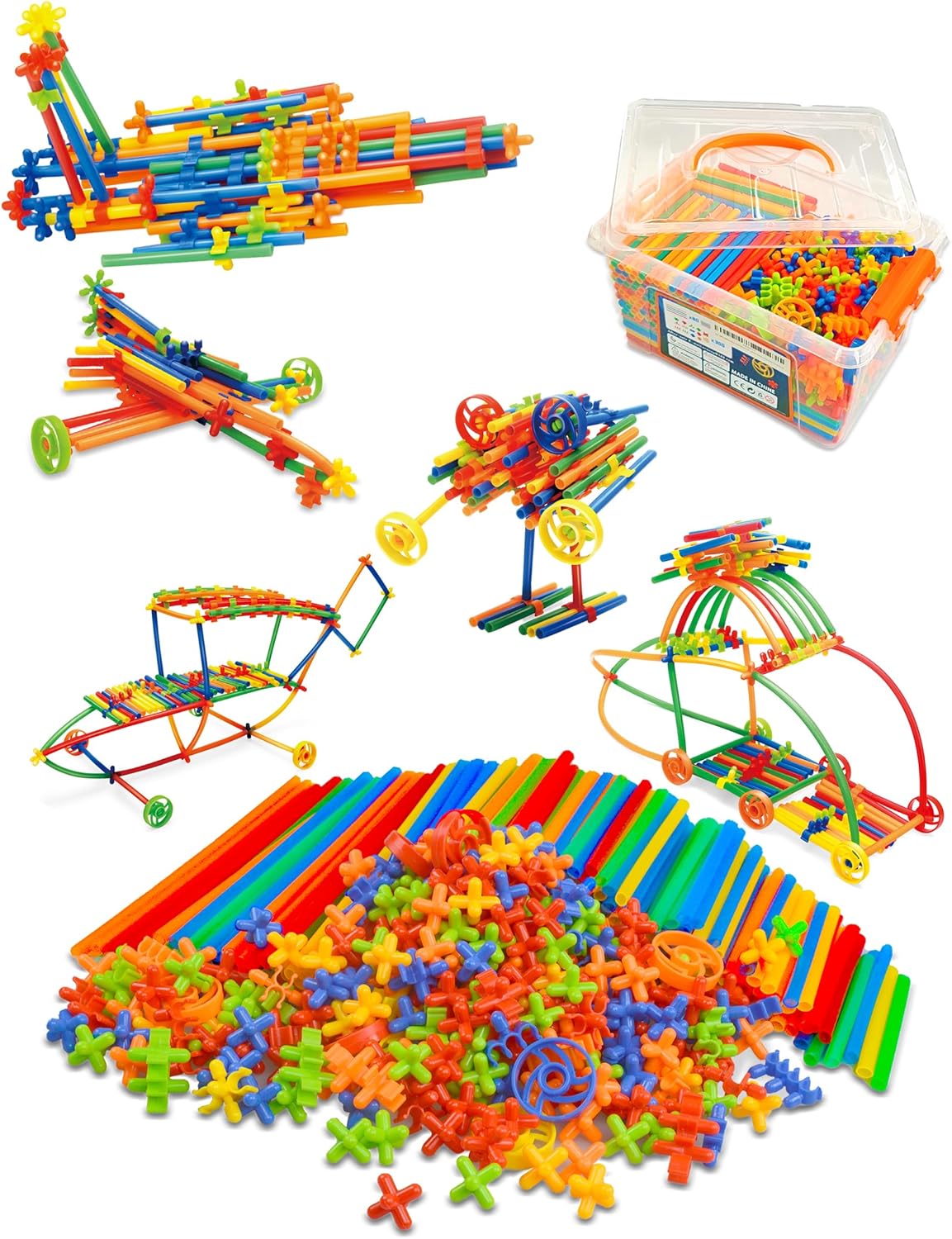
The second straw system on the list is another 600 piece straw constructor, listed as straw construction toys with 600 pieces. It overlaps with the other straw set in piece count, so the choice between them comes down to the listing details and personal preference. As a group activity, though, this one stands out because of how many hands it can employ at once. Three or four children can each take a corner of a structure and meet in the middle, which makes it a lively team project.
Straw constructors turn math into something physical. Each straw is a line segment, each connector a corner, and kids quickly learn how many sides make a square, a pyramid or a cube. They also discover that a flexible frame can sag under weight, then fix it by adding diagonal braces, which is exactly how real bridges and cranes are made stronger. Big structures also create a hands free kind of fun afterward, because kids crawl through or around what they built.
This set suits a classroom, a scout group or a family with three or four kids who want to build something big together. It also appeals to children who find snapping bricks too limiting and would rather design an enormous structure. The listing does not state an age range, so treat it as a preschool and up style set and confirm on the live page. Parents of children who love fort building often find that this set satisfies the same urge with less cleanup than blankets and chairs.
Plan ahead for cleanup and storage: a bag or tub with a lid prevents scattered connectors. Younger children who still mouth objects need constant supervision, and adults should check connectors for wear over time. Because it uses a similar concept to the other straw set, families rarely need both, so pick whichever listing details suit you. A simple rule that nobody pulls apart another child’s build without asking prevents most arguments.
How to Choose the Best Stem Toys
What Actually Makes a Toy a STEM Toy
A toy earns the STEM label when it asks a child to do something that science, technology, engineering or math also asks: observe, plan, build, check and adjust. A set of connecting pieces qualifies because the child has to decide how parts fit together and whether the result holds up. A toy that only lights up and plays a song, by contrast, tells a child what to do rather than letting them figure it out.
This is why the picks in this guide focus on construction. Blocks, straws, bolts and connectors turn abstract ideas such as balance, symmetry and load into things a small hand can feel. Marketing words matter less than the experience, so look for open ended parts, a way to rebuild, and room for mistakes. If a toy lets a child fail safely and try again, it is doing real STEM work.
Matching the Toy to Age and Skill
Age labels are a starting point, not a verdict. A three year old usually does best with larger, chunkier pieces and simple snap together actions, while a six or seven year old can handle screws, small connectors and written instructions. Most of the sets here cover wide bands such as 3 to 8, so think about your child’s patience and hand strength as much as the number on the box.
A useful trick is to picture the first ten minutes. Will your child be able to start alone, or will they need you beside them? Neither answer is wrong, but it shapes the choice. Kids who give up quickly do well with fewer, easier pieces, while confident builders may feel bored by a small starter set and enjoy a larger or multi model kit more.
Why Piece Count Is Only Part of the Story
A big number looks impressive on a listing, yet piece count alone does not make a toy better. Two hundred identical connectors give less variety than one hundred pieces in several shapes. Think about how many different things a child can make, how big those things can get, and whether the set grows with them over several years rather than just filling a bigger box.
Larger counts do help in a few cases: two children sharing, a group activity, or a child who wants to build something taller than a table lamp. Smaller counts help when storage is tight or a child is easily overwhelmed. The sets in this guide range from the 167 and 170 piece options to the 215 piece block set and two 600 piece straw systems, so there is a fit for each situation.
Block Sets Versus Straw Constructors
Block sets give children solid, stable models that look like real vehicles or animals, and they suit kids who love finishing and displaying a project. Straw constructors give an airy skeleton that teaches structure, since a wobbly frame must be braced to stand. Neither is better, but they develop slightly different habits: blocks reward precision and imagination, straws reward trial and error and geometry.
If you can only buy one, think about your child’s play style. A storyteller who wants a car to drive across the carpet will prefer blocks. A child who likes to see how things stand up, and who enjoys making huge frames, may adore straws. Some families buy one of each across a birthday and a holiday, and the two systems rarely duplicate each other.
Power Tool Sets and Why Supervision Matters
The 195 piece set with a kid safe electric drill brings a motor into the mix, which makes it exciting and also calls for adult attention. A drill turns screws faster than fingers, so a child should learn to keep hands clear, hold the model steady and stop when something jams. Setting a few simple rules before the first build keeps it fun and avoids frustration for everyone involved.
Check what the listing says about power, since many drill sets use batteries that may need to be bought separately. Keep screws and small fasteners in a tray so they do not roll away, and store the drill out of reach when playtime ends. For children at the younger end of the age band, an adult might hold the model while the child operates the tool.
Materials, Labels and Safety Basics
Most listings in this category give little detail about the plastic or other materials, and this guide does not guess. Instead, look at the live page for age grading, small parts warnings and any compliance statements the seller includes, and treat any missing information as a reason to read further. In the United States, children’s products are expected to meet CPSIA requirements, and in Europe the EN71 toy standard applies, so reputable sellers often mention them.
Whatever the standard, small parts are the main hazard for children under 3, which is why every pick here lists a minimum age of 3 or older. Inspect pieces from time to time for cracks, sharp edges or loose fits, and throw out any damaged parts. Supervise kids who still mouth objects, and keep construction sets away from babies and toddlers in the house.
Storage, Sorting and Keeping Pieces Together
Construction toys live or die by storage. A set with hundreds of parts needs a tub with a lid, a zip bag or a shallow tray, and ideally a place where a half finished build can sit untouched overnight. Without a system, pieces disappear into couches and the set gradually becomes less fun as parts go missing. Even a simple shoebox lined up on a shelf is better than leaving parts spread across the floor.
Make sorting part of the play. Children can group straws by color, blocks by shape or connectors by size, which is counting and classifying practice disguised as tidying. A rule that the set goes back in the bin before dinner keeps the habit simple, and a clear plastic bin lets kids see what is inside so they are more likely to start building again.
Budget Logic Without Quoting Prices
Prices shift by seller and season, so this guide never prints numbers. A sensible way to think about value is cost per hour of play: a set that gets rebuilt weekly for a year is worth more than a novelty that is forgotten after a weekend. Open ended parts, many model options and room for siblings to share all stretch the life of a toy.
Compare listings by what is included: piece count, number of model ideas, tools or extras, and the age span. A wider age span usually means longer use. Also consider whether you already own similar bricks or connectors, since duplicating a system wastes money. If a purchase is meant as a gift, remember that a modest set with a good storage bag is often better than a huge set that overwhelms the child.
Building a Simple Learning Path
A good learning path starts easy and grows. For ages 3 to 4, begin with stacking, matching colors and building the simplest shapes. For ages 5 to 6, add instruction following, symmetry and small challenges such as building a bridge that holds a toy car. For ages 7 and up, introduce design goals, like making a model that survives a gentle shake or carrying a small load across a gap.
Parents can guide with questions rather than answers. Ask what would make a tower stronger, what happens if the base is wider, or how many pieces a model might need before building it. Let the child predict first, then check. This habit of guess, build and compare is the heart of scientific thinking and costs nothing beyond a few minutes of attention.
Common Mistakes Parents Make with STEM Toys
One common mistake is buying for the age printed on the box rather than the child in front of you. A set that is too advanced causes tears, and one that is too simple gets ignored. Another is hovering: if a parent builds the whole thing, the child learns little. Offer help when asked, and otherwise let the struggle happen, since the struggle is the lesson.
A third mistake is forgetting storage and supervision until the pieces are everywhere. A fourth is treating the toy as a one time event rather than a system that grows. Rebuild old models in new ways, add a challenge card of your own, and invite friends over to build together. Small habits like these turn a single purchase into months of learning.
Gift Tips for STEM Toys
When buying for another family, pick a set with a clear age range and a wide appeal, such as the large pack or the balanced 170 piece option. Check the live listing for delivery windows and order early for birthdays and holidays. Include a gift receipt, and mention that some sets need batteries or tools, since a power drill kit is no fun without them.
Wrapping ideas can add to the fun. Put the pieces into a reusable bin and wrap the bin, or tuck a small notebook and pencil inside so the child can sketch designs. If siblings are involved, choose a set big enough to share. Avoid sets with tiny parts when a younger brother or sister under 3 lives in the home.
Frequently Asked Questions
What are STEM toys?
STEM toys are playthings that let children explore science, technology, engineering or math through active doing, such as building, sorting and solving small problems. In this guide that mostly means construction sets, because building asks kids to plan, adjust and try again.
What age should a child start with STEM toys?
Children can start around age 3 with large, simple pieces, as long as an adult supervises small parts. Most sets here list ages 3 to 8, and more complex kits that build ten models suit ages 5 and up better.
Which type is best for a preschooler?
A simple block set or straw constructor with an adult nearby works best. The 170 piece creative set and 180 piece large pack both include 3 or 4 in their age targets. Choose fewer pieces if your child gets overwhelmed.
Is a kit with a drill safe for young children?
The listing calls the 195 piece drill set kid safe, but any motor driven toy needs supervision. Show your child how to hold the model, keep fingers clear and stop when it jams. Younger children may need help.
How many pieces do I really need?
It depends on how many children are playing and how big they want to build. A set in the range of 170 to 215 pieces suits one or two kids, while the 600 piece straw sets suit groups or very large projects.
Are straw constructors better than building blocks?
Neither is better, they simply teach slightly different things. Straws show how structure and shape work, while blocks suit finished models and pretend play. Many families enjoy having both types and switching between them across the year.
How do I store a big STEM set?
Use a lidded tub, a zip bag or a shallow tray, and keep a clear bin if possible so kids can see the contents. Sorting pieces by color or shape at cleanup time turns tidying into extra learning practice.
Are these toys safe for children under 3?
No. Every pick here lists a minimum age of 3 or older because of small parts. Keep construction sets away from babies and toddlers, and check pieces regularly for damage. Always read the age grading on the live listing.
How can I make a STEM toy more educational?
Ask questions before and after building: what will make it stronger, how many pieces will it need, why did it fall? Let the child predict and then check. Set small challenges like building a bridge a toy car can cross.
Do I need batteries or extra tools?
Only some sets do. The drill kit likely needs a power source, and the listing may not include it, so read the live page. Block and straw sets generally rely on hand assembly. Always confirm what is in the box before gifting.
The Bottom Line
Our top pick for most families is the 170 piece creative building set, a well balanced starter that fits ages 4 to 8. It is easy to begin with, flexible enough for open play and sized well for storage.
If your child loves tools, choose the drill set; for large builds pick a 600 piece straw system or the 215 piece block set. Whatever you choose, check the live listing for current details, supervise small parts and let the child lead the building.
Updated for the 2027 buying season. Amazon listings and availability change often, so check the product page for current details.


Write Your Review
No reviews yet. Be the first to share your experience!