

As an Amazon Associate we earn from qualifying purchases. If you buy through links on this page we may receive a commission at no extra cost to you. Product details come from Amazon listings and can change.
Finding the best affordable model kits for kids is mostly a question of value. A good kit should keep a child busy for more than one afternoon, teach something real about how things move or fit together, and leave behind a model that is fun to play with or display. This guide looks at nine budget friendly picks for children aged 6 to 12, covering race cars, solar science, hydraulics, engines, metal engineering and space.
Each pick is described from its listing details, so you will see what the kit contains, what skills it asks for and where an adult may need to step in. We also point out honestly where a kit is aimed at older kids or needs extra tools such as glue or paint.
Prices change often and differ between sellers, so we do not quote any. Every product links to its live listing, where you can check the current offer, the age label and the delivery window before you decide.
Key Takeaways
Best Affordable Model Kits For Kids at a Glance
| Product | Our score | |
|---|---|---|
| Klever Kits 4 DIY Wooden Race Best Overall |
9.0 / 10 | Check Price |
| 5 in 1 STEM Kits for Best Variety of Cars |
9.2 / 10 | Check Price |
| STEM Toys for Ages 8-13 Boys Best Solar Science Pick |
9.2 / 10 | Check Price |
| 10 in 1 STEM Toys for Best for Younger Builders |
9.2 / 10 | Check Price |
| Smartivity DIY Pinball Machine Award Winning Best for Game Night |
9.0 / 10 | Check Price |
| Smartivity 2in1 Hydraulic Aeroplane and Dart Best Launcher Kit |
9.2 / 10 | Check Price |
| Buildable 3D Metal Engineering Kit 194-Piece Best for Spatial Skills |
9.0 / 10 | Check Price |
| Playz Large V8 Engine Model Kit Best Engine Model |
8.8 / 10 | Check Price |
| National Geographic Glow in the Dark Best for Space Fans |
9.2 / 10 | Check Price |
How We Chose the Best Affordable Model Kits For Kids
This is a research based guide, not a lab comparison. We read each listing closely, looked at the stated age range, the kind of model, the materials named in the title or bullets, and how much building variety the box offers. We also weighed how well each kit fits a family on a budget, such as several models in one box or a finished piece that can be played with.
Because model kits vary so much, we balanced the list across wooden, plastic, metal and block based builds, and across easy and more demanding projects. Each pick carries an editorial score out of 10 that comes from its features, specs and use case fit. Where a listing leaves out a detail, we speak generally instead of guessing.
In-Depth Reviews
1. Klever Kits 4 DIY Wooden Race: Best Overall

Our score: 9.0/10 iOur editorial score (1 to 10), based on listing specs, features and how well each pick fits its use case. It is not an Amazon customer rating.
4 wooden race cars Build and paint Value kit DIY assembly
The Klever Kits set earns the top spot because it packs the most project time into one box. The listing describes a super value kit with four wooden race cars that your child builds and then paints. That means one purchase can cover a whole weekend, or be shared between siblings who each take a car and give it their own colors. Families who like to spread a purchase across many play sessions will find this box useful, since the building and the painting can be done on separate days.
Wooden car kits like this usually come as flat parts that slot or glue together, followed by a painting stage. The title says Build and Paint Your Own, so the finished cars are a personal craft project rather than a ready made toy. The listing does not state how many paint colors are included, so check the product page before you assume a full paint set is in the box. Wooden kits of this kind are popular for classroom, scout and holiday projects because the same simple steps work for a group of children at once.
This set suits kids who enjoy making things look their own. Building teaches careful hand work and following a pattern, while painting adds a creative finish that STEM only kits often skip. It is a gentle fit for the younger end of the 6 to 12 range, with an adult close by for the first car. A child who enjoys art more than machines is often happier here than with a motor driven kit, and that can be a welcome change of pace for parents.
There are practical points to plan for. Paint and glue can be messy, so cover the table and keep wipes nearby. Let each car dry fully before it goes on a shelf or into play. Small wooden parts can be a concern for little siblings, so keep the work area away from toddlers and store unfinished pieces in a tray. A cardboard sheet under the work area, a cup of water for brushes and a few spare minutes at the end for tidying will keep the whole session relaxed.
2. 5 in 1 STEM Kits for: Best Variety of Cars
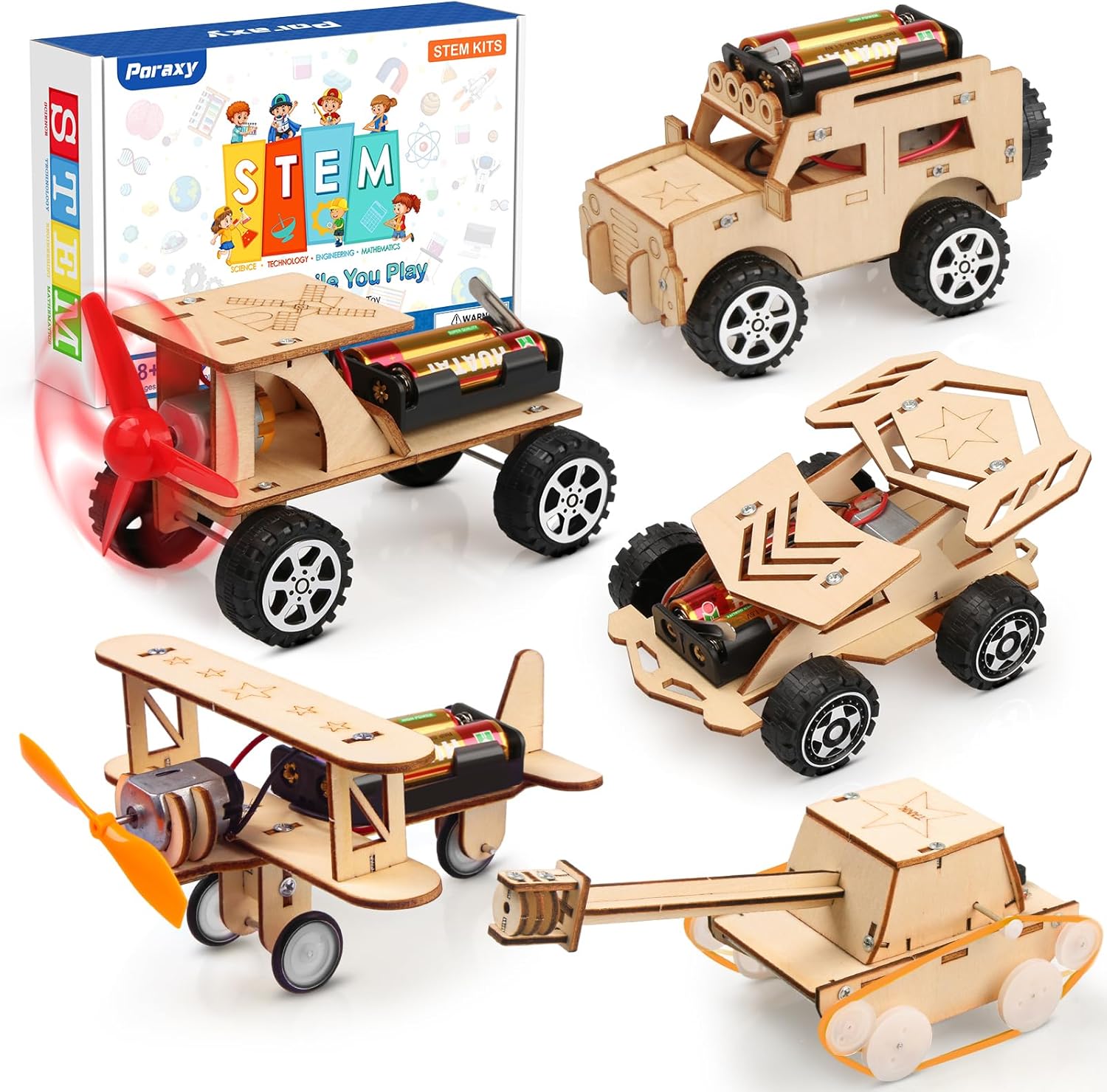
Our score: 9.2/10 iOur editorial score (1 to 10), based on listing specs, features and how well each pick fits its use case. It is not an Amazon customer rating.
5 model cars Ages 8 to 10 STEM kit Science projects
If your child cannot decide on one vehicle, the 5 in 1 STEM kit is the answer. The listing says it holds five different kinds of model cars in one kit, and the title labels it for ages 8 to 10 with science building projects. Five models from a single box is a strong value story for a family watching the budget. For a household with limited shelf space, having five small vehicles instead of five large boxes keeps storage simple and the bedroom floor clear.
Kits in this style generally supply parts for several vehicles, and the child chooses which to assemble first. Because the models differ, each build teaches a slightly different idea about wheels, drive mechanisms and body shape. The listing does not spell out the power source for each car, so read the product page for what is included and what you must supply. Because the cars are different, a child can compare them side by side and talk about which one rolls farthest or looks the most solid.
The kit fits the middle of the age range well. An eight year old who likes instructions will enjoy working through each model in turn, and a ten year old may attempt the later builds with less help. It also works as a simple first lesson in why one design is faster, lighter or steadier than another. Parents who want screen free time on a rainy weekend often look for a kit like this, because several projects are ready to go straight away.
Plan for a tidy workspace, because five models mean many small pieces. A shallow tray with sections keeps parts sorted between sessions. Batteries, if a model needs them, are often sold separately, so check before gift wrapping. An adult should supervise any small parts for younger siblings in the house. Keep the instruction booklet flat and open at the right page, and let your child lay out the parts for each car before starting.
3. STEM Toys for Ages 8-13 Boys: Best Solar Science Pick

Our score: 9.2/10 iOur editorial score (1 to 10), based on listing specs, features and how well each pick fits its use case. It is not an Amazon customer rating.
Ages 8 to 13 4 wooden kits Solar project Wood STEM
This pick stands out for children who ask how things work. The listing describes four sets of wooden STEM kits, including a solar project, and the title gives an age range of 8 to 13. Four separate builds from one purchase stretch the budget nicely, and the solar element adds an energy lesson that many pure building kits lack. A kit with four themes means a child who loses interest in one subject can switch to another without waiting for a new gift to arrive.
Wooden science kits usually combine pre cut parts with a small mechanism, and the solar one would run from light rather than batteries. The listing does not say which models are in the four sets, so check the product page for the full list before you buy. Expect the builds to differ in difficulty, with some quicker and others better suited to patient builders. Wood is also a friendly material for a first science kit, because it is easy to handle and does not feel as fragile as thin plastic.
The wide age range makes this a kit that can grow with a child. An eight year old can learn to follow steps and place parts accurately, while an eleven or twelve year old can think about why the solar model needs bright light to move. It also suits siblings of different ages who want to build side by side. Teachers and home school parents may like the solar project as a lesson starter, followed by a few simple questions about energy and light.
Solar models work best in direct sunshine, so plan a sunny windowsill or a day outdoors for the finale. Wooden pieces can split if forced, so teach gentle fitting. Some glue or small tools may be involved, which calls for an adult nearby. Keep spare parts in a labeled bag so nothing is lost between builds. Let your child predict what will happen before each trial, then write down the result, which turns a simple craft session into a small experiment.
4. 10 in 1 STEM Toys for: Best for Younger Builders

Our score: 9.2/10 iOur editorial score (1 to 10), based on listing specs, features and how well each pick fits its use case. It is not an Amazon customer rating.
10 models Ages 5 and up Building blocks STEM kit
For the youngest builders on this list, the 10 in 1 STEM block kit is the friendliest starting point. The listing says it can be built into 10 different models, and the title speaks to children aged 5 up to 9 and beyond. That is the widest age window of any kit here, which helps when a family has more than one child to buy for. Because each model can be rebuilt after it is taken apart, a single box can stay in rotation long after a one shot kit would be finished.
Block based kits work by clicking or snapping parts together, so there is no glue, paint or sharp tool to manage. The child follows the guide for one model, then takes it apart and starts another. The listing does not say how many pieces are included, so rely on the product page for the exact parts count. Sets like this are often chosen for car trips and quiet time, since everything fits in one container and no mess is involved.
This set suits a five or six year old who needs a clear, forgiving build, and it still has room for a nine year old who wants to design something new. It teaches sequencing, shape matching and early engineering ideas. Because the models are rebuilt many times, the value per hour of play can be high. A sibling pair with a few years between them can share the kit, with the older child reading the guide aloud while the younger one places the pieces.
Be honest about the age label: blocks can include small pieces, so children under the stated age or with younger siblings need close adult supervision. Sort pieces into a box with a lid after each session. Take photos of favorite models before dismantling them, so a child can rebuild their best design later. A quick tip is to build the first model together at the table, so the child learns how the guide shows each step before working alone.
5. Smartivity DIY Pinball Machine Award Winning: Best for Game Night

Our score: 9.0/10 iOur editorial score (1 to 10), based on listing specs, features and how well each pick fits its use case. It is not an Amazon customer rating.
DIY pinball Build then play Smartivity Listing says award winning
Smartivity makes this pinball machine a standout because the fun does not stop at assembly. The listing says to build it, then actually play it, and the title describes it as an award winning game. We attribute that claim to the listing and have not verified it. The practical point is simple: the finished model is a toy your child will want to use. Games that children build themselves tend to be treated with more care, because the child remembers the effort that went into the machine.
A do it yourself pinball kit usually asks a child to put together a frame, launcher and flippers, then use a ball to chase a score. The listing gives few details about materials or piece counts, so look at the product page for what is included and what tools you might need. The learning comes from seeing how levers and angles shape the ball path. The kit also gives a natural link to a family challenge, such as a friendly contest for the highest score on the machine your child made.
This kit suits a child who likes a clear reward for finishing a project. It also works well for family game time, since two or three people can take turns on the finished machine. Kids aged around 8 to 12 are a good match, though the exact age label is worth confirming on the listing. Children who usually shy away from construction sets sometimes make an exception for this one, since the goal is play and the building feels like a means to an end.
Treat it as a build that rewards patience. If a part sits loosely, the game will feel flat, so encourage careful assembly. Keep the ball in a small cup, because loose balls roll away fast. An adult should help with any small parts if younger children share the room. Setting a rule that the machine lives on a table, and not on the floor, protects both the model and the loose ball.
6. Smartivity 2in1 Hydraulic Aeroplane and Dart: Best Launcher Kit

Our score: 9.2/10 iOur editorial score (1 to 10), based on listing specs, features and how well each pick fits its use case. It is not an Amazon customer rating.
2 in 1 kit Hydraulic power Aeroplane build Dart launcher
This Smartivity kit is the pick for kids who like action. The listing calls it an action packed 2 in 1 hydraulic airplane and dart launcher kit, so a child builds two different models from one box. Getting two working builds in a single kit helps the value case for a family with a modest budget. Two builds from one kit keep a child engaged even after the first model is finished, and that matters when a family wants steady value from a small purchase.
Hydraulic models use fluid pressure, often in a sealed syringe and tube system, to push a part forward. In a kit like this, the child assembles the frame and the hydraulic lines, then watches pressing one end move another. The listing does not describe the exact parts, so check the product page for what is included and any extra items you need. Pressure based toys have a long history in classrooms, because the effect is easy to see and a child can discuss it in simple words.
It suits curious kids aged around 8 and up who enjoy seeing how a mechanism works. The build teaches cause and effect, force and the basic idea of pressure. A dart launcher also adds a target game, which turns the finished model into something to play with and not only to display. Children who enjoy backyard games or competitions will find the launcher a natural centerpiece for a small contest with friends.
Safety deserves a clear mention. Dart launchers should only be aimed at targets, never at people or pets, and eye protection is a sensible habit. Water or fluid in a hydraulic build can leak, so work over a tray. Adults should supervise assembly and the first launches. Set up a clear zone for launching, with a soft target such as a cardboard box, and keep younger children behind a marked line.
7. Buildable 3D Metal Engineering Kit 194-Piece: Best for Spatial Skills

Our score: 9.0/10 iOur editorial score (1 to 10), based on listing specs, features and how well each pick fits its use case. It is not an Amazon customer rating.
194 pieces Ages 8 and up 3D metal build Engineering set
The metal engineering kit is the most grown up build on the list. The listing calls it a buildable 3D metal engineering kit with a 194 piece STEM set, and the bullet says it is a skill builder for ages 8 and up that develops spatial skills. That makes it a good bridge from toy blocks toward real model making. Compared with a block set, a metal kit offers a more adult looking result, which can motivate a child who thinks plastic toys are for little kids.
Metal model kits generally use thin pre cut sheets or parts that are fitted together, often with small connectors. The listing does not state the finished subject, the tools included or the exact material type, so confirm those on the product page. Expect a more careful, slower build than a block set, with many small parts to place correctly. Reading a drawing and then building the shape it describes is the same kind of thinking used in design, architecture and many technical careers.
This kit suits an older child, perhaps 10 to 12, who likes puzzles and patient work. Younger children at the lower end of the label may need an adult sitting alongside. The payoff is a detailed model plus practice in reading a diagram and turning flat parts into a three dimensional shape. A parent who enjoys crafts can build alongside the child, with each person working on a section and the two sides joining up at the end.
Honest caveats matter here. Thin metal edges can be sharp, so adults should check parts and consider gloves or careful handling. Small pieces mean it is not a choice for homes with toddlers within reach. Work on a light colored mat so dropped parts are easy to spot. Keep a small container beside you for tiny parts, and place the instruction sheet where it will not be covered by the pieces.
8. Playz Large V8 Engine Model Kit: Best Engine Model

Our score: 8.8/10 iOur editorial score (1 to 10), based on listing specs, features and how well each pick fits its use case. It is not an Amazon customer rating.
Mini V8 engine Working model Large size Playz kit
Playz offers a different kind of build: a model engine. The listing calls it a large V8 engine model kit where you build your own mini V8, and the bullet says it is a working engine model. For a child who loves cars, seeing pistons and parts move is a strong draw that few other kits match. Many parents buy an engine kit for a child who has already shown interest in how cars work, such as asking questions on a drive or watching a mechanic.
Engine kits typically include a set of parts that fit together to show how a crankshaft, pistons and valves relate. The listing does not say how the model is powered, whether by hand cranking, a motor or batteries, so read the product page for that detail. It also does not give a piece count, so we do not state one. Seeing the parts together makes the idea of an engine less mysterious, and it gives a child new words to use, such as piston and crank.
This kit suits a mechanically minded child, probably around 10 to 12, who can follow a longer set of instructions. It is a useful way to explain what happens inside a car without opening a real engine. Younger kids may enjoy it too, but they will likely need an adult helping. A kit like this can also be a good shared project for a parent and child, with one reading the guide and the other fitting the pieces.
Plan for a patient build and a clean surface. Parts can be small and tight fitting, so avoid forcing them. A small screwdriver may be needed, which makes adult help sensible. Keep any lubricant or battery items away from little hands, and put the finished engine on a shelf where it will not be knocked. Display it on a clear shelf at eye height, and let your child explain how it works to visitors, which is a fun way to build confidence.
9. National Geographic Glow in the Dark: Best for Space Fans

Our score: 9.2/10 iOur editorial score (1 to 10), based on listing specs, features and how well each pick fits its use case. It is not an Amazon customer rating.
Solar system model Glow in the dark Moving display National Geographic
The National Geographic solar system kit is the choice for young astronomers. The listing says you can build and display a moving, glowing solar system, and the title adds glow in the dark. It trades the mechanical focus of the other kits for a science display that looks great in a bedroom at night. A glowing model is a gentle way to turn bedtime into a short science chat, particularly for children who ask big questions about the universe.
Solar system models usually include a base or frame, planet pieces and an arm or rotating part so the planets appear to orbit. The glow in the dark effect generally works by charging the parts under a bright light first. The listing does not give the number of planets, the finished size or the power source, so confirm those on the product page. Space themes are a common school topic, so a model at home can support classwork and help a child remember planet names and order.
This kit suits kids aged around 6 to 10 who love space and enjoy learning planet names and their order from the sun. It is a gentle build, with more of the learning in the display than in the engineering. A parent can turn it into a space night by pointing out each world as it goes around. Families with a child who is nervous about a dark room sometimes find that soft glow objects help, though it should not replace a regular night light.
Keep expectations realistic: it is a model for learning and display, not a precision scale model. Charge the glowing parts under a lamp before lights out. Small parts and any batteries should be handled with adult help. Place it on a stable shelf away from a bed edge, so it does not tumble. Pair the build with a library book about planets, and let your child add facts to a small chart pinned beside the model.
How to Choose the Best Affordable Model Kits For Kids
What makes a model kit affordable value for kids
Real value in a model kit is not only about the amount a family spends. It is about how many hours of building, play and learning one box can deliver. A single kit that builds four cars or ten models gives a child many sessions, which spreads the cost across more play. Think of cost per hour of fun rather than cost per box, and the choice becomes clearer.
Look for kits that include more than one build, a finished item that can be played with, or a design that can be taken apart and rebuilt. A display only model that sits on a shelf can still be a fine buy if the child truly loves the subject, but it delivers a shorter burst of fun. A short list of questions helps: how many builds are in the box, what extras are needed, and will the child return to it? Honest answers will point you toward the better value.
Matching model kits to age and skill from 6 to 12
Age labels on listings are a guide, not a promise. A six year old who loves blocks may handle a click together set easily, while a seven year old who is new to following diagrams may struggle with a metal kit. Think about your own child’s patience and fine motor skills first. If you are unsure, start one step easier than you think is needed, because success early on builds the confidence for harder kits later.
Younger builders do best with snap together blocks and wooden pieces that need little force. Older kids, around 10 to 12, can handle detailed engine or metal builds with many small steps. Where a kit sits between two levels, plan to sit alongside for the first session and step back as confidence grows. A child who finishes a build and feels proud will ask for another, while a child stuck on step twelve may decide that model kits are not for them.
Wood, plastic, metal or blocks: choosing materials
Each material changes the experience. Wooden kits feel natural and often add a painting step. Plastic engine and mechanism kits show moving parts clearly. Metal kits are detailed and demanding. Block sets are forgiving and reusable. None is better in every case, so pick the one that suits the child. Think about where the finished model will live too, since wooden and metal pieces can look fine on a shelf while block builds are mostly for play.
For a first model, blocks or wood are usually the easiest to manage. Save metal and engine builds for children who have shown they can finish a longer project. The listing usually names the main material in its title or bullets, which is a useful first filter. Weight also matters for gifts that travel, because a heavy box can be tiring for a young child to carry or a family to post.
Safety labels and small parts to watch
Model kits are full of small pieces, so the age label matters. Children under three should not be near them, and homes with toddlers need a plan for keeping parts out of reach. Look for the manufacturer age guidance on the listing and respect it. If a family member has allergies or sensitive skin, look closely at paints and glues named on the product page and keep tubs and brushes away from the face.
When a kit includes paint, glue or hydraulic fluid, check what the listing says about materials, and use only products meant for children. Some paints carry labels such as ASTM D4236, which relates to art material safety in the United States. Do not assume a label is present unless the listing states it. It is wise to keep a small first aid kit nearby for splinters or scrapes, and to teach children to tell an adult at once if anything pinches or cuts.
Painting and finishing wooden model kits
Painting turns a wooden car from a plain build into a personal object. Let your child decide on a color plan before they begin, and wash brushes between colors to keep tones clear. Thin coats look neater than thick ones and dry faster. Taking time over the finish also teaches patience, a skill that carries over to homework and sports practice.
Cover the table with paper or a plastic sheet, and wear an old shirt. Let each coat dry before the next one goes on. If a model will be handled often, a clear child safe sealer can help, but check the label first and ask an adult to apply it. Gloss or matte, bright or soft, every choice is part of the project, and that sense of ownership is what makes a painted wooden model feel special.
Solar and science builds: what to expect
Solar kits teach that light can be turned into movement. They need strong light, so direct sunshine works better than a lamp in a dim room. That means a good plan includes a bright spot and some patience while the model starts up. A simple chart in a notebook, with columns for the time of day, the weather and how fast the model moved, gives the experiment a scientific shape.
Treat the build as a lesson. Ask your child what would happen in shade, in the morning or on a cloudy day, and let them try it. Questions like these are what make a science kit more valuable than a plain construction set. Parents do not need to be scientists to help, because asking what happened and why is often more useful than giving the answer straight away.
Working models, from engines to hydraulics
Working models show a mechanism in action, which can be more memorable than reading about it. An engine model shows pistons and cranks moving, while a hydraulic kit shows how pressing one end can move another. These ideas appear in real machines like cars and diggers. Letting a child try to fix the problem first, with a gentle nudge, builds resilience as well as technical skill.
Because they have moving parts, these kits need careful assembly. A loose part can stop the model from working, which can frustrate a child. Encourage slow, steady building and a check of each step against the guide before moving on. When the model finally runs, the sense of success is often greater than with an easy kit, which is a good reason to match challenge to age with care.
Storage, workspace and keeping parts together
A good workspace saves a lot of stress. Choose a table where a half built model can stay between sessions, and use a tray or muffin tin for small parts. A light colored mat shows dropped pieces much more easily than a patterned floor. Clear boxes let a child see what is inside without tipping everything onto the floor, which saves a lot of time at clean up.
Store spare pieces in a labeled bag and keep the instruction sheet with the kit. A shoebox with a lid works well for a family with several kits. Taking a quick photo of a half finished build helps a child pick up where they left off. Make a habit of counting out a few key parts at the end of the session, so that missing pieces are noticed quickly and are easier to find.
Care and longevity for finished models
Finished models last longer when they are treated gently. Dust wooden and plastic pieces with a soft dry cloth, and keep them away from damp places. Display models, such as a solar system or an engine, do best on a stable shelf out of reach of flying balls. Avoid direct heat, such as a radiator or a window with strong sun all day, which can warp thin plastic or fade painted wood.
If a model is meant to be played with, accept that a few knocks are part of the fun. Keep spare parts and a small tube of child safe glue handy for repairs. Fixing a model together can teach as much as building it. A little regular checking, such as tightening a loose part or wiping away fingerprints, keeps a model looking good for years and helps it survive moves and gifts to a cousin.
A simple learning path from first kit to advanced
A smart path starts with a forgiving build such as a block kit or wooden cars, then moves to mechanism and science kits, then to engine and metal models. This order builds confidence and spares kids from a kit that is too hard too soon. Keep a note of which models were completed and which are still waiting, which gives children a feeling of progress and a reason to pick up the next box.
At each stage, ask the child to explain how a part works before moving on. Then let them change something, such as a color, a design or a launching angle. Small experiments turn following instructions into real problem solving. If a child reaches the end of the path and wants more, they are ready for larger sets from craft stores or hobby shops, with more detail and a higher level of difficulty.
Common mistakes when buying budget model kits
The most common mistake is buying a kit that is too hard. A frustrated child may drop the project and the value is lost. Another is overlooking what is not included, such as glue, paint, batteries or tools, which can add extra cost and delay. Another trap is ignoring the work area, since a kit that needs a big clear table may not suit a small home or a shared bedroom.
Also be wary of kits that look impressive in photos but offer only one quick build. Read the listing for the number of models, the age label and the materials. A calm look at these details avoids most disappointment. Some parents also expect the child to build alone, but most kids in this age range do better with an adult close by, at least for the first model.
Gift tips for model kits at any budget
Model kits make good gifts for birthdays, holidays and rainy day boxes. Pick a subject the child already loves, such as cars, space or games, and check that any needed batteries or paint are included or added to the gift. A handwritten card describing the plan, such as a promise to build the first model together, can mean more to a child than the box itself.
Order early, and check the delivery window on the live listing, since stock and shipping times change. Add a gift receipt and a small extra, such as brushes or a storage box. A kit that is shared between siblings can stretch a gift budget well. If the budget is tight, choose one kit and add something low cost to go with it, such as a notebook for design ideas or a small container for parts.
Frequently Asked Questions
What are the best affordable model kits for kids?
The best value kits give several builds in one box or a model you can play with afterward. In this guide, the Klever Kits wooden race cars, the 5 in 1 STEM kit and the 10 in 1 block kit all stand out for variety.
What age are model kits suitable for?
Most kits here are aimed at roughly 5 to 13, but the labels differ. Block kits suit younger children, while engine and metal kits suit older ones. Always check the age label on the live listing.
Do these kits need glue or paint?
Some do. The wooden race car kit involves painting, and other kits may use glue or small tools. The listing does not always say, so read the product page and have child safe supplies ready.
Are model kits safe for young children?
Model kits contain small parts, so adult supervision is essential, especially for children under the age label or homes with toddlers. No kit can be guaranteed safe, so follow the manufacturer guidance on the listing.
Which kit is best for a child who likes cars?
The Klever Kits race cars and the 5 in 1 STEM car kit are strong choices for car fans. The Playz V8 engine is a good step up for an older child who wants to see how engines work.
Which kit teaches the most science?
The 4 set wooden STEM kit with a solar project and the hydraulic aeroplane and dart launcher both teach clear science ideas. One covers light and energy, and the other shows fluid pressure at work.
Can siblings share one kit?
Yes, kits with several models are ideal for sharing. The race car set, the 5 in 1 kit and the 10 in 1 block kit let each child build a different model. Agree on turns before opening the box.
Do model kits need batteries?
It depends on the model. The listing does not always state the power source, so check the product page. Solar kits run on light, while some engine or glow models may need batteries sold separately.
How long does a model kit take to build?
Build time varies with the kit and the child. Block and wooden sets may take an hour or two per model, while engine and metal kits can take several sessions. Plan breaks and a place to leave work.
How do I keep small parts from getting lost?
Use a shallow tray, a muffin tin or labeled bags, and work on a light colored mat. Keep an old box with a lid for storage. Checking the table after each session helps to catch strays.
The Bottom Line
The best affordable model kits for kids give more than one build and teach something along the way. Our top pick, the Klever Kits set of 4 wooden race cars, delivers that with a creative painting step, and it is easy to share.
If your child prefers science, try the wooden solar set. For variety, choose the 5 in 1 STEM car kit. Always check the live listing for the age label, power needs and what is in the box.
Updated for the 2027 buying season. Amazon listings and availability change often, so check the product page for current details.


Write Your Review
No reviews yet. Be the first to share your experience!