

As an Amazon Associate we earn from qualifying purchases. If you buy through links on this page we may receive a commission at no extra cost to you. Product details come from Amazon listings and can change.
Looking for the best stem toys for 8 year olds? This guide gathers nine kits and games that suit that exact stage, when children can read instructions on their own, hold a longer project in mind and ask why things work. The picks cover electronics, gears, hydraulics, chemistry, marble physics and logic, so you can match a toy to the child rather than to a label.
Eight is a sweet spot for science and engineering play. Kids are past the stage of simply stacking and not yet ready for the abstract parts of school science, so a hands busy kit that shows a result bridges the gap nicely. We looked at each listing for age range, parts, and the kind of thinking it asks for, and we note where a pick needs an adult nearby.
Prices change often, so we do not quote any here. Each product links to a live listing where you can check the current offer, delivery window and full contents before you order. Read the age notes on the page, because a few of these include small parts, glass marbles or chemicals that call for supervision.
Key Takeaways
Best Stem Toys For 8 Year Olds at a Glance
| Product | Our score | |
|---|---|---|
| SNAP CIRCUITS Explorer SC-100 Electronics Kit Best Overall |
9.6 / 10 | Check Price |
| ThinkFun Gravity Maze Marble Logic Game Best Logic Puzzle |
9.2 / 10 | Check Price |
| Klutz LEGO Gear Bots Science and Best Gear and Motion Kit |
9.2 / 10 | Check Price |
| Smartivity Robotic Mechanical Hand STEM Toy Best Screen Free Build |
9.2 / 10 | Check Price |
| Smartivity DIY Pinball Machine Best for Game Night |
9.0 / 10 | Check Price |
| Smartivity Hydraulic Paper Airplane and Dart Best for Outdoor Play |
9.2 / 10 | Check Price |
| National Geographic Magic Chemistry Set with Best Science Show |
9.4 / 10 | Check Price |
| National Geographic Glowing Marble Run Construct Best Glow in the Dark Build |
9.4 / 10 | Check Price |
| National Geographic Circuit Kit with 120 Best Video Guided Projects |
9.4 / 10 | Check Price |
How We Chose the Best Stem Toys For 8 Year Olds
This is a research based guide, not a lab comparison. We read each listing closely, noted the stated age range, the parts and the type of activity, and weighed how well each one fits an eight year old who is curious but still needs clear steps. We also considered safety points that matter at this age, including small parts, water, glass marbles and chemicals.
We aimed for balance, so the list spans electronics, mechanics, fluid power, chemistry, spatial logic and construction rather than nine versions of the same idea. Every pick also carries an editorial score out of 10, based on its features, specs and how well it fits the use case. Where the listing leaves out a detail, we speak generally and suggest checking the live page.
In-Depth Reviews
1. SNAP CIRCUITS Explorer SC-100 Electronics Kit: Best Overall

Our score: 9.6/10 iOur editorial score (1 to 10), based on listing specs, features and how well each pick fits its use case. It is not an Amazon customer rating.
Ages 8 and up 100+ projects 29 parts Color instruction book
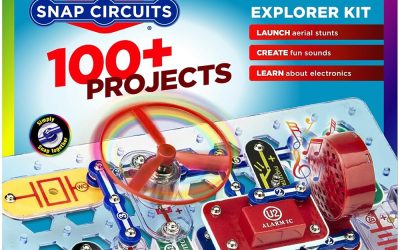
Snap Circuits Explorer SC-100 takes the top spot because it matches the age, the subject and the pace of a typical eight year old better than any other pick here. The listing describes a snap together electronics kit with more than 100 projects, which means a child can keep finding new things to build for months instead of finishing everything in one weekend. Electronics sounds like a teenager topic, yet this format keeps it friendly and low pressure.
Inside the box, the listing mentions 29 parts and a colorful instruction book. The parts snap onto a base grid, so there is no soldering and no loose wire to strip. A child follows the picture for each project, places the numbered pieces in order, and then watches a light, sound or motor respond. That quick cause and effect loop is what makes circuits click for young builders, because the result of a mistake is visible straight away.
This set suits a child who asks how things work and enjoys following diagrams. It teaches that electricity needs a complete loop, that switches open and close that loop, and that different parts do different jobs. Those ideas carry straight into school science units about energy. Reading the book also gives practice with sequencing, which is a quiet coding skill, and many kids start inventing their own layouts once the first few projects are done.
A few practical points are worth planning for. The listing does not say whether batteries come in the box, so check the live page and keep spare ones handy. The small snap pieces can go missing, so a shallow tray helps. An adult should be nearby for the first session, mostly to explain the book and to keep small parts away from younger siblings. Once the routine is set, most eight year olds work alone.
2. ThinkFun Gravity Maze Marble Logic Game: Best Logic Puzzle

Our score: 9.2/10 iOur editorial score (1 to 10), based on listing specs, features and how well each pick fits its use case. It is not an Amazon customer rating.
Ages 8 to 12 9 towers 3 marbles Game grid and target piece
Gravity Maze from ThinkFun earns the logic puzzle award because it turns spatial reasoning into a quiet, focused challenge. The listing describes a marble puzzle for ages 8 to 12, and that range fits well for a child who likes brain teasers more than building kits. It is also one of the easiest items here to slip into a backpack for a trip, since nothing needs an outlet or a work surface larger than a tray.
The listing names nine towers, three marbles, a game grid and a target piece. A challenge card shows where some towers start on the grid. The player has to place the remaining towers so that a marble dropped from the top travels through them and lands on the target. Gravity does the checking, so there is no need for an adult to confirm the answer. Either the marble arrives or it does not.
What it teaches is planning ahead. A child must picture the path of the marble, think about heights and openings, and then adjust when the first guess fails. That habit of trying an idea out in the head before moving a piece is the heart of engineering thinking, and it is a good counterweight to the louder, light up toys on many wish lists. Parents of eight year olds will find the early cards approachable and the later ones properly tough.
On the downside, this is a solo puzzle at heart, so a sibling may end up watching. Marbles roll under furniture, so play over a rug or a tray and count the three marbles before packing up. The small marbles are also a reason to keep it away from toddlers in the house. Because the challenges are fixed, a very quick solver may eventually exhaust the booklet, though the satisfaction of a clean solve keeps many children coming back.
3. Klutz LEGO Gear Bots Science and: Best Gear and Motion Kit

Our score: 9.2/10 iOur editorial score (1 to 10), based on listing specs, features and how well each pick fits its use case. It is not an Amazon customer rating.
Ages 8 to 12 8 kinetic creatures LEGO Technic bricks 64 page book
Klutz LEGO Gear Bots brings mechanical ideas to the list in a way that feels like play rather than a lesson. The listing says a child can build eight kinetic creatures from LEGO Technic bricks and papercraft, guided by a 64 page book on axles, cams and cranks, for ages 8 to 12. It earns the gear and motion award because few other kits on this page focus so squarely on how turning parts create movement.
The format is a book and a build set in one package. Each creature moves when a crank turns, and the pages explain which part converts the circular motion into a walk, a flap or a bounce. Mixing bricks with folded paper details keeps the creatures charming and gives the child a craft element along with the mechanics, which suits children who like drawing as much as building. Reading each page aloud together also helps.
This kit suits a child who already enjoys brick play and is ready to ask why a model moves. Axles, cams and cranks are the same simple machines found in toys, clocks and engines, so the vocabulary pays off later in school. Reading a short explanation, building a mechanism and then watching it work is a strong learning cycle for eight year olds, who often learn best when the explanation and the movement arrive together.
A few cautions apply. The creatures are made partly of paper, so they are display and gentle play items rather than rough toys. Small bricks mean an adult should keep the kit away from younger children. Because the build set is a fixed model line up, the parts are not a general brick collection, though the Technic pieces can still be mixed into other builds. Give the child a clear table and a small tray before starting.
4. Smartivity Robotic Mechanical Hand STEM Toy: Best Screen Free Build

Our score: 9.2/10 iOur editorial score (1 to 10), based on listing specs, features and how well each pick fits its use case. It is not an Amazon customer rating.
Ages 8 to 14 Mechanical hand Step by step manual Replacement parts for life
The Smartivity Robotic Mechanical Hand is the pick for families who want a serious build without a tablet in sight. The listing calls it a screen free STEM toy for ages 8 to 14, and that wide band means an eight year old can start now while still finding it interesting for a few years. A working hand is also an impressive thing to show grandparents or classmates. It is a gift that looks as clever as it is.
According to the listing, the child builds a mechanical hand from a step by step manual, and the maker offers replacement parts for life. That second detail is unusual in this category and speaks to durability, because a lost or snapped part does not have to end the project. The manual drives the whole process, so the pace is set by how carefully the builder reads and fits each piece.
The learning here is about levers, tension and how a simple pulling motion can make fingers curl. A child sees that a human hand is a mechanism, which links the toy to biology as well as engineering. Patience matters more than speed, so it suits a calm builder who enjoys finishing something that works, and it can be a rewarding project to share with a parent or older sibling on a rainy afternoon.
As a caveat, eight is at the lower end of the listed range, so expect to help with the trickier steps and with any fiddly threading. Plan a clear table, good light and a free afternoon, because rushing leads to mistakes that mean going back several pages. Small parts are involved, so keep the tray away from younger children. Once built, the hand is more of a display and demonstration model than a rough play item.
5. Smartivity DIY Pinball Machine: Best for Game Night

Our score: 9.0/10 iOur editorial score (1 to 10), based on listing specs, features and how well each pick fits its use case. It is not an Amazon customer rating.
Ages 8 and up Spring launcher Flippers Scoring targets
Smartivity DIY Pinball Machine wins the game night award because the child builds the game first and then the whole family gets to play it. The listing describes a working pinball machine with a spring launcher, flippers and scoring targets, for ages 8 and up. That combination makes it a project and a toy at once, which is a rare find for a family with a mix of ages around the table.
The kit is assembled by hand from the parts in the box. The launcher fires the ball up the playfield, the flippers keep it in play, and the targets let players keep score. Because the child put each mechanism together, the cause of any rattle or sticking point is easier to understand and fix. That connection between building and playing is exactly what turns a toy into a lesson in mechanics.
This one suits a competitive child who likes arcade games but is happy to build. It teaches springs, levers and angles, since a slightly different flipper position changes where the ball goes. It also offers a chance to practice taking turns, keeping score and being a gracious loser, which are skills every game night rewards. Siblings can help with assembly and then trade high score challenges for weeks. Those habits reach well beyond the game itself.
There are a few things to know. Assembly needs time and a steady table, so do not start it ten minutes before guests arrive. The ball is small, so supervise around younger children. The machine is a build and play model, not a full size arcade cabinet, so set expectations on size and speed. Store it on a shelf between sessions, because the launcher and flippers are best kept free from pressure and knocks.
6. Smartivity Hydraulic Paper Airplane and Dart: Best for Outdoor Play

Our score: 9.2/10 iOur editorial score (1 to 10), based on listing specs, features and how well each pick fits its use case. It is not an Amazon customer rating.
Ages 6 to 14 Water powered Laser cut wood Paper planes and foam darts
The Smartivity Hydraulic Paper Airplane and Dart Launcher is the clear choice when the goal is to get an eight year old away from the couch and into the yard. The listing says the child assembles a water powered hydraulic launcher from laser cut wooden parts, and that it fires paper planes and soft foam darts for ages 6 to 14. It joins a build project to active outdoor play.
Hydraulics is the key idea. Pressing a plunger pushes water through a tube and the fluid carries the force to the launch end, which is a close cousin of the systems in car brakes and construction machines. The wooden parts press together into a frame, and the foam darts keep the target practice gentle. Folding paper planes adds a second small project, because every plane flies a little differently. Each launch is a small lesson in pressure.
The kit suits a hands busy, outdoorsy child who enjoys experiments with a visible result. It teaches fluid power, aim and the effect of design changes, since a tighter fold or a different dart changes the distance. Because the age range starts at six, a younger sibling can join in the target game while the older child acts as the engineer and range officer, which is a good way to share one toy between ages.
Practical notes are simple. Water means it should be filled and used outdoors or over a tiled floor, and the wooden parts are best dried after each session. Launch only at targets, never at faces or pets, and keep an adult nearby for the first few shots. Small parts are part of the assembly, so tidy up carefully. Check the live listing for exact size so you can plan a place to store it.
7. National Geographic Magic Chemistry Set with: Best Science Show

Our score: 9.4/10 iOur editorial score (1 to 10), based on listing specs, features and how well each pick fits its use case. It is not an Amazon customer rating.
Ages 8 to 12 10 experiments Magic wand and gloves Illustrated guide
The National Geographic Magic Chemistry Set earns the science show award because it wraps real experiments in a performance. The listing describes ten science experiments that are performed as magic tricks, for ages 8 to 12, with a magic wand, white gloves and an illustrated guide. For a child who finds a plain experiment a bit dry, the stage presence makes chemistry feel like a secret. Presentation turns each experiment into a memory.
The illustrated guide walks the child through each trick, and the props set the scene. A chemical change that looks like magic, such as a color shift, becomes a trick that can be rehearsed and shown to family. The guide supplies the explanation behind each effect, so after the applause the child learns what actually happened. That mix of showmanship and cause and effect is a clever route into chemistry.
This is an excellent match for a confident, talkative eight year old who likes an audience. It encourages reading instructions, following a sequence in order and speaking clearly while presenting. It also introduces the idea that science explains things that seem impossible. Many children will repeat a favorite trick and add their own patter, which is a good sign that the ideas are sticking beyond the first read. Its guide even helps with the presenting part.
Because this is a chemistry set, adult supervision is a must. Read the safety notes in the guide, work on a protected surface, and keep the set away from younger children and pets. Wear the gloves as directed and wash hands afterward. The listing does not detail every material, so look at the live page and the instructions before starting. Plan for some spills, and keep paper towels close at hand.
8. National Geographic Glowing Marble Run Construct: Best Glow in the Dark Build

Our score: 9.4/10 iOur editorial score (1 to 10), based on listing specs, features and how well each pick fits its use case. It is not an Amazon customer rating.
5 bases 15 action pieces 45 clear track pieces 15 glow marbles
The National Geographic Glowing Marble Run is a showy construction set that gets the glow in the dark award. The listing gives clear counts: five bases, fifteen action pieces, forty five clear track pieces and fifteen glow in the dark glass marbles, plus a storage bag. Those numbers show that this is a full sized build, not a token set, and they give a child lots of room for layouts.
The track pieces are clear, so the marbles are visible as they travel, and the action pieces add twists, drops and other effects along the way. The glow marbles charge in light and then shine in a dim room, which turns each run into a small light show. Because the parts are modular, a child can rebuild the course repeatedly and chase a longer, faster or more complicated route each time.
Marble runs teach gravity, momentum and trial and error. An eight year old will quickly learn that a steeper slope speeds a marble up and that a gap in the wrong place causes it to fall out. Working with siblings to plan a course adds cooperation and planning to the mix. The activity suits kids who like construction but want something that keeps moving after the building is done. A parent can join in for a joint challenge.
Take note of a few downsides. Fifteen small glass marbles are a choking hazard for younger children and can roll far, so play on a rug and keep count. The glow effect depends on charging them in light first. The storage bag helps with cleanup, but long tracks take floor space, so choose a corner where a build can stay up for a few days. Supervise the glass marbles carefully.
9. National Geographic Circuit Kit with 120: Best Video Guided Projects

Our score: 9.4/10 iOur editorial score (1 to 10), based on listing specs, features and how well each pick fits its use case. It is not an Amazon customer rating.
120+ projects Keyboard mode Light shows Video help via QR code
The National Geographic Circuit Kit offers the biggest project count in the list, which is why it takes the video guided award. The listing says it contains more than 120 electrical projects, including keyboard mode, light shows and a flying copter, and that it provides video instructions through a QR code. For a child who learns best by watching, that video support is a real advantage. That variety keeps a busy mind engaged for a long while.
The projects are varied. A keyboard mode lets a child play tones, light shows add color and effects, and the flying copter is a showpiece that gets attention at once. Scanning the QR code opens video guidance for builds, so a child who gets stuck can watch a step instead of waiting for an adult. The listing does not describe each part, so check the live page for the contents.
This kit suits a child who likes a mix of music, light and motion in one box. It teaches basic circuit ideas, how parts connect, and why order matters when building. Because the projects range from simple to more involved, it is useful for building confidence step by step. It also pairs nicely with a first kit, since a child who has done a snap together set will find the same ideas in a new format.
Remember the video support depends on a phone or tablet to scan the code, so the build is not entirely screen free. Check the live listing for battery needs and keep spares ready. Small parts and moving copter blades mean an adult should supervise the first flight, and the copter should be used in an open room away from faces. Keep the parts organized, because a project count this big means plenty of pieces.
How to Choose the Best Stem Toys For 8 Year Olds
What makes a STEM toy right for an 8 year old
A good STEM toy at this age asks a child to build, predict and adjust, not just press a button. Look for projects with a visible result, such as a light, a moving creature or a marble reaching a target. The best kits give feedback instantly, so a child learns from a wrong guess within seconds rather than waiting for a grade. Variety across a toy shelf matters too, since a child who builds, solves and experiments grows a broader toolkit.
The word STEM covers science, technology, engineering and math, and the strongest toys blend at least two of them. A circuit kit mixes science and technology, while a gear kit mixes engineering and math. When you compare options, ask which skill the child will practice most, and whether that matches what they already enjoy at school or at home. Choosing a kit with room to grow also protects the purchase, because a child may outgrow a simple toy within weeks.
Reading level and independence at age eight
Most eight year olds can follow a picture based manual alone, but longer text steps may still need a parent. Check whether the instructions rely on diagrams, a book or video. A kit with a clear colorful book lets a child work independently, which builds confidence and frees you from sitting beside every step. A short read through the manual before buying, or a glance at sample pages on the listing, can show whether the tone suits your child.
Independence also depends on how forgiving the kit is. A snap together set lets a child undo an error in a second, while a glued or folded model may not. If your child gets frustrated easily, start with a modular kit and save the fiddly mechanical builds for a day when you have time to help. If your child likes to read ahead, they may enjoy kits whose books reward curiosity with extra challenges.
Matching the toy to your child’s interests
A child who loves music may enjoy a circuit kit with a keyboard mode, while a dramatic child may prefer a chemistry set with a wand and gloves. Interest drives persistence, and persistence is what turns a purchase into real learning. Think about what your child chooses to do in free time before you pick a subject. Ask your child to name three things they love doing, and look for a kit that touches at least one of them.
Brick fans often enjoy mechanical kits that use familiar pieces, and puzzle lovers prefer a self contained logic game. Sporty or outdoor kids tend to respond to launchers and active builds. A toy that connects to an existing hobby feels like a new chapter of that hobby, not homework in disguise. Talking about the finished project at dinner is another way to keep that interest alive beyond the first week.
Safety labels and small parts
Many STEM kits for this age include small parts, glass marbles or tiny snap pieces. Eight year olds are generally past the stage of mouthing objects, but younger siblings are not. Store kits on a high shelf or in a lidded box, and count marbles and key pieces after each session so none gets left behind. Teach older children to put small parts back in the box straight away, which protects both the kit and the household.
Look for the age grade printed on the listing and follow it. For toys that involve chemicals, water or moving launch parts, read the safety notes in the instructions before the first use. No label replaces supervision, so keep an adult close for the first session and set clear rules about aiming launchers only at targets. A quick safety talk before opening the box takes two minutes and sets a tone of responsible play for the whole project.
Electronics kits: what to expect
Snap together electronics kits use a base grid and numbered parts, so there is no soldering and no need for tools. The listings for these sets describe over a hundred projects, which usually start with a single light or sound and build toward more complex circuits. Expect the early projects to take minutes and the later ones to take longer. Hands that are used to snapping parts together will also find soldering and wiring easier when they are older.
Check battery needs on the live listing, because the box may not include them. A child learns from these kits that current needs a closed loop, and that parts such as switches and motors have jobs. If your child enjoys one kit, a second kit with a different format reinforces the same ideas in a fresh way. Keep a spare set of batteries in the same drawer as the kit so a flat cell never ends the fun.
Mechanical and gear builds
Gear, crank and lever kits teach how movement is created and transferred. A child turns a handle and sees a creature walk, which makes abstract words such as cam and axle concrete. These builds reward patience and careful reading, so they work best when a child is calm and has a clear table to work on. Take pictures of favorite builds before taking them apart, which gives the child a record to look back on.
Expect some fiddly steps, especially near the lower end of a stated age range. Sitting with your child for the first build is a good investment. After that, many kids start modifying the mechanism, which is a sign that the idea has landed and that the toy is doing its job as a teacher. Mechanical toys also make a good bridge to model building, bike repair and other practical hobbies later on.
Marble runs and logic puzzles
Marble based toys are a gentle introduction to physics. A child sees gravity, momentum and friction without a single equation. A modular run offers open ended play, while a card based puzzle offers one right answer and a clear finish. Both are useful, and many families end up wanting one of each. Parents can join in by guessing where a marble will land before each run, which adds friendly competition.
Because marbles are small and roll, choose a play spot with a rug or a tray. Count marbles at the start and end of each session. Glass marbles are not suitable for younger children, so keep them away from toddlers and consider how the toy will be stored when it is not in use. Encourage your child to predict the result before every run, because predictions make the learning stick.
Chemistry sets and supervision
A chemistry set can be a memorable gift, but it calls for the most adult involvement of any toy in this guide. Read the instructions first, set up on a protected surface and make sure your child knows which items are not to be tasted or splashed. Keep the set away from younger children and pets. Counting pieces back into the box becomes a small math exercise that children often enjoy once it is a habit.
Wearing the included protection, washing hands after each trick and cleaning up together are habits worth building. If your child enjoys the first experiments, talk about what actually happened in each one, so the performance becomes real understanding. A short chat after each trick is worth more than a dozen extra experiments. Ask why a trick worked before moving on, so the child connects the effect to the idea behind it.
Space, storage and cleanup
Some kits are tidy and some sprawl. A circuit set fits in its box, while a long marble run or a launcher needs a larger area. Before you buy, think about where the child will build and where the finished model will live. A dedicated shelf or a shallow tray stops pieces from migrating around the house. A labelled bin for each kit keeps pieces from mixing and makes it easy for the child to pack up alone.
Sort small parts into a compartment box or zip bags so the next session starts quickly. Keep manuals with the kit, because losing the book can end a project early. A short tidy up routine at the end of each session saves you from hunting for a missing piece before the next try. A lidded storage tub on a low shelf lets an eight year old take out and put away projects without asking for help.
Making a budget friendly STEM choice
Value is about more than the lowest sticker amount. A kit with a large number of projects, a replacement parts policy or reusable pieces can give more play per purchase than a cheaper looking toy that is finished in an hour. Compare what the listing includes and how long a child is likely to stay interested. Look for choices that can be extended, such as a marble run that accepts more track pieces over time.
Shared use stretches value further. A marble run or a pinball build can be enjoyed by several siblings and friends, and a puzzle can be passed down. Because prices change often, open the live listing to check the current offer, and avoid paying extra for extras your child will not use. Compare the project count with the age range to see whether a kit offers enough depth to last the year.
A learning path from first kit to advanced builds
A simple path starts with a quick win such as a marble puzzle or a snap together circuit, moves to a mechanical build like gears or a hydraulic launcher, and then to bigger challenges such as a mechanical hand or a pinball machine. Each step uses ideas from the one before. Keep a simple log of completed builds, and let your child tick off each one for a sense of progress.
Let the child lead the order, and celebrate finished projects by letting them show family. When a kit is complete, ask what they would change. That question turns a manual following exercise into design thinking, and it is the point at which a toy becomes a springboard to a hobby. When the child outgrows a kit, handing it to a younger cousin or a classroom gives it a second life.
Gift tips and common mistakes
When buying a STEM toy as a gift, check the age range and confirm what is included. Look at whether batteries, water or paper are needed, and add them to the package if they are. A gift receipt is a good idea, and ordering early leaves time to check the delivery window shown on the listing. Check the contents on the listing against the claimed project list so the child does not find something missing.
The most common mistake is choosing a kit that is too advanced or too simple. Pick toward the upper end of the listed range only for a child who loves to build. Another mistake is skipping supervision for chemistry or launchers. A pair of siblings may also fight over one kit, so consider a shared project or two separate ones. If a kit is a surprise, keep the receipt and check return windows on the listing in case it is not a match.
Frequently Asked Questions
What counts as a STEM toy for an 8 year old?
A STEM toy asks a child to explore science, technology, engineering or math through building, experimenting or solving problems. At eight, good examples include circuit kits, gear builds, marble puzzles and chemistry sets, all of which give a clear result and a reason to try again.
Which toy here is best for a beginner?
The Snap Circuits Explorer SC-100 is a friendly starting point because the parts snap together without tools and the picture book guides every project. The ThinkFun Gravity Maze is another easy entry, as its early challenges are short and the marble tells you whether you succeeded.
Are these toys safe for an 8 year old?
They are aimed at roughly this age, but safety depends on use. Several include small parts, glass marbles, water or chemicals. Follow the age notes on each listing, keep an adult nearby for the first session and keep kits away from younger siblings.
Does an 8 year old need help with these kits?
Usually only at the start. Snap together and puzzle toys can be done alone after a short explanation. Mechanical builds such as the robotic hand or the pinball machine often benefit from a parent for tricky steps, and the chemistry set needs supervision throughout.
Which toy is best for a child who dislikes screens?
The Smartivity Robotic Mechanical Hand is described in its listing as screen free, and the Gravity Maze, Gear Bots and marble run also work without any device. Note that the National Geographic Circuit Kit uses a QR code for video instructions.
What is a good STEM gift for a child who loves performing?
The National Geographic Magic Chemistry Set is built for that child. It packages ten experiments as magic tricks and includes a wand and gloves, so the child can rehearse and present to family while learning what causes each effect.
Can two siblings share one of these toys?
Yes, with some planning. The marble run, the pinball machine and the hydraulic launcher work well for two players. Circuit kits can be built side by side if there are enough parts, and puzzles can be taken in turns. Set simple sharing rules before starting.
Do these kits need batteries or other extras?
Some do. The listings for electronics kits may not include batteries, the hydraulic launcher needs water and paper, and video guided kits need a phone or tablet. Check the live listing for the full details and gather what you need before the gift is opened.
How long will these toys keep a child interested?
It varies. Kits with over a hundred projects can last for months, while a single build such as the hand or the pinball machine gives a long first session and then replay value. Modular items such as the marble run often stay in rotation the longest.
Where can I check current offers and delivery?
Each product links to a live listing. Because prices and stock change often, open the page to see the current offer, the delivery window and the most recent product details before you decide, and order early if the toy is meant as a gift.
The Bottom Line
For most families, the Snap Circuits Explorer SC-100 is the safest bet, thanks to its range of projects, tool free design and good fit for eight year olds. It teaches real circuit ideas and gives a child room to grow without demanding a parent at every step.
If your child leans toward another interest, use the picks above as a map. Choose the Gravity Maze for logic, Gear Bots for mechanics, the pinball build for family play and the chemistry set for a budding performer. Whichever you pick, keep supervision close and let the child lead.
Updated for the 2027 buying season. Amazon listings and availability change often, so check the product page for current details.

Write Your Review
No reviews yet. Be the first to share your experience!